Confidence indicators in the economy

There is a type of data that no official statistic fully captures: the mood. How does an entrepreneur feel when deciding whether to hire or not? How does a family feel when considering whether to buy a car or wait? These decisions, made daily by millions of people, together form an extremely valuable economic signal.
In a previous episode, am explorat fundamentele economiei comportamentale, de ce oamenii nu iau decizii pur raționale și cum emoțiile, incertitudinea și contextul social influențează alegerile economice reale. La end of 2025, I analyzed what economists expected from 2026 regarding the economic sentiment. Now that we have part of the data for the period April 2025 - April 2026, we invite you to The MacRO Zone let's do the puzzle together to see how the full perspective looks like.
A MINUTE FOR CONTEXTA MINUTE FOR CONTEXT
Confidence indicators are economic opinion polls, meaning they measure how people perceive the current situation and how they anticipate the future. The most important is Economic Sentiment Indicator (ESI) which aggregates perceptions from five sectors: industry, services, retail, construction and consumer confidence.
We also call it leading indicators because they tend to signal economic changes before they appear in "hard" statistics such as production or GDP. For example, a rapid decrease in the ESI indicates a probable economic slowdown in the following months, while an increase points to a possible relaunch. In interpretation, not only the absolute level matters, but also the dynamics (the trend over several months) and the comparison with other economies or with the EU average.
The reference value is 100:
- Over 100 = an economic climate above average (optimism)
- Under 100 = indicates a below average climate (pessimism)
ESI ROMANIA VS EU AVERAGE
April 2025 – April 2026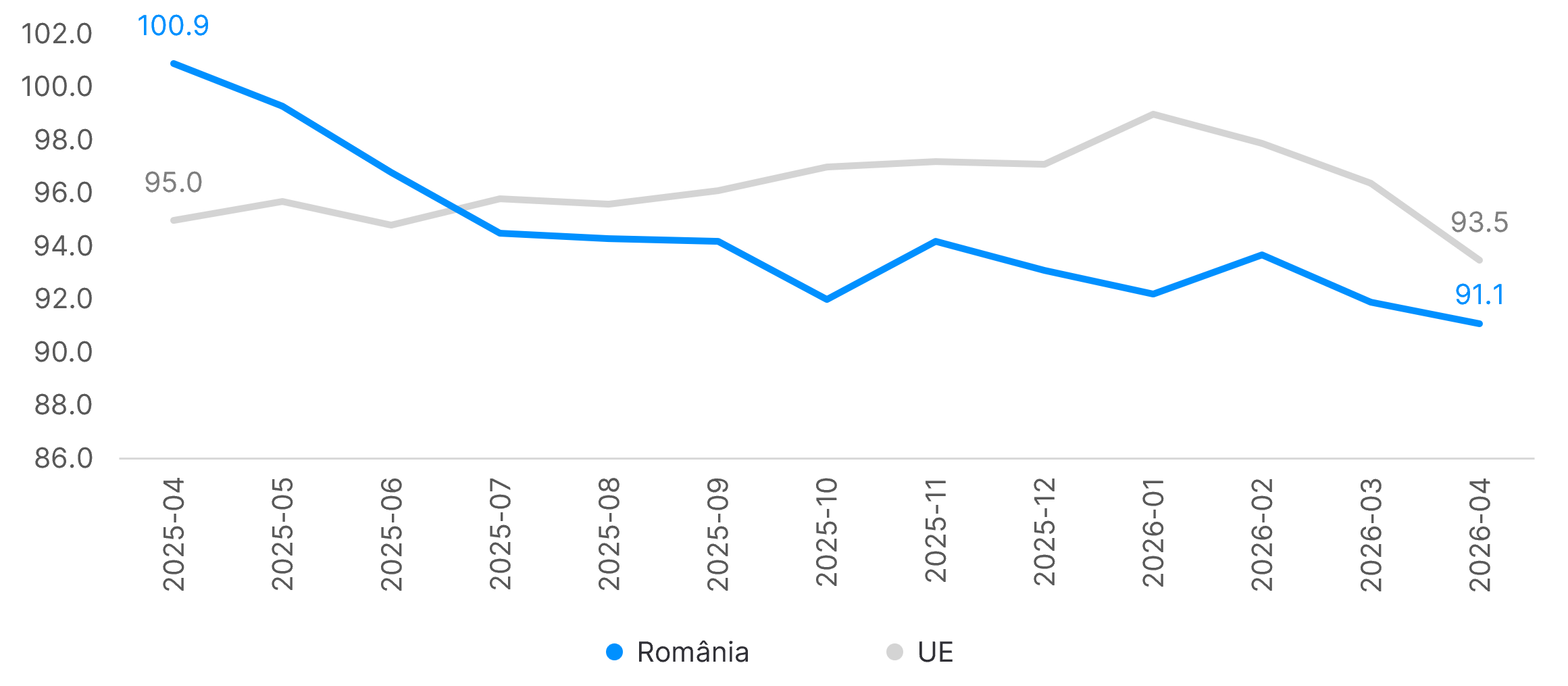
- I started in April 2025 from a favorable position, with a high confidence indicator (100.9) and with optimism that finally we have a stable environment. We were even more optimistic than the EU average (95.0), until the previously accumulated imbalances caught up with us.
- Thus, over a period of 12 months, we managed to lose 9.8 points, compared to 1.5 points in the EU, and to go down on a steep slope to the level of 91.1, the lowest level in the last year.
CAUSES
If you are wondering how we got here, so quickly, we have to take into account the fact that the economy entered 2025 with major imbalances (record budget deficit, current account deficit, persistent inflation). The adjustments that followed, through the fiscal measures implemented (tax increases, elimination of some facilities, pressure on expenses), had a direct effect on domestic demand and the perception of the business environment.
In parallel, inflation remained high, eroding consumers' purchasing power, and at the moment when companies and households felt that the rules of the game were changing and that purchasing power was decreasing, optimism also went downhill.
- And yet, we must emphasize the fact that this period must be viewed through the lens specific to the context. In other words, the decline in the ESI, although it can be interpreted as a negative signal, is at the same time also a consequence of a necessary process of macroeconomic adjustment.
SCENARIO #1 On the one hand, there is the scenario in which the recovery will delay: fiscal consolidation may continue to weigh on consumption and private investments, inflation may remain high, and political uncertainty may keep confidence levels low. |
On the other hand, there is also the possibility that the current levels represent a stabilization point, from which the economy will begin a gradual recovery, provided that public investments and European funds compensate for the weakening consumption and support economic activity. |
In both scenarios, however, the risks remain significant. The most important ones are tax risks (implementation and credibility of fiscal consolidation), inflationary risks (which can affect real incomes and interest rates) and political risks (which can influence economic decisions and investor confidence). Therefore, the future evolution of the ESI will largely depend on how these risks are managed and the economy's ability to move from a phase of adjustment to one of stabilization and growth.
SECTORIAL INDICATORS
If ESI provides an aggregated image, it is good to also know that there are five sectoral indicators that offer a specific image, depending on certain branches of the economy.
- Confidence indicator in industry (Industrial Confidence Indicator) measures the perceptions of industry managers regarding orders, stocks, and future production. It is very sensitive to external demand and exports, therefore it quickly reflects changes in the European and global economy.
- Confidence indicator in services (Services Confidence Indicator) captures the expectations of service firms regarding demand and future activity. It is closely linked to domestic consumption and general economic dynamics, as services have a large share in GDP.
- Confidence indicator in retail (Retail Trade Confidence Indicator) reflects traders' perceptions of sales, stocks and future demand. It is a good proxy for consumer spending and responds quickly to changes in real incomes and inflation.
- Confidence indicator in constructions (Construction Confidence Indicator) is based on firms' opinions about existing orders and the workforce. It is influenced by public investments, the real estate sector, and financing conditions (interest rates).
- Indicator of consumer confidence (Consumer Confidence Indicator) measures households' perceptions of their own financial situation and the economy, as well as consumption and saving intentions. It is essential for anticipating the evolution of private consumption, one of the main drivers of the economy.
Sectoral indicators are read slightly differently, because they are around threshold 0: pozitiv înseamnă optimism, negativ înseamnă pesimism.
EU INDUSTRY RECOVERING
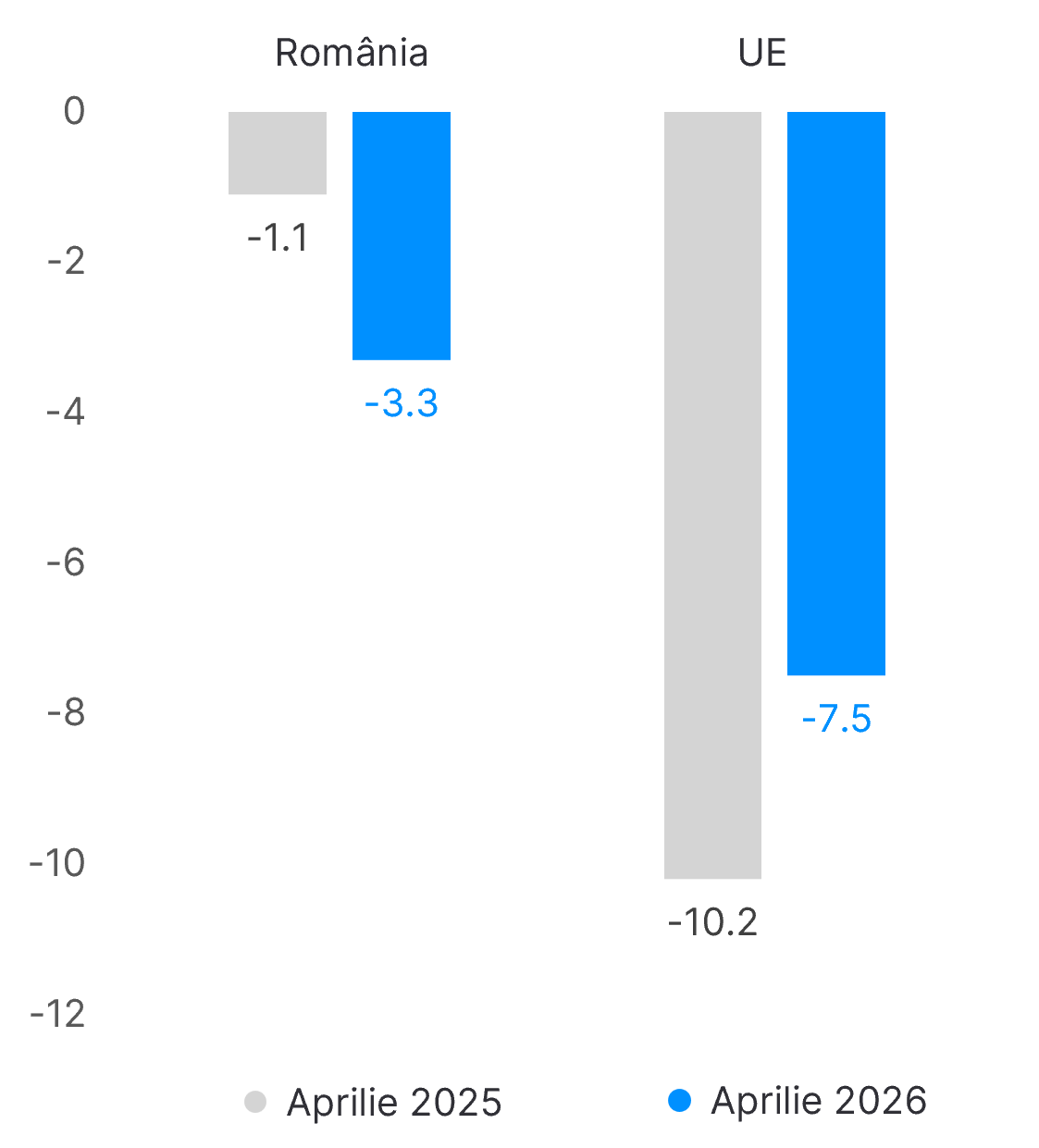
Industry confidence indicator brings us an interesting situation. Romania started in 2025 from a better position than the EU, but has deteriorated. In 2026, we see that the dynamics are now different.
Why is Romania declining? The Romanian industry is deeply integrated into European production chains, about 2/3 of Romania's exports come from the industrial sector. The connection with the real economy is direct: when confidence in industry decreases, we quickly see reduced production, more cautious investments, and a smaller contribution of exports to GDP. Conversely, a recovery of the industry has a strong multiplier effect on the economy, through higher exports, more jobs, and higher incomes.
The first signs of stabilization come from the major European economies, but the recovery is, for now, fragile. If the trend consolidates, the Romanian industry could benefit from a revival of external demand, due to integration into European production chains.
However, the risks remain in place. A slower European recovery means high costs (energy and labor), domestic fiscal uncertainty, and possible trade or geopolitical tensions. In this context, although the industrial indicator in Romania is declining, it remains relatively more solid than in the EU, and the future direction will largely depend on the evolution of the European industry, the main potential driver of a recovery.
CONSUMERS, SHARP DECLINE
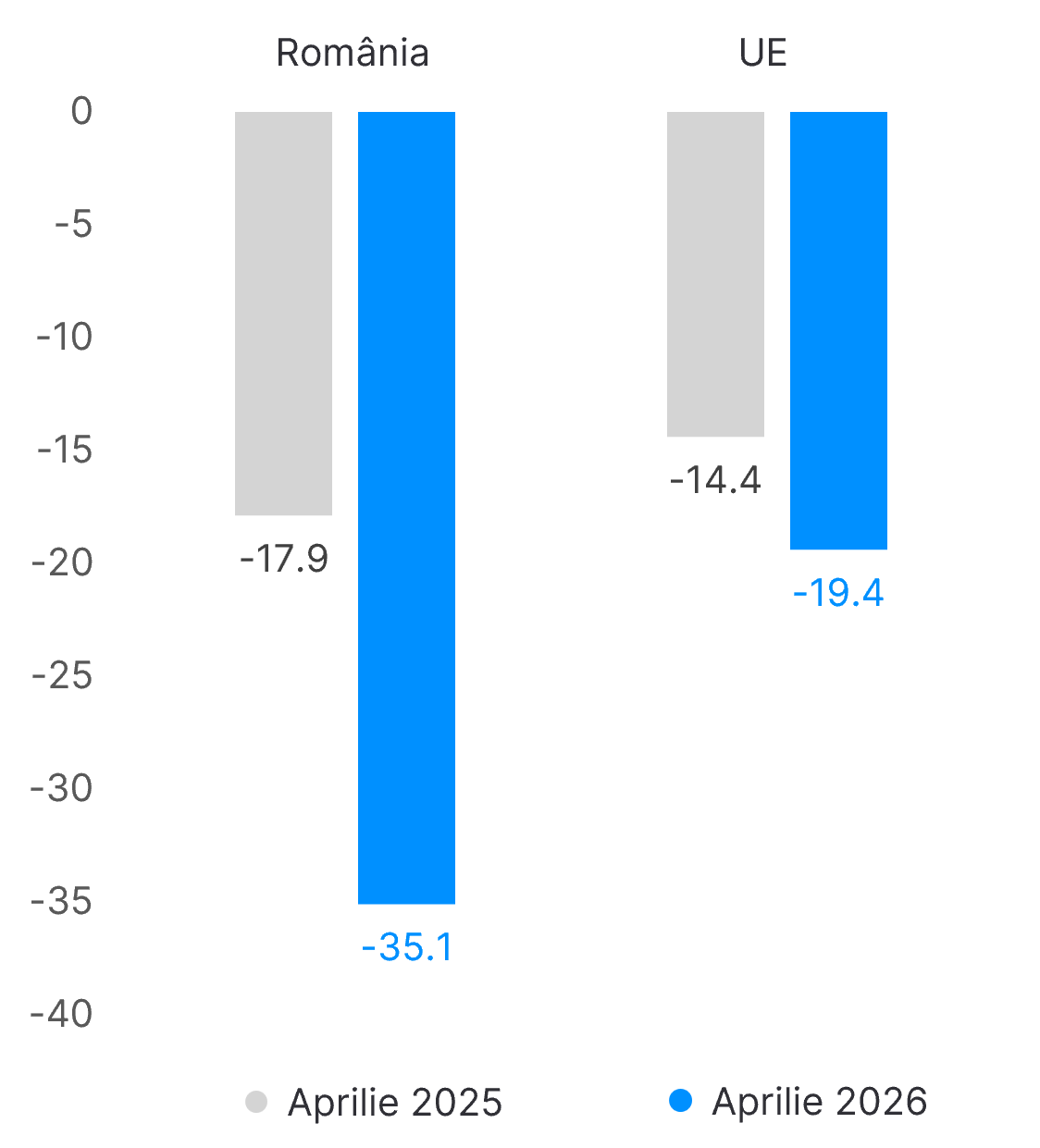
If in the case of the industry we saw a mixed signal, in the case of consumers the figures are clear, but not quite optimistic. Romania reached, in 2026, a consumer confidence indicator of -35.1, while the EU average is at -19.4. Practically, the Romanian consumer is twice as pessimistic as a European one.
It is exactly the type of thinking:
„Let's wait a little longer with the car. And we'll see about the vacation later. Let's think a little more, because you never know.”
Decrease in consumer confidence is quickly transmitted to private consumption, and this is already reflected in the deterioration of the retail indicator and, subsequently, in the weakening of the services sector.
Practically, household pessimism leads to the postponement of expenditures, increased precautionary saving, and reduced demand for goods and services, which amplifies the effects of the economic slowdown.
The outlook for the coming period is mixed. In a negative scenario, consumer confidence may remain at very low levels or may further deteriorate if inflation persists, fiscal consolidation continues to affect disposable incomes, and political uncertainty remains high. In this case, private consumption would continue to be weak, prolonging the period of modest economic growth.
In a more favorable scenario, the indicator could begin to stabilize or even gradually recover if inflation decreases, real incomes improve, and there is greater clarity and predictability of fiscal policies. Also, public investments and European funds can indirectly support confidence by maintaining employment and economic activity.
AT THE CROSSROADS
Like the end of 2025, the outlook remains dual. There is no single certain trajectory. Data from the last 12 months confirm that Romania is going through an adjustment phase strong, but necessary. ESI has dropped from optimism to marked caution, consumers are at the period's minimum, and the industry feels both uncertainty and imbalances.
And yet, this is a story about adjustment. Behavioral economics has shown us that perceptions can change quickly when signals change: falling inflation, an adjusted budget, recovering external demand can quite quickly restore confidence.
The question is not whether Romania will come out of this phase, we are sure it will come out. The question that remains is how fast and how will come out, and this depends primarily on the quality of economic policy decisions in the coming months.