2026 from the perspective of the Economic Sentiment Indicator

At the end of the year, the economy begins to speak less through "heavy" figures and more through the mood. And when it comes to sentiment, the indicator we refer to is the one that analyzes the economic sentiment (ESI).
The story of the following year begins to take shape through the aggregated emotions of millions of consumers and hundreds of thousands of companies that make their plans, budgets, and objectives for 2026. What to expect in the new year, we see today in The MacRO Zone.
SHORT RECAP
Economic Sentiment Indicator (ESI) is the sum of all perceptions in the economy (industry, services, retail and consumers). Confidence indicators work as short-term forward-looking tools, capturing the "mood" of companies and households, forecasts regarding demand, investments, consumption and overall economic activity.
The reference value is 100, which means that:
- ESI > 100 – optimism above average
- ESI < 100 – caution on all fronts
ESI ROMANIA EVOLUTION
2022-2025
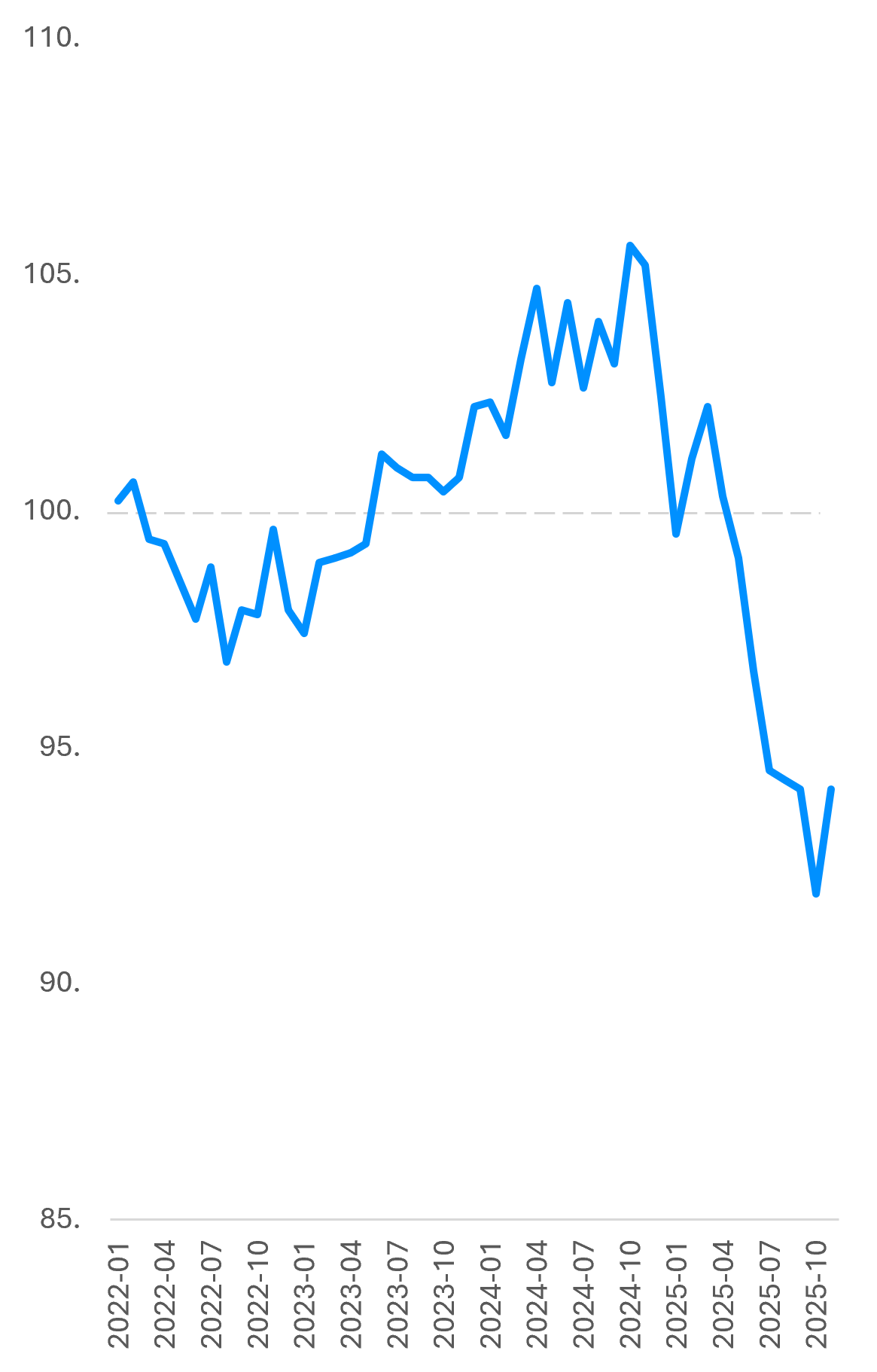
- 2022-2023: We see a period of volatility, with the ESI oscillating around the threshold of 100, which means an economy that "moves forward" (population income growth), but with the handbrake slightly pulled (impact of the energy crisis, high inflation, geopolitical uncertainty).
- 2024: The most optimistic year in the last 5 years. With peaks reaching 105 and then 106, we observe a clear recovery of confidence and optimism in the market.
- 2025: At the beginning of the year we see a sharp and rapid correction with a low point in the second half of the year. We observe that the indicator falls well below the average of recent years, indicating increased caution in the market.
- 2022-2025: We can observe how during this period a complete cycle of "economic confidence" takes shape, with the dynamics:
- Economy in motion
- Optimism above average, then
- Return to a more cautious behavior
HOW WILL 2026 BE?
The fact that the ESI drops from an average of 103.5 in 2024 to 97.1 in 2025, with a downward trajectory in the second half of the year, suggests that 2026 could start with more modest economic growth.
A slightly below-threshold 100 ESI signals a "settling" phase: investments are made more selectively and consumers become more cautious. If no external shock occurs, a probable scenario is the consolidation of the indicator within an interval [95–100] in the first quarters of 2026, provided that inflation and interest rates continue a downward trajectory and the labor market remains robust.
If however the weakening of consumer confidence persists, ESI could remain below the threshold of 100 for a longer time, prolonging the phase of economic growth "below potential".
CONSUMERS: MORE ATTENTIVE, MORE CALCULATED
Consumer Confidence Indicator (CCI) actually shows us how comfortable households feel spending money. In 2025, consumer perceptions have significantly deteriorated: from better values at the beginning of the year (-20.4), it reaches the (-30) area in the second half, with an annual average of -24.5.
In translation, this fact shows us that people do not panic, but postpone big decisions. If we refer to behaviors, we can imagine a family that says:
„Let's wait a bit longer with the new car / with the renovation.”
In 2026, the effects may be reflected in the increased preference for saving, orientation towards cheaper products, or pressure on premium segments.
A real comeback would require the indicator to rise towards -15, which depends on the decrease in inflation, labor market stability, and fiscal clarity.
RETAIL: THE FIRST TO FEEL THE IMPACT
Retail Confidence Indicator (RCI) or the retail confidence indicator reacts the fastest to changes in customer consumption, the result being directly in current and future sales.
In 2025, retail moved from enthusiasm to increased caution. With the first months of the year very good, we quickly faced an abrupt turn towards a negative territory, in the second half of the year.
We practically see a signal that the peak consumption was reached in 2023-2024, driven by the increase in nominal incomes, and 2025 marks the beginning of a normalization and a correction phase. Thus, retailers enter a recalibration phase in which they are more careful with inventory management, go for carefully targeted promotions, and show prudence.
Being so correlated with the consumer segment, for retail even a small progress in the population's confidence can generate a revival of sales, especially within essential and non-cyclical categories.
SERVICES: ENGINE IN MOTION
Service Confidence Indicator (SCI) reflects both domestic demand and external demand (tourism, transport, etc). While the services sector, overall, remains one of the most stable engines of the economy, we observe an erosion of confidence in this sector.
Throwing a glance at the averages from the last three years, 2023 with 4.7, 2024 with 6.3, and 2025 with 2.5, we observe that this year we took a step back, but we benefit from a positive indicator that may suggest a possible transition to a more tempered growth.
Visually here we have an engine that still runs well, but it is not quite revved to the max. In 2026, the indicator could remain around the range 2-4, which corresponds to a scenario of moderate but solid growth.
INDUSTRY: STABILIZATION AFTER A COMPLICATED PERIOD
Industrial Confidence Indicator (ICI), the economic indicator that presents us the mood directly from the production lines, so that we can get an idea about the industry in Romania.
After the tumultuous period of recent years and the high European volatility, the indicator no longer falls sharply but reaches a point of equilibrium. Located around the annual average of -1.8, the industry remains in a slightly negative but stable zone.
This is, paradoxically, good news. In the industry, stabilization translates into preparing the ground for a possible gradual growth. Energy costs have moderated, European supply chains are recovering, and certain key sectors with positive dynamics (auto, electrical equipment, food industry) can generate a traction effect on the entire indicator.
Thus, a plausible scenario for 2026 is that of a gradual recovery of the industrial indicator, as companies re-enter a more normalized order cycle. In a European macroeconomic context of slight stabilization, the Romanian industry has chances to enter 2026 not with a feeling of vulnerability, but with one of constructive prudence, ready to capitalize on the positive impulses that will appear on the external market.
A STORY ABOUT CONSTRUCTIVE CAUTION
The economy enters 2026 with a confidence level lower than in previous years, but many of the visible adjustments in indicators seem already internalized by companies and households. The ESI, at an average of 97.1, signals a more reserved attitude, but not a radical change in cycle. At the same time, key sectors show different signs of evolution: industry is stabilizing, services still maintain a positive momentum, while trade and consumers are going through a phase of recalibration.
Two elements will count decisively in 2026: the evolution of consumer confidence, respectively the dynamics of investments.
THE POPULATION'S TRUST, SLIGHTLY FRAGILE
Although consumer confidence has dropped to -24.5 amid fiscal consolidation packages, there are relevant premises for stabilization from the second half of next year, especially if inflationary pressures continue to decrease, and the impact of fiscal measures becomes much clearer.
INVESTMENTS
In an economy seeking balance, investments, both public and private, can play a decisive role. European-funded infrastructure projects, investments in energy, can offset the cautious behavior of consumers. An increase in investments in the first part of 2026 will have the potential to support jobs, stabilize activity in construction, and generate a new moderate cycle of confidence in the industry.
CONCLUSION FOR THE BEGINNING OF 2026
IT IS ONE OF CONSTRUCTIVE CAUTION
Confidence indicators do not signal a spectacular acceleration, but neither a sharp deterioration. They describe an economy that is rebalancing, which has absorbed part of the uncertainties of recent periods and which can gradually rebuild its confidence if the external environment becomes more predictable, if investments are maintained at a solid pace, and if consumer confidence gradually recovers.