Behavioral economics
We like to believe that we make rational decisions, especially when it comes to money. But reality contradicts us more often than we would like to admit 😜.
Today, in The MacRO Zone, we propose a short incursion into a field located at the intersection of economics and psychology. So, if you have ever wondered why people continue to buy during periods of inflation or why investors sell in panic right when the markets fall, the answer is... behavioral economics. Let’s dive in, shall we?
WHERE DO WE START?
Behavioral economics (or behavioral finance, when referring to financial markets) explains why people do not always act "rationally" when they have to make financial decisions. The idea is quite simple: people are not perfectly rational agents. Which means that, when we make decisions, there is a mixture of limited rationality and emotional reactions to uncertainty, risk, or changes in the economic environment.
We, as humans, are influenced by cognitive biases, emotions, norms and social groups or informational limitations. We are not capable of making perfect decisions based solely on raw data, and this was most evident in the 2008 financial crisis, when traditional economic models failed to anticipate speculative behaviors or sudden market crashes.
LINE-UP
Although known for his economic theory invisible hand, which guides the prosperity of society based on the capacity of each individual to make decisions in their own interest, Adam Smith has often recognized that people are at the same time too confident in their own abilities (overconfidence), more afraid of loss than eager for gain (risk aversion), and more inclined toward short-term benefits than long-term opportunities (self-control). |  | |
 | Psychologist and Nobel Prize laureate for Economics in 2002, Daniel Kahneman integrated psychological insights into economics. Author of the books Thinking, Fast and Slow and Noise, Kahneman put a magnifying glass on people's judgment under conditions of uncertainty. Alongside Amos Tversky, he defined cognitive biases and formulated prospect theory which explains how people perceive gains and losses. | |
Considered one of the modern founders of behavioral economics, Richard Thaler was awarded the Nobel Prize in Economics in 2017 for his contributions in the field of nudging-ului, more precisely, subtle changes in the decision architecture (default choices, strategic placement of products, etc.) that influence behavior. The observations made by him brought to the public's attention concepts such as sunk-cost fallacy, which explains the tendency to continue with an investment, even if it does not work, due to resources already allocated (time, energy, money). |  |
EVERYTHING UP TO THE INDICATORS
A concrete way in which behavioral economics is manifested in macroeconomic analysis is through the use sentiment indicators. They capture the perceptions, expectations, and trust of consumers or companies, being essential in anticipating consumption, investment, or saving decisions. 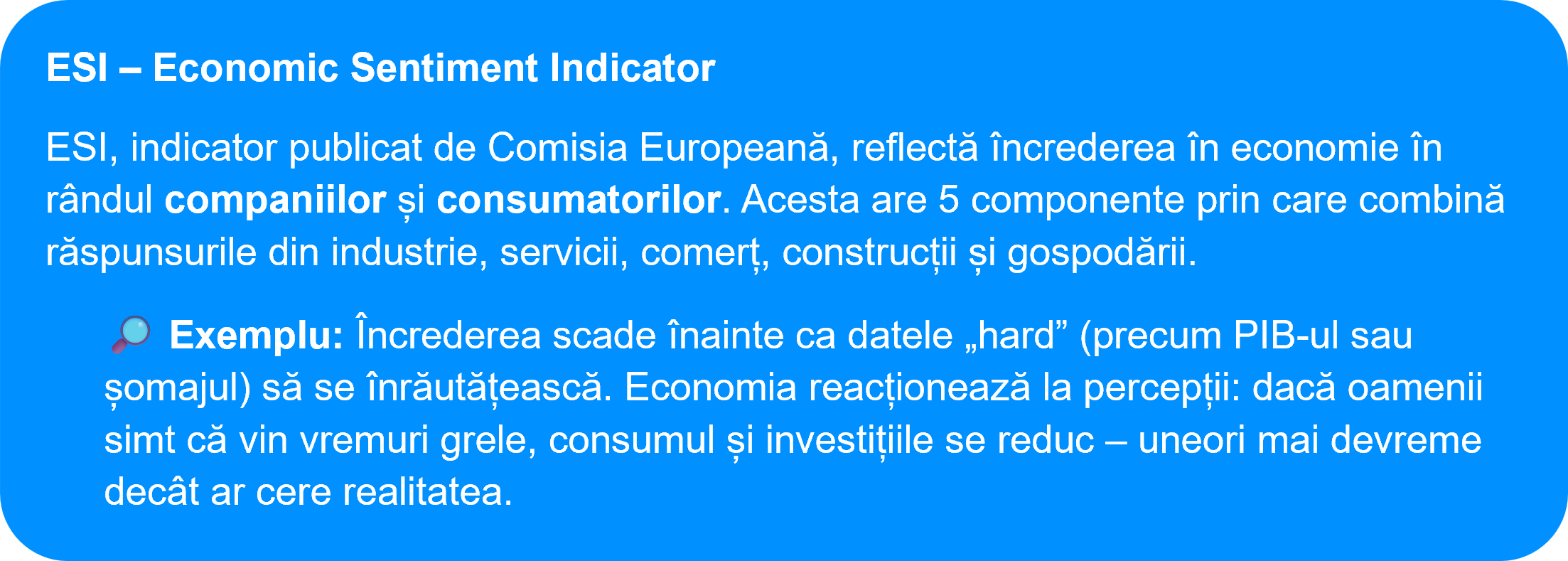
ESI ROMANIA
Evolution 2021 - 2025
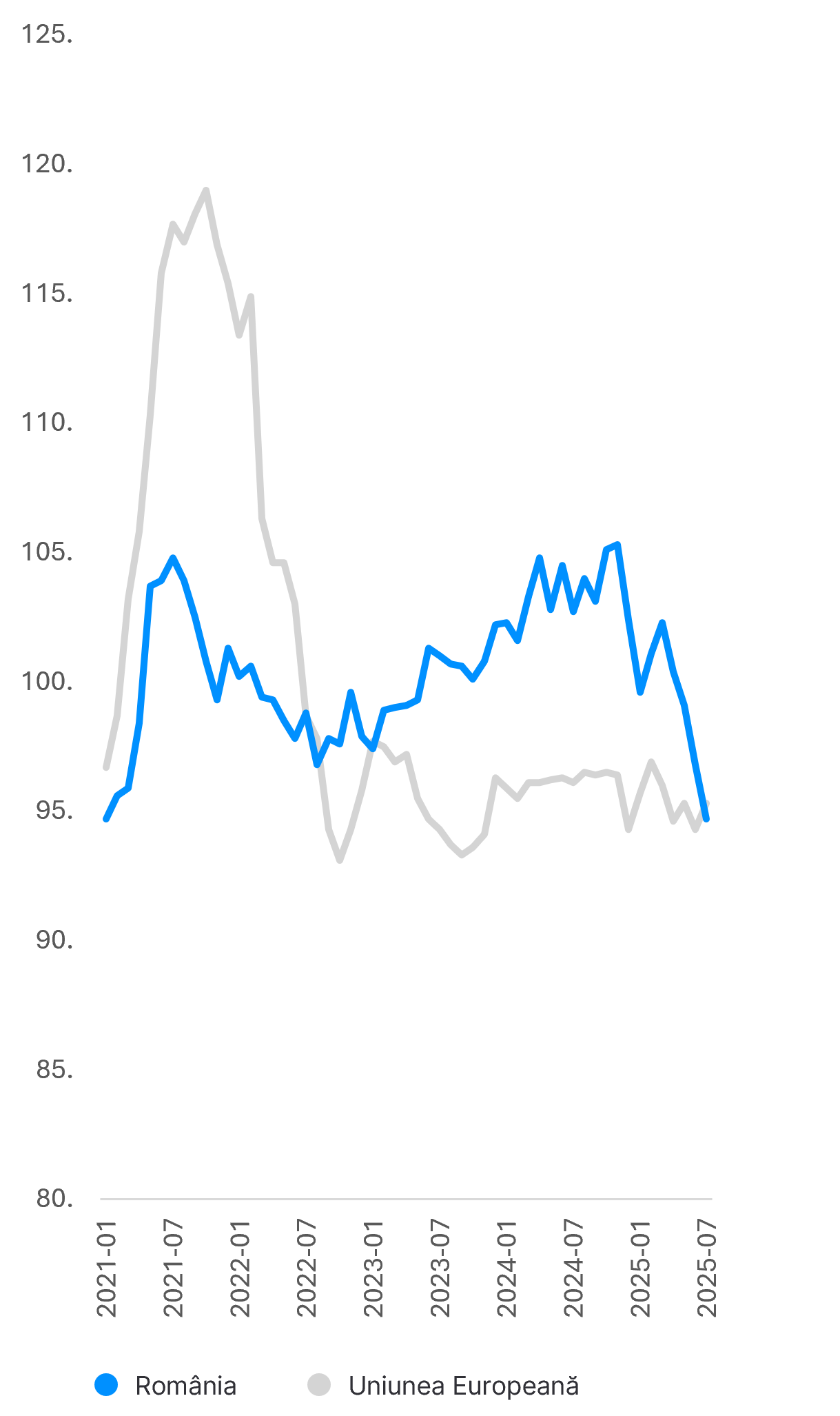
- 2021: Uneven post-pandemic rebound
ESI grew strongly in the EU, a sign of rapid recovery. Romania had a slower comeback, affected by political instability (government crisis, fragile coalitions). - 2022: EU decoupling in the energy crisis
EU has suffered a sharp decline in ESI due to the conflict in Ukraine and the impact of the crisis. Romania has been more resilient, with a reduced impact due to the domestic energy mix and PNRR funds. - 2023-2024: Fragile stability in Romania
ESI has remained above the EU average, against the background of stable governance and public investments. However, inflation and fiscal pressures have gradually eroded economic sentiment. - 2025: Accelerated decline before elections
ESI Romania falls below the EU average, against the backdrop of electoral uncertainties, high budget deficit and the risk of harsh fiscal measures after the elections.
- Present: Synchronized deterioration
The current point indicates low economic confidence mainly due to fiscal budget adjustments. But it should also be seen as a possible turning point.
AUSTERITY, TRUST, AND THE HERD EFFECT
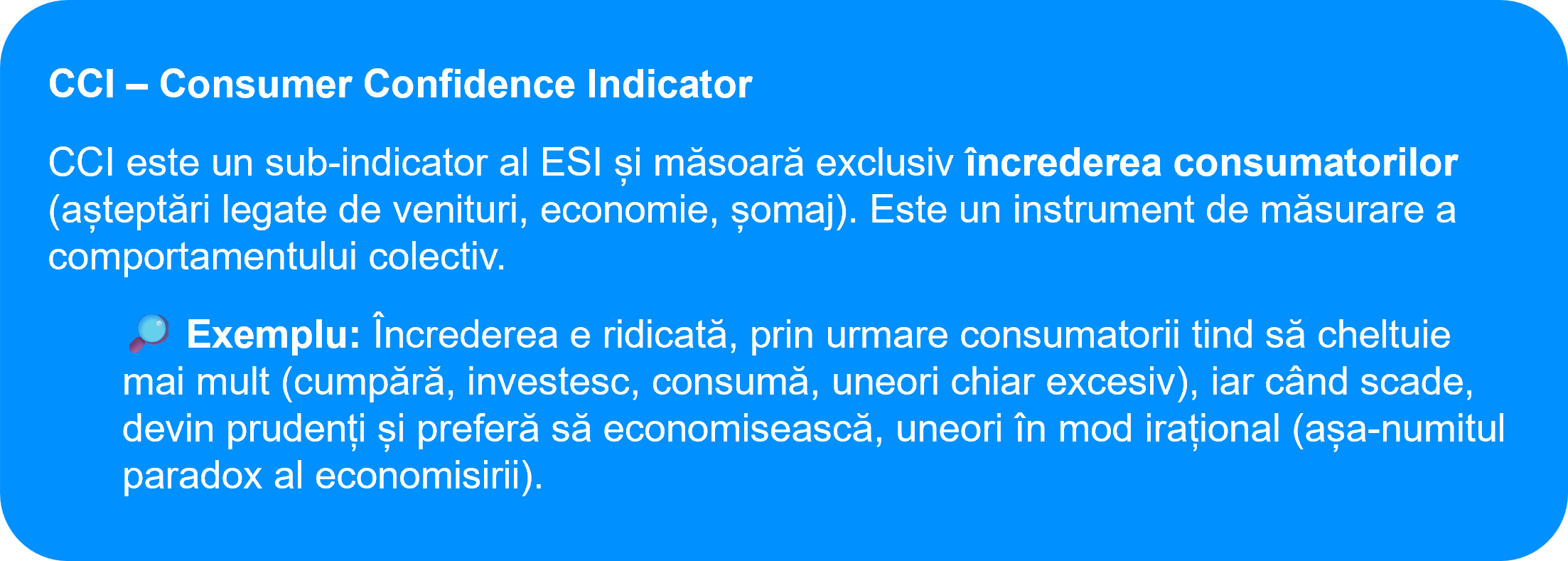
The sharp decline in confidence, as we see at present, is linked including to the onset of some austerity measures: tax increases, wage freezes, budget adjustments. The reaction is natural: people feel insecurity and adopt a defensive behavior. This psychological effect is amplified by uncertainty and lack of predictability – economic behaviors become defensive: the population limits its consumption, and investors adopt a waiting position.
WHEN PSYCHOLOGY BEATS MATHEMATICS
However, the more austerity measures are communicate clearly, applied coherent and begin to produce visible effects translated into fiscal stability, perception can change. What seemed painful becomes, over time, a signal of governmental responsibility, and confidence indicators begin to recover.
It is a clear demonstration that it is not austerity itself that changes economic behavior, but the perception of how well it is managed, by the way of the spectacular evolution of the BET index.
#HUMANECONOMY
From a macroeconomic perspective, Romania is at a turning point, and behavioral economics offers us a lens through which we can observe the complexity of human behavior.
It is vital to do (also) this thing, because, in such a complex and interconnected economy, traditional models provide us a snapshot, and those related to behavioral economics, an image forward-looking. Together, they reflect the reality and perspectives much more faithfully.