Defense expenses
For three decades since the fall of the Berlin Wall, Europe lived with a comfortable conviction: war and conflict on the old continent remain in the shadow of history. Defense budgets gradually decreased, the money found another purpose being allocated to health, reconstruction, infrastructure, and security was largely delegated to NATO and, implicitly, to the United States of America.
The situation changed rapidly, when, in 2014, the first signal came that was going to change the logic of peace, which we had known until that moment, with the annexation of Crimea by Russia. The context was finalized in 2022 when the large-scale invasion of Ukraine completely transformed European security into an immediate, concrete, and costly issue.
Now, at The MacRO Zone, we try to put into perspective the defense spending figures in Europe, Romania's approach in this context and especially what the SAFE program means, about which we hear so much talk.
EXPENSES VS. INVESTMENTS
Before figures, an essential clarification is that, although the two concepts are similar, they do not mean the same thing and must be viewed distinctly:
Expenses of defense = everything a state allocates for the military function (salaries, pensions, fuels, maintenance, training, maintenance of military bases, etc.). Practically, it is about the total budgetary effort.
Investments in defense = the side that effectively changes the military capacity in the long term (modernized military infrastructure, major military equipment, aircraft, vehicles, technologies).
The difference is important, because a state, although it may spend a lot on defense, may not modernize its army if most of the budget is allocated to salaries and maintenance. On the other hand, a state that invests a lot builds real defense capacity.
STRATEGIC DIRECTION
The current direction of European defense policy has become increasingly clear: member states are being pushed to spend more, invest more efficiently, and cooperate more closely. It is not enough for each country to purchase military equipment separately. The European Union is trying to encourage joint acquisitions, standardization, interoperability, and the development of the European defense industry.
SAFE program fits exactly in this direction, as it offers member states access to European loans for defense projects, with an emphasis on joint procurements and strengthening the European industrial base. Instead of a fragmented defense, where each state buys differently, expensively, and slowly, the European objective is to create a more coordinated, faster, and more efficient capacity.
In this new context, the budget allocated to the SAFE program must be understood as an investment in national security, in institutional resilience, and in the state's capacity to protect its population, critical infrastructure, and strategic interests. For the countries on the eastern flank of NATO and the European Union, defense has become a central component of economic policy, not just of foreign or military policy. |
DEFENSE EXPENDITURES OF EU MEMBER STATES
% of GDP | 2025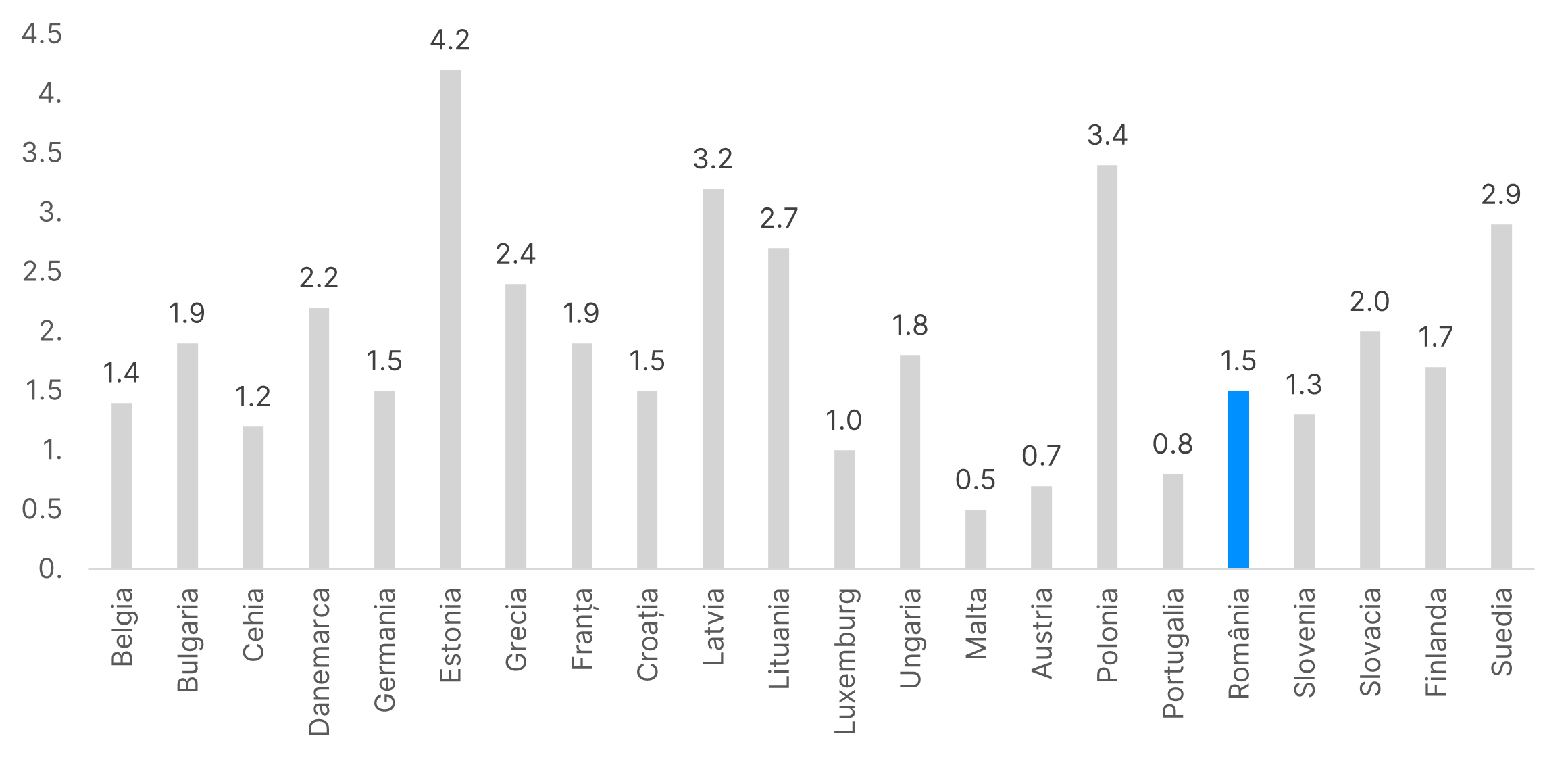
TOP 3 EXPENSES
| Romania (1,5%) | LAST 3 EXPENSES
|
TOP 3 INVESTMENTS
| Romania (0,4%) | LAST 3 INVESTMENTS
|
PROXIMITY TO RISK
In 2025, both the distribution of expenditures and that of investments allocated for defense in the EU, as a percentage of GDP, show a clear correlation between budget allocation and proximity to risk. This distribution confirms that the countries closer to the strategic risk zone in Eastern Europe tend to allocate much larger shares of GDP to defense.
Estonia, Poland and Latvia are clear examples of countries that have turned defense into a dominant budgetary priority. Romania is in an intermediate zone, has an obvious strategic need, but the investment pace reported does not yet reflect a mobilization on the scale observed in other countries on the eastern flank.
THE PEACEMAKER: A BUDGET OF 150 BILLION EUROS
Program SAFE, abbreviation for Security Action for Europe, represents one of the most important financial instruments created by the European Union after the outbreak of the war in Ukraine and after the fundamental change in the European security environment.
SAFE is a European borrowing instrument, through which the European Commission borrows from markets on behalf of the Union, using the solid EU rating, and then provides long-term loans to member states, with competitive costs, for urgent investments in defense.
The total value of the instrument is up to 150 billion euros
The purpose of SAFE is to reduce the fragmentation of the European defense market, to stimulate European industrial production, and to accelerate the equipping of member states with capabilities considered critical.
ROMANIA, BETWEEN DEFENSE AND STRATEGIC OPPORTUNITY
Our country is eligible to access up to 16.68 billion euros, which means that the SAFE program is quickly becoming an essential stake at the national level. If Romania reported defense investments of 0.4% of GDP in 2025, the full and efficient access to SAFE could significantly change the trajectory of military investments in the second half of the decade.
The first concrete step already came in April 2026, when the Romanian Parliament approved defense contracts worth 8.33 billion euros that are to be financed through SAFE.
This guidance shows that SAFE has a double dimension.
- Military size: modernization of the Romanian Army at a time when security risks in the Black Sea are evident.
- Economic size: if projects are structured correctly, with local production, maintenance in Romania, technology transfer and the integration of Romanian companies in European supply chains, defense spending also becomes an industrial policy tool, which in turn can create specialized jobs, attract foreign investments and generate technological skills with long-term value.
A DISCUSSION ABOUT STRATEGIC YIELD
The direction for Romania should be one of qualitative growth, not just quantitative. It is not enough for the defense budget to increase in percentage terms. The growth must be oriented towards those areas where vulnerabilities are greatest and where the strategic effect is highest. Romania also needs better integration between military needs and industrial policy. If defense acquisitions are limited to imports, the military effect can be positive, but the internal economic effect remains limited. However, if acquisitions include local production, maintenance, technology transfer and the integration of Romanian companies into European supply chains, defense expenditures can also become an instrument of industrial development.
From this perspective, the SAFE program can play an accelerating role. It offers Romania access to large-scale European financing for military projects. SAFE can help Romania reduce the gap with countries that have invested more heavily, but it cannot replace a coherent national strategy. European loans are useful only if they finance real capabilities and if they do not become a source of debt without strategic return.