Digital Romania

We have phones with 5G, we order food online, and we spend hours on social networks. Through all these measurements, Romania seems like a digitalized country. And yet, when the EU truly measures the digital maturity of the population (skills, online public services, AI in companies, cloud, digital banking), Romania almost consistently appears among the last places.
This is the central contradiction of Romanian digitalization: connection without digitalization. The Internet has reached us, but we have not yet transformed it into productivity, services, education, and competitiveness. Today, at The MacRO Zone, we suggest that we look over these figures together.
DIGITAL COMPETENCIES
Before we talk about complex concepts such as LLMs, AI, or cloud, we need to talk about basic digital skills: how many people actually know how to use a computer or a phone for things more complex than social media.
EU has set a goal that, by 2030, 80% of the population to have at least basic digital skills. In 2025, the European average was at 60%, so still 20 points away from the target. Romania was in the last place in the EU: 32%. 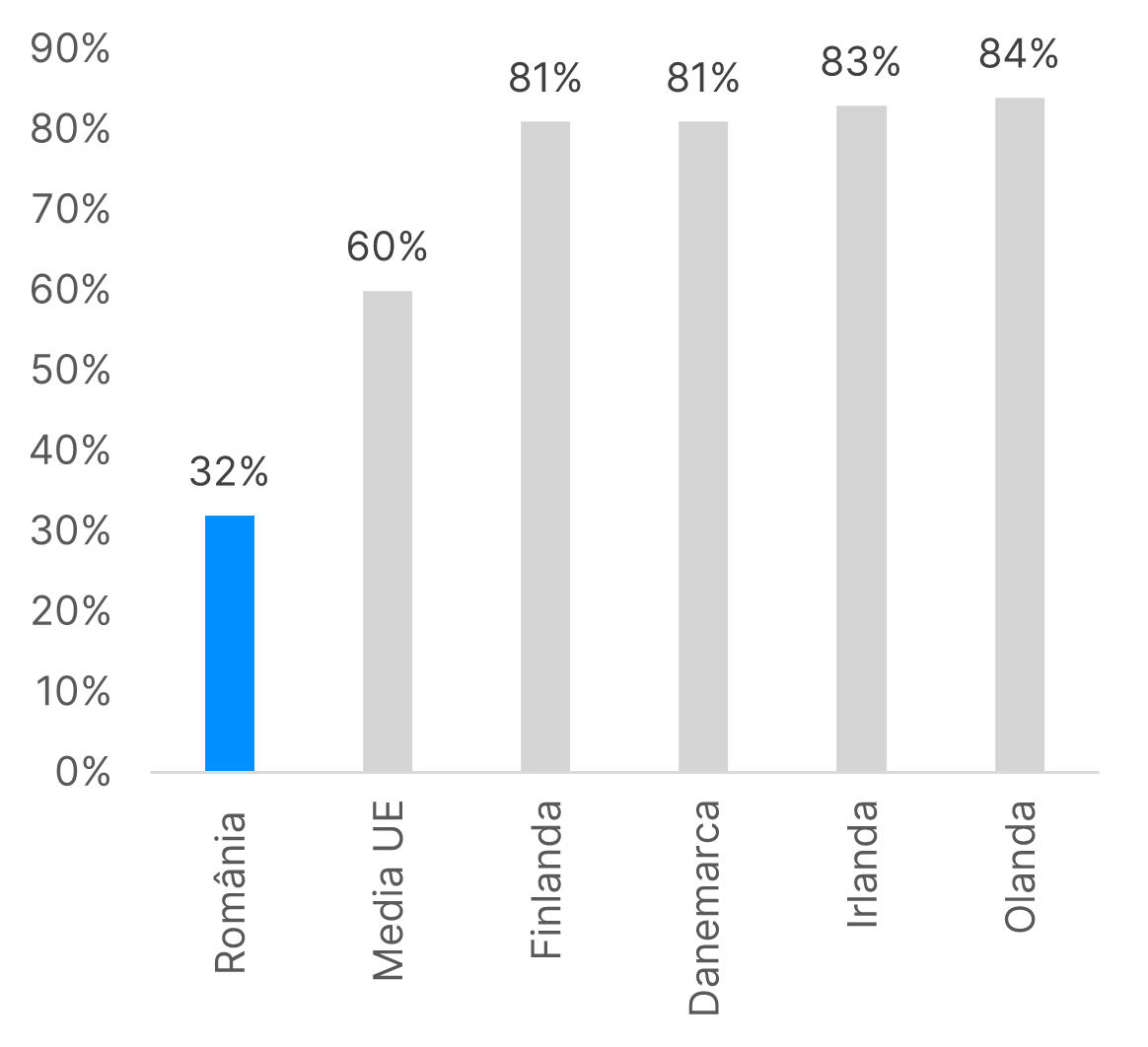
Practically, this percentage tells us that less than one in three Romanians between 16 and 74 years old has the minimum digital skills to navigate comfortably in today's digital world. Compared to the EU target for 2030 (80%), we are even further away.
This is, probably, the most important structural vulnerability, because all other forms of digitization, such as e-governance, online banking, AI, electronic commerce, cybersecurity, depend on this competence base.
Regarding ICT specialists, they represent 5% of the total employment in the EU. While Romania is among the countries with the smallest share, at 3%, only Greece has less (2.5%). However, there is also good news in this regard: the share of women ICT specialists in Romania is 28%, the highest in the EU (19%).
ROMANIAN COMPANIES: ONLINE PRESENT, DIGITALLY ABSENT
When it comes to the Romanian entrepreneurial environment, the gap becomes even clearer, and to measure this we need to look at Digital Intensity Index.
|
A kind of digital maturity score for companies, the index showed us in 2025 that approximately 71% among the SMEs in the EU reached at least the basic level of this index. The European target for 2030 is over 90%.
Romania, unfortunately, even on this scale is almost at the tail end of the ranking: 44% of Romanian SMEs reached the basic level of digital intensity.
That isless than half of Romanian SMEs I use digitization at a basic level. The gap compared to leaders such as Finland (94%) and Denmark (92%) is nearly 50 percentage points, which means that we are no longer talking about a difference in pace, but about a major digital competitiveness deficit compared to the European average.
ADOPTION OF NEW TECHNOLOGIES
When it comes to the Romanian entrepreneurial environment, the gap becomes even clearer, and to measure this we need to look at Digital Intensity Index.
 | ROMANIA USES HALF AS MUCH AS EUROPE USES |
ROMANIA, THE LAST PLACE IN THE EUROPEAN UNION If the situation is worrying in the cloud, when it comes to Artificial Intelligence (AI), the gap is even more severe.
Romania thus enters the AI economy at a very slow pace, which will affect productivity, automation, marketing, the cybersecurity area, and innovation in services. |  |
E-GOVERNANCE, THE LOWEST PERCENTAGE IN THE EU
The major problem arises at the moment when the lack of use of such technologies is reflected in the services that could make our life as citizens easier. Although the EU's objective by 2030 is for all key public services for citizens and businesses to be completely online, the Romanian reality is very far from this target.
In 2025, 14.7% of people aged between 25-64 years had used a public authority's website or application. This is the lowest level in the EU, standing well below the European average of 49.5%.
Unlike countries such as Denmark (73%), Finland (75%) or Norway (77%), Romania is at one third of the European average in e-governance. This means that citizens' interaction with the state still predominantly takes place physically, at the counter, handling papers. Every trip to ANAF, to the town hall or to a public institution instead of a click represents lost time and productivity for both parties.
SOCIAL MEDIA, BETWEEN SCROLL AND INFORMATION
Romania is a country of contrasts; therefore, if in implementing new technologies we are deficient, when it comes to using social networks we are champions. We are strongly present in social media: with a level of 85.4%, we are above the EU average. And this says a lot about us. We are on Facebook, we post on Instagram and we lose ourselves for hours scrolling on TikTok, this is how we ended up, in October 2025, spending on average, per week, 7 hours and 49 minutes on social networks.
And the most worrying part is that we also get information from social media. Studies show that 58% of Romanians accessed social media in 2023 to follow current news and events. In 2025, the situation worsened, and the disparity at the national level increased. If we look at the main sources of information for Romanians, depending on income, we observe that persons with an income below 3,000 lei monthly prefer to get informed, in proportion of 44% from social networks, while people with an income between 5,000 and 10,000 lei access specialized news websites.
ACCESS AND USE OF THE INTERNET
According to official data, 17.7 million Romanians use the internet in Romania, which means a threshold of 94%, in line with the EU level. Discrepancies appear here depending on the mode of use of linternetului.
Thus, if in the EU people use the internet for:
- communication by instant messaging (88%)
- sending or receiving emails (87%)
- audio or video calls (81%)
- search for information about goods and services (77%)
- internet banking (74%)
- participation in social networks (72%)
- online news reading (71%)
- searching for health information (64%),
in Romania we are very weak in functional digital activities, only 32% among persons aged 16–74 with at least basic digital skills, compared to 60% EU average. Thus, delays become visible even in simple activities such as using e-mail, where we stand at a level of 49.3%, compared to the EU average (87%).
THE DEGREE OF INTERNET BANKING USAGE IN EUROPE
2025 | %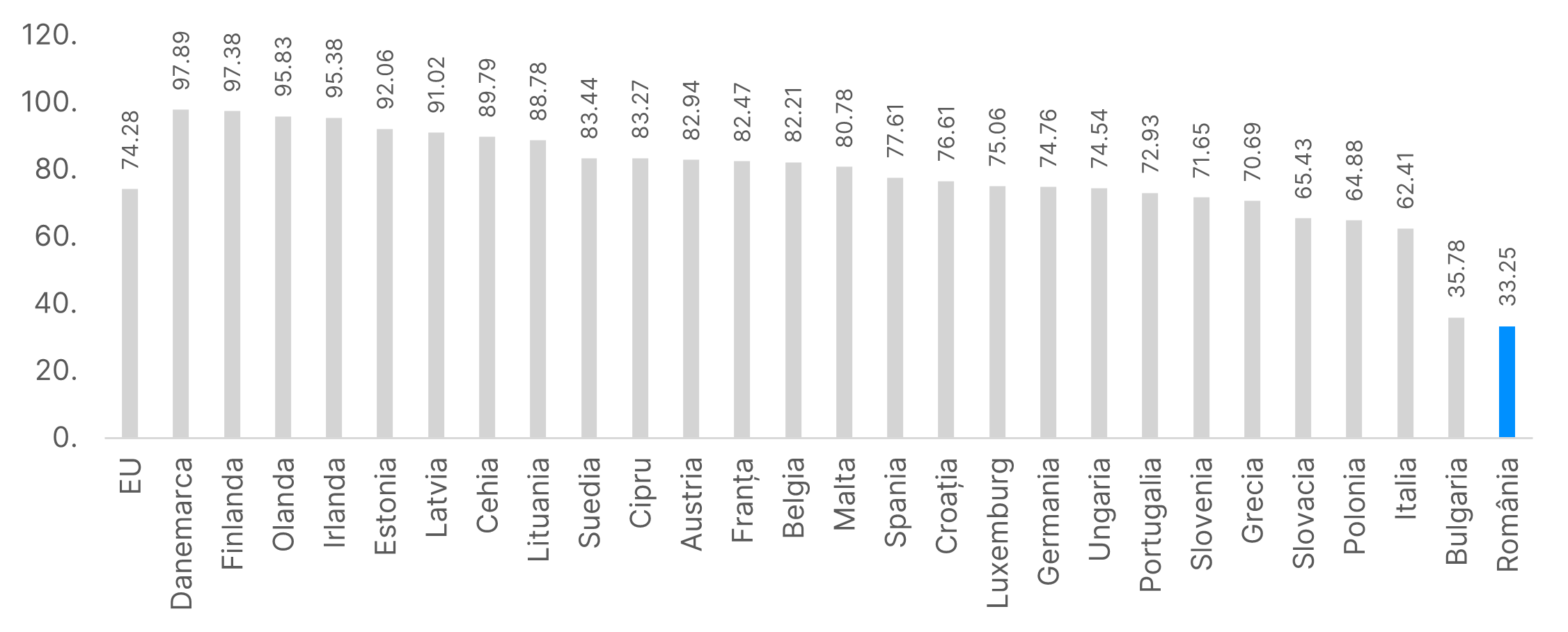
- In 2025, 74% of internet users in the EU used online banking services (vs 56% in 2015), digital banking becoming a standard service in Europe.
- Romania is today in last place in the EU (33.3%), after Bulgaria (35.8%), reaching a ratio of 1 in 3 Romanians who use the internet to also do online banking.
In this case, three structural causes overlap:
1. Low digital skills – with a percentage of 32% of the population having basic skills, the rest of the population might not navigate comfortably through financial applications.
2. Preference for cash and physical interaction – among people in rural areas, older individuals, and those with lower incomes, there is still a strong preference for cash and assisted banking operations.
3. Reduced use of digital services – if people are not used to interacting online with the state, there is a very high chance that they will not interact digitally with the bank either. Digital behavior is built layer by layer, over time.
In the following years, the probable direction for Romania is growth, but not automatically rapid convergence with the EU. Growth will come from the expansion of mobile banking applications, from the pressure on banks to reduce counter operations, from the popularity of payments with cards and phones, from the younger generations entering the labor market, and from the development of fintechs.
However, Romania risks remaining below the EU average if it does not simultaneously increase digital literacy, trust in online security, and access to simple digital services for the elderly or rural population. Most likely, Romania will advance proportionally, but the gap compared to the European leaders will remain large: the Nordic and Western countries are already at 95–98%, almost saturated, while Romania starts from 33.3%.
To recover, it is not enough for banks to have good applications; digital education, cybersecurity campaigns, support for vulnerable users, and a real digitization of public administration are needed. Essentially, internet banking shows that Romania no longer has just a problem of digital infrastructure, but one of adoption, trust, and skills.
CONNECTED, BUT NOT DIGITALIZED
In a country with the fastest internet in the world and a very high degree of internet accessibility, we observe that the problem is structural and relates to skills, trust, and behaviors. Our great challenge is to transform internet use into human capital, productivity, functional public services, competitive companies, and credible digital institutions.
The change can only come from digital education, from the real digitalization of the administration, and from building trust in the online environment. Every additional percentage point in cloud adoption, artificial intelligence, or internet banking represents an additional point in closing the gap with the West through more productive companies, faster services, and citizens who can rely on a strong state.