Budget deficit, from fiscal deterioration to the beginning of correction

The budget situation of Romania in the first four months of 2026 brings some good news. In April we had a change in the balance of income and expenses. Thus, after a long period of time, we spent less than usual and collected more efficiently. It is good news, which shows us that the fiscal-budgetary measures adopted are starting to yield results. Nevertheless, the imbalance accumulated over the years remains.
In this episode from The MacRO Zone we look together over the data from the budget execution and try to understand what has improved, what remains still fragile and what follows.
STARTING POINT: THE LARGEST DEFICIT IN THE EU
Romania entered 2026 with a heavy tax burden. In 2025, it recorded the largest government deficit in the European Union: -7.9% of GDP (-9.3% in 2024), at more than double the EU average by -3.1%.
INDICATOR | ROMANIA 2025 | EU AVERAGE 2025 |
| Budget revenues | 35,4% | 46,4% |
| Budgetary expenses | 43,3% | -7,9% |
| Deficit (ESA) | -7,9% | -3,1% |
- Romania spends less than the EU average. But it collects with 11 percentage points of GDP less. This is one of the main factors of the deficit, insufficient revenues.
- Another factor contributing to this imbalance is the fact that over time Romania's revenues have remained stuck as a share:
- 2022: 40.9% (of GDP)
- 2023: 41.1% (of GDP)
- 2024: 43.3% (of GDP)
- 2025: 43.3% (of GDP)
We observe that Romania has not only expenses that are difficult to control, but especially a weak collection capacity and an insufficient tax base. Improvement must come from increasing recurring revenues, not from temporary measures.
Even though on the one hand, the deficit is decreasing, on the background of increasing revenues and tempering expenditures, on the other hand, the imbalance remains high compared to the European level, and fiscal consolidation remains dependent on budgetary discipline, absorption of European funds, and maintaining credibility in front of financial markets.
2026 CAME WITH A REAL CORRECTION
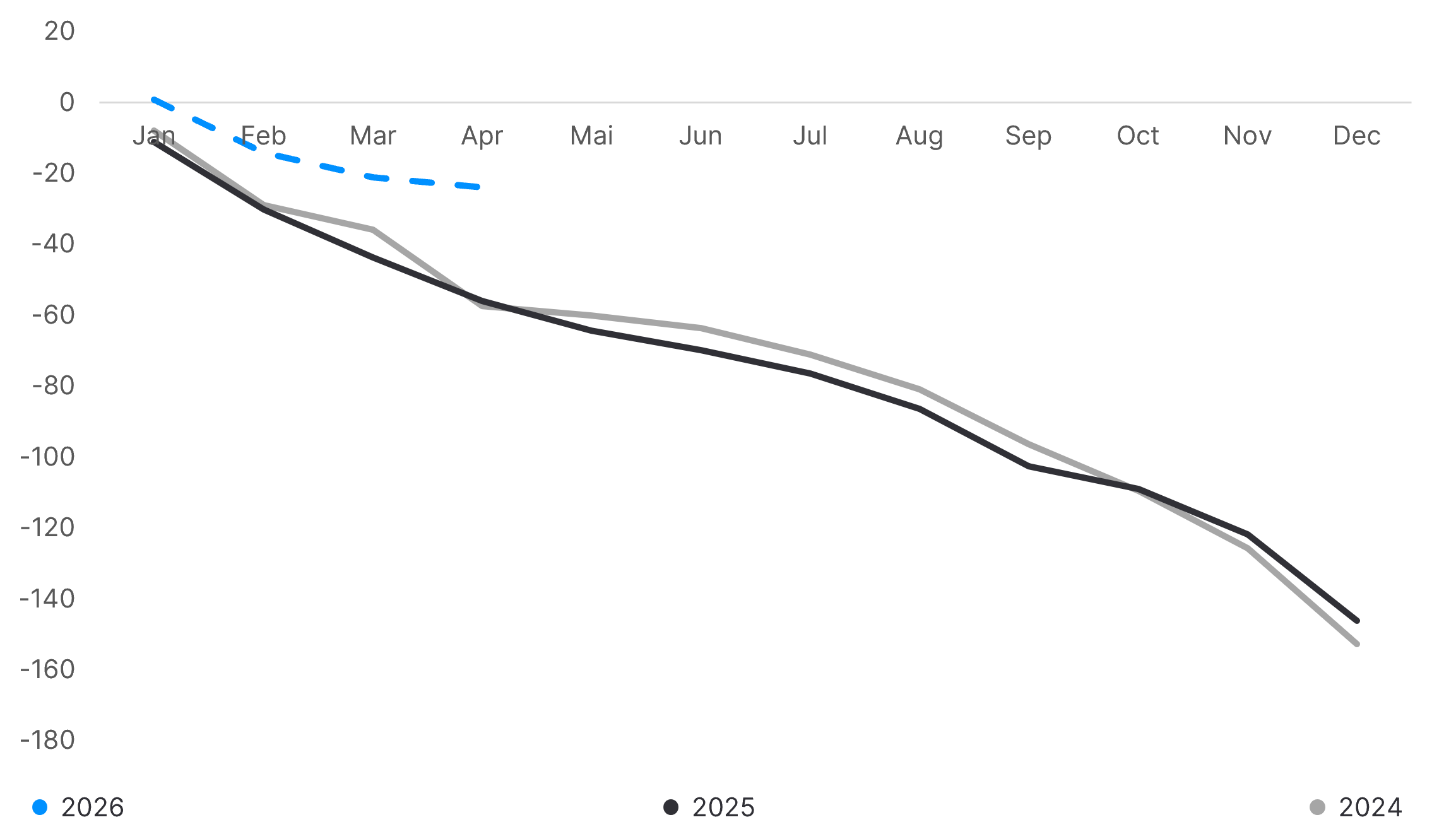
The data from the Ministry of Finance for April 2026 marks an important change of pace. The execution of the consolidated general budget ended, after the first four months, with a deficit of 23.95 billion lei (1.17% of GDP).
To put the figures into perspective, think that the deficit has decreased by almost two thirds compared to the same period in 2025. Practically, we see not just a marginal change, but a substantial correction achieved simultaneously from both directions: higher revenues and lower expenses.
DEFICIT | % OF GDP | |
| Jan-Apr 2025 | 55.97 BLN LEI | 2,92% |
| Jan-Apr 2026 | 23.95 BIL RON | 1,17% |
| Variation | -32.02 BIL EUR | -1.75pp |
BUDGET DEFICIT ROMANIA
MLD RON | 2024 – 2025 – 2026
HOW DO WE EXPLAIN CORRECTION?
The total revenues increased to 223.83 billion lei (10.9% of GDP). At the same time, total expenditures decreased to 247.79 billion lei (12.1% of GDP). From this perspective, the deficit correction is almost perfectly explainable from an accounting standpoint: about three quarters of the adjustment come from the increase in revenues, and the rest from the decrease in expenditures.
REVENUES (+12.0% year/year)
(1) Current taxes: fiscal revenues increased from 101.81 billion lei to 117.56 billion lei (+15.76 billion lei, +15.5%), and within these, VAT played the central role. Net VAT receipts rose to 47.80 billion lei, compared to 39.04 billion lei in the same period of 2025 (+8.76 billion lei, +22.4%).
(2) Tax on salaries and income: a ajuns la 23,89 billion lei, compared to 19.62 billion lei in 2025 (+4.27 billion lei, +21.8%). The increase was supported by the dividend tax (+47%), the revenues related to the Single Declaration (+276%) and the effect of eliminating some tax facilities.
EXPENSES (-3.2% year/year)
(1) Personnel expenses: fell to 54.66 billion lei, compared to 56.55 billion lei (-1.89 billion lei, -3.3%).
(2) Subsidies were reduced to 3.57 billion lei, compared to 4.92 billion lei (-1.34 billion lei, -27.3%).
CLEAR VULNERABILITY: INTEREST RATES
Interest expenses reached 23.68 billion lei, compared to 20.42 billion lei in 2025 (+3.26 billion lei, +16.0% year/year). As a share of GDP, interest remained around the level of 1.16% of GDP, but the nominal increase shows that Romania's fiscal past continues to cost.
As public debt increases, a larger part of the state's revenues is absorbed by debt financing, not by investments, public services or deficit reduction. This is the snowball effect we described in the episode about public debt.
INVESTMENTS
Interpretation of the deficit in April would not be complete without the investment structure. The funds allocated in this direction reached the amount of 31.03 billion lei, 75.58% being represented by projects financed from non-reimbursable external funds, PNRR and the loan component of PNRR. Payments for projects financed from external funds, PNRR grants and PNRR loans were higher by 5.99 billion lei (+34.32%) compared to the same period in 2025.
This structure is important because it shows that the budget adjustment was not made exclusively by cutting investments, but by the change of funding source and by reducing some exceptional national expenses.
In an economy with still insufficient infrastructure, a healthy fiscal consolidation cannot mean only the compression of investments. It must mean reducing the current deficit, controlling rigid expenses, and using European funds to maintain productive investments.
2026 STILL IN BUDGET CONSTRUCTION
The data from the first four months of the year are encouraging, but fiscal imbalances remain and are consolidating into a macroeconomic vulnerability. Even though recent data confirm the beginning of the correction, as we have seen today, for 2026 we estimate a budget deficit of approximately 6.00% of GDP and a public debt of 61.8% of GDP at the end of the year.
A deficit of 6.0% means a real improvement compared to the end of 2025, but remains nearly twice as high as the EU average and therefore does not completely eliminate the pressure on debt and the cumulative effect of interest.
The risks remain as well:
- Modest economic growth – an economy that grows slowly means less VAT, less income tax, fewer social contributions. The collection base narrows.
- Rising interest rates – with a debt of 59.3% of GDP at the end of 2025 and increasing, interest rates will continue to accumulate and rise gradually, being influenced also by political instability.
- Budget seasonality – Traditionally, the deficit accumulates more strongly in the second half of the year, when investment payments increase, payments are accelerated, and the political pressure on expenditures becomes greater. Practically, the second half of the year will be the real durability test for the deficit.
KEEPING PRUDENT OPTIMISM
Romania started 2026 with a visible fiscal correction, but still insufficient to eliminate the vulnerability accumulated in recent years: the deficit strongly decreased by April, tax revenues accelerated, and expenditures were better controlled, but the high level of interest rates, weak economic growth, and public revenues still low as a share of GDP show that adjustment must continue with discipline.
Stake it is not only the short-term deficit reduction, but the reconstruction of a sustainable fiscal balance, in which the state collects more efficiently, spends more selectively, and uses European funds for investments with a multiplier effect in the economy.
For more details on how we at Banca Transilvania view the evolution of the main macroeconomic indicators throughout the year, we invite you to consult the latest BT Outlook report, available on the platform BT Research.