Trade deficit

Today, we suggest taking another look at the past year, because, isn't it so, in order to analyze the year 2026 it is very important to know where we are starting from. And because the figures have just arrived fresh from the commercial context area, we invite you, to The MacRO Zone, at a deep dive on the trade deficit.
THE TRADE DEFICIT
Appears when the value of imports exceeds the value of exports. It is not, by definition, a short-term problem, but it becomes a structural one when it persists for years and is fueled by key sectors.
In 2025, Romania found a balance point, stabilizing after a period with several fluctuations.
- Exports: 96.60 BIL euro (+4.2% vs 2024)
- Imports: 129.35 Bn euro (+2.6% vs 2024)
- Trade deficit: 32.7 BIL EUR (-2.0% vs 2024)
At the end of the year, exports accelerated (+9.4% year/year Dec’25), while imports slowed slightly (-0.4% year/year Dec’25). We see a rare and favorable combination, even though the balance remained negative.
WHY IS THE DEFICIT DANGEROUS?
|
| |
|
| |
| ||
| ||
AT THE LIMIT BETWEEN EXPORT SUPPORT AND IMPORT PRESSURE
The fact that Romania is a country integrated into production chains and implicitly into the European industry is best reflected in two major groups:
CARS AND TRANSPORT EQUIPMENT
- 46.6% of exports (45.03 Bn euro) and 36.8% of imports (47.64 Bn euro)
- Steady pace on export (+3.5%)
OTHER MANUFACTURED PRODUCTS
- 26.6% of exports and 28.1% of imports
Romania functions as a link in an extended European factory.
Other sectors that have influenced deficit movements throughout the year:
- Food and live animals
- Exports: 7.41 BIL euro (weight 7.7%, +12.7%)
- Imports: 11.34 BLN euros (weight 8.8%, -1.1%)
- We see a relative improvement in the balance on the food segment (increasing exports, decreasing imports).
- Fuels materials and derived materials
- Exports: 5.74 BIL euro (weight 5.9%, +18.9%)
- Imports: 10.38 Bn euro (weight 8.0%, +0.2%)
- Even with exports on the rise, the level of imports remains for now much higher, turning into a constant source of deficit.
- Chemical products
- Exports: 5.24 BLN euro (weight 5.4%, +5.0%)
- Imports: 18.71 Bn euro (weight 14.5%, +5.0%)
- With such high imports, we clearly observe a dependency with impact on a high value-added segment.
THE EUROPEAN PARADOX
Analyzing the geographical structure of trade, it is confirmed once again that Romania operates, from a commercial point of view, within the logic of an ”EU factory”, with integrated supply chains and deliveries:
WITHIN-EU
- Exports: 71,3% of total (68.91 Bn euros)
- Imports: 72,1% from total (93.24 BIL EUR)
On the one hand, this concentration offers stability and volume; on the other hand, it makes Romania vulnerable to the slowdowns/industrial cycles in the EU.
EXTRA-EU
- Exports: 28,7% of total (27.69 BIL EUR)
- Imports: 27,9% out of total (36.10 BIL euro)
If we do a short calculation (imports minus exports), we thus see that within the EU we have a deficit amounting to 24,329.9 MN euro, while outside the EU we have a deficit of 8,413.2 MN euro, which translates into the fact that the greatest part of the deficit is formed right within the single market, where the volume is also dominant. |
EVOLUTION OF THE TRADE DEFICIT
2019 - 2025 | Romania | Bn/€
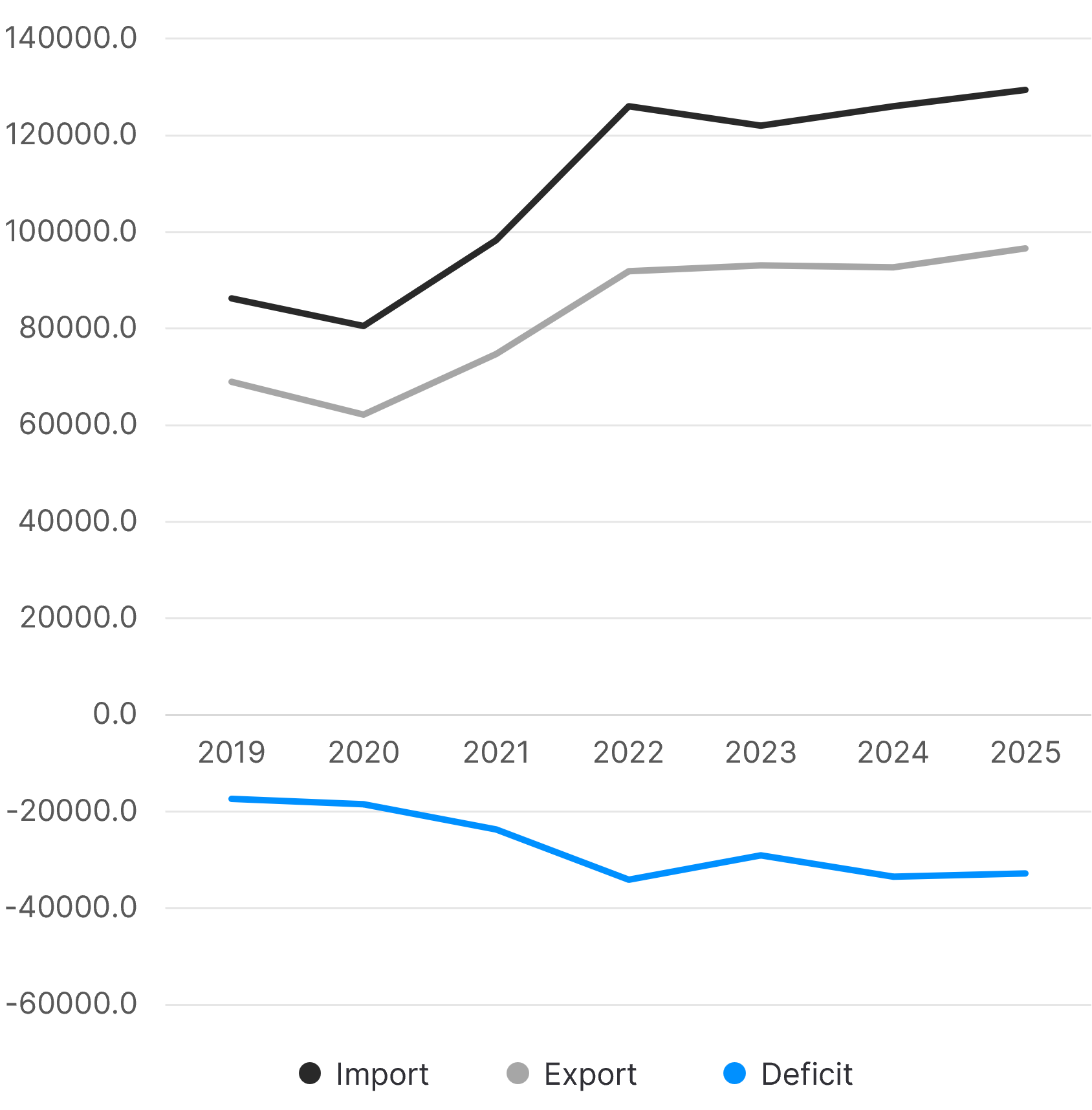
- 2020 – The year of shock: It brought a synchronized collapse of trade flows, forming a deficit that reached -18.4 billion euros. The shock reflects logistical blockages and the collapse of external demand.
- 2021 – Recovery: Rapid relaunch of domestic demand, restoration of supply chains, and faster growth of imports impact the deficit, reaching -23.7 billion euros.
- 2022 – Record deficit: The last shock comes along with energy price increases, inflation that is established at the global level, as well as still robust domestic demand. Although the growth is more in price than in volume, it reaches a maximum of -34.1 billion euros.
- 2023-2024 – Correction: We see a temporary improvement with exports stagnating and imports reaccelerating, the deficit reaching -33.4 billion euros in 2024, leaving behind pronounced external imbalances.
- 2025 – Minimal adjustment: The deficit decreases slightly, by approximately 2%, reaching -32.7 Bn euros, but remains a high structural imbalance.
OVERVIEW 2019 – 2025
Difference in speed between imports and exports explains the structural deterioration of the trade balance and the persistence of a high deficit. |
INTERNATIONAL TRADE ON A LARGE SCALE
The year 2025 ended as follows:
EUROPEAN UNION
- Exports outside the EU: 2,645.0 Bn euros (+2.0%)
- Imports: 2,511.5 BLN euros (+2.4%)
- Surplus: 133.5 BIL euro
The European surplus was mainly due to manufactures – cars and vehicles – (large exports), while energy was the main category that generated large imports.
EU – USA
- Exports: 37.1 BNL euro (-12.6% vs Dec’24)
- Imports: 27.8 Bn euro (+1.6% vs Dec’24)
- Consistent surplus: 9.3 BIL EUR (lower than 15.1 BIL EUR in Dec’24)
EU – CHINA
- Exports: 18.4 Bn euros (+11.5% vs Dec’24)
- Imports: 45.2 BLN euros (+10.2% vs Dec’24)
- Structural deficit: -26.8 BIL euro (-24.5 BIL euro in Dec '24)
ADJUSTMENT ON THE BACKGROUND, NOT STRUCTURAL TRANSFORMATION
2025 was a year of adjustment in which a few sectors changed their pace. The deficit in Romania slightly decreased, and at the European level we only saw minor adjustments that explain the decrease in the surplus. The premises of 2026 indicate a continuation of the trend: exports could remain moderately growing, while imports will largely depend on demand. In a context of mixed competitiveness, we look towards a deficit that is in the process of gradual correction.