The evolution of the number of pensioners in Romania - A public system under pressure

There is a question that almost every family in Romania asks itself at some point: will the pension be sufficient? It is not a rhetorical question. It is a concrete one, with answers that differ enormously depending on where you live, how much you have earned during your professional activity, and how many years you have contributed.
In 2025, the data shows us a double perspective. On one hand, pensioners fared somewhat better than in the previous year, on the other hand, the system that supports them remains under structural pressure that no good year can erase. With the "decreței" (children of the 1960s birth rate increase) close to retirement age and with a system suffocated by expenses, it is time to talk at The MacRO Zone about how we make our backup plan.
IT’S A BITTER SWEET POSITION
2025 was a year with an apparently paradoxical dynamic for the pension system in Romania: the average number of pensioners continued to decline, the average monthly pension increased, and the real pension advanced beyond inflation.
Nevertheless, in 2025, we had an average number of pensioners of 4,917 million people, iar în perioada care urmează, estimările ne arată că vor ieși din activitatea profesională încă aproximativ 1,6 milioane de persoane. Este vorba despre generația ”decrețeilor” care se vor pensiona în următorii zece ani, fapt care va crea o presiune suplimentară asupra sistemului de pensii românesc aflat în prezent într-un echilibru extrem de fragil.
|
PENSION ADJUSTMENT
The average monthly pension for all categories reached 2,936 lei in 2025, an increase of 13.8% compared to 2024. In the state social insurance system, that is the "ordinary" pension of the majority of Romanians, the average pension rose to 2.814 lei, with 14.4% more than in the previous year.
And because, in some contexts, nominal figures can be misleading, we need to take a look at the value of money, that is, what and how much they can buy. And here comes the really good news: the real average pension index was 105,7%. In other words, after inflation was taken out of the equation, pensioners were able to buy, on average, more than in 2024. Not only did they receive more lei, but they also received more purchasing power.
Another indicator that improved was the average pension / average net salary ratio which reached 63.1%, compared to 53.9% in 2024. This means that the gap between how much an employee earns and how much a retiree receives has decreased, which is reflected in a slightly better standard of living for our parents and grandparents.
In a context where previous years have been marked by the erosion of real incomes due to inflation, this result is socially relevant, because:
- reduce the immediate pressure on fixed income categories
- reduces social tensions
- increases the sense of fairness between generations
THE IMPERFECT BALANCE
Nevertheless, a complete analysis cannot reflect the overall picture without paying attention to the structural ratio between those who contribute to the pension and those who receive it. And, unfortunately, here the data are less comfortable.
|
This imbalance means that, while in the EU a person's pension is "divided" among 2.5 employees, in Romania a single employee must almost solely cover the pension of an elderly person (0.8). Because the contribution cannot cover a full pension, the Romanian state must provide money from the budget to supplement pension payments.
THE RATIO BETWEEN THE AVERAGE NUMBER OF STATE PENSIONERS AND EMPLOYEES
Pensioners/10 employees | Romania | 2025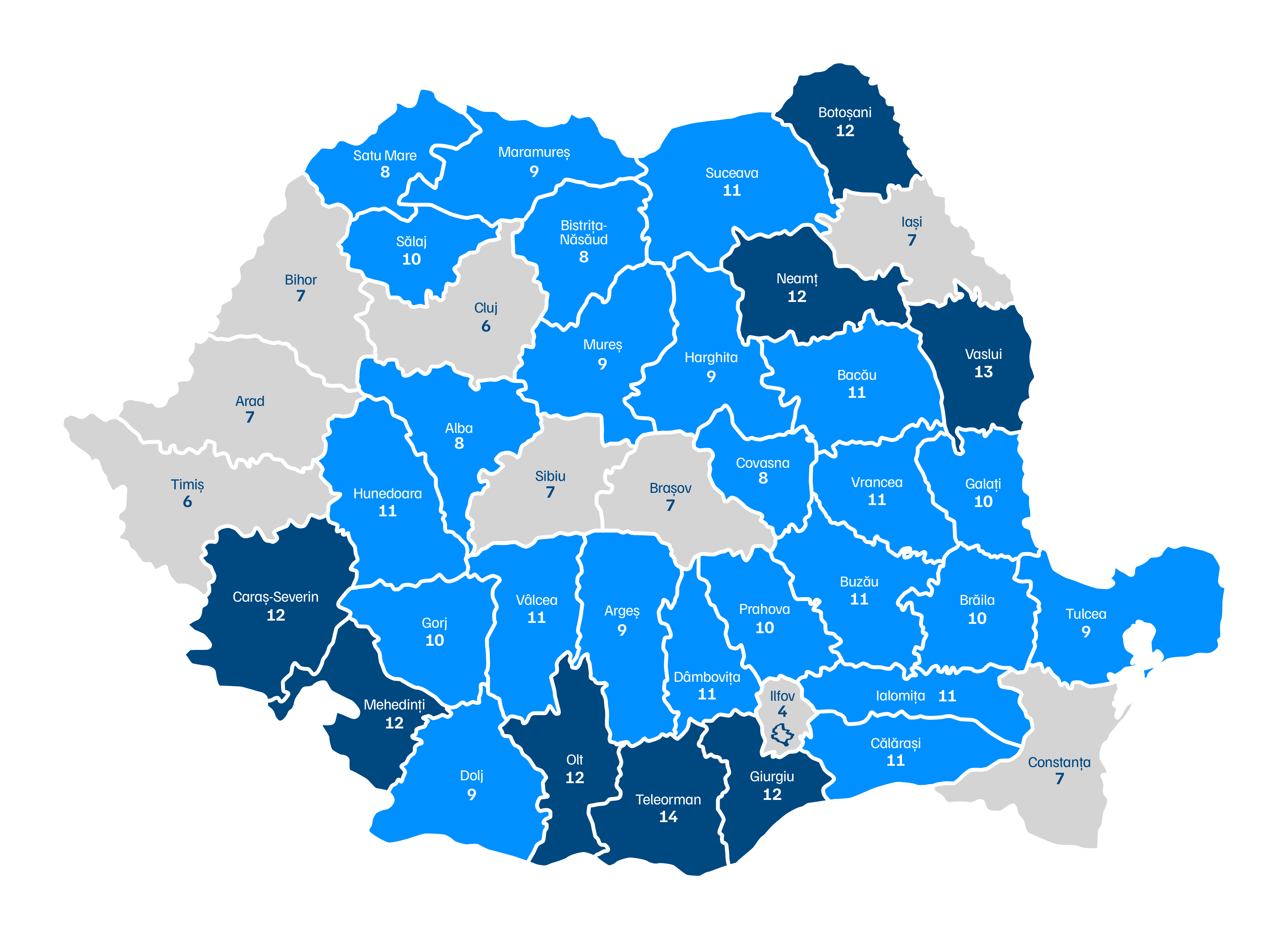
- Another major problem we face is that, if the national average is 8 pensioners per 10 employees, the territorial distribution brings to light much more painful truths. Thus, if in Bucharest we see 4 pensioners supported by 10 employees, in Teleorman we have 14 pensioners supported by 10 employees.
MAXIMUM AND MINIMUM VALUES OF THE AVERAGE MONTHLY STATE SOCIAL INSURANCE PENSION
Territorial | Romania | 2025 | RON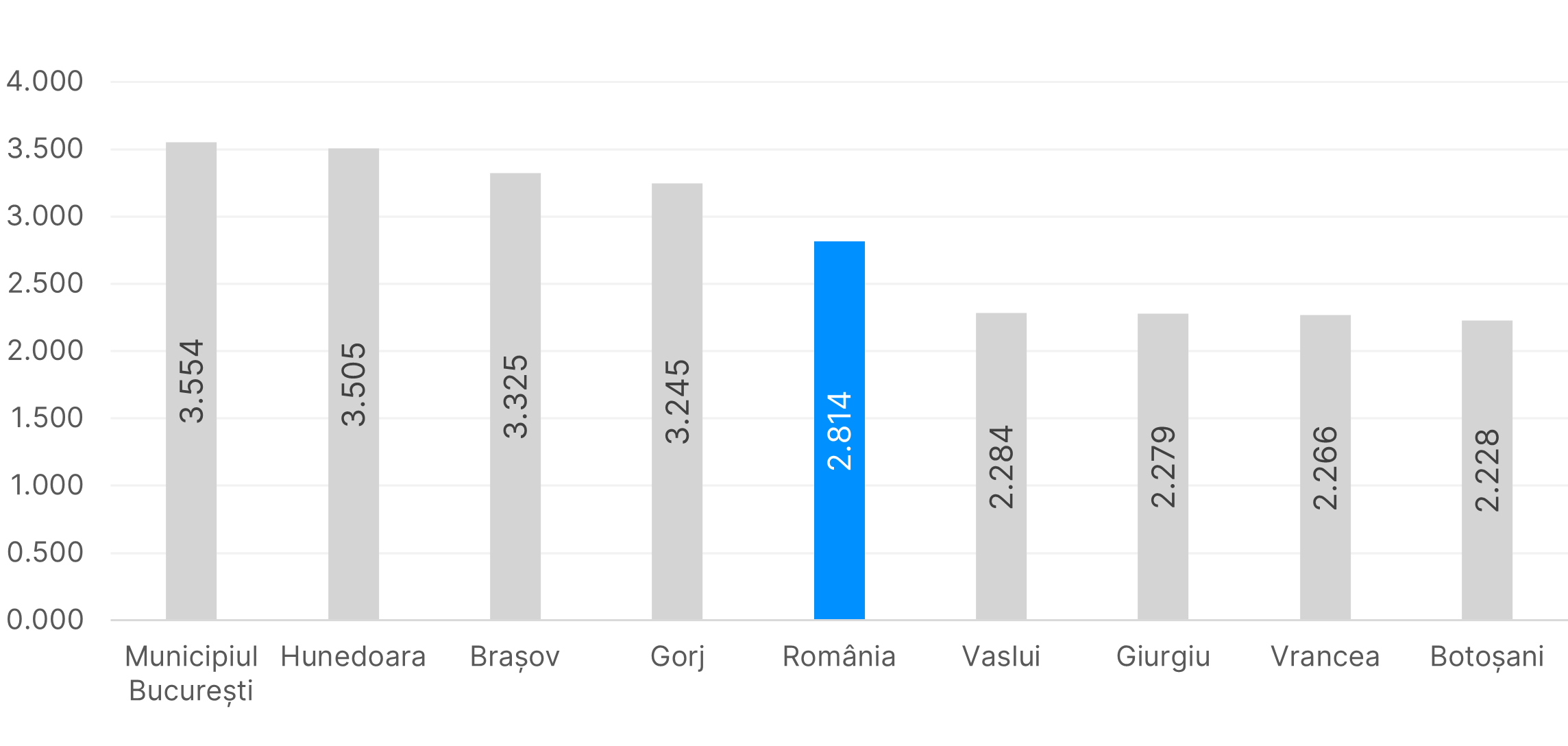
- Territorial discrepancies are visible even at the level of the average pension, so that, if the average pension in 2025 was 2,814 lei at the national level, the average pension in Botoșani was only 2,228 lei, while in Bucharest it reached 3,554 lei.
- More than that, throughout last year 902.3 thousand people benefited from the social allowance for pensioners. Practically, almost one fifth of Romania's pensioners remain dependent on a minimum social protection mechanism.
- Of course, the differences reflect different wage histories, distinct operational structures, and old economic development gaps, but even so, we also observe that at the national level we cannot talk about the "average Romanian pensioner" because the average hides inequalities between regions and categories of pensioners.
BATTLE WITH DEMOGRAPHY
In the European Commission scenarios, presented in 2024 Ageing Report, for Romania we see a projection of the number of pensioners increasing to 5.230 million in 2050, while the labor force participation rate decreases. As a result, the dependency ratio of the pension system would rise to 90%, which means a ratio of almost 9 pensioners supported by 10 employees.
With a population over 65 years old increasing and a 20-64 years old segment decreasing, the underlying trend remains one of pronounced aging and reduction of the contributor base.
PRIVATE PENSION SYSTEM, THE FINANCIAL BUFFER
Up to this point, we have all realized that the situation is quite complicated from the perspective of resources managed by the state. And here the focus should be shifted to Pillar II and Pillar III of pensions. In this context, the two pillars can no longer be treated as a technical, niche subject, but as a discussion about financial security to the generation that is currently in the workforce.
The situation is confirmed including by the most recent report of Financial Supervisory Authority (ASF), which shows that private pension funds in Romania had accumulated, at the end of 2025, total assets of 209 billion lei, equivalent to 11% of GDP. And if for a second the question arises about how they are organized pillars of pension in Romania and who administers it, we leave at your disposal the materials from the BT Blog.
But... To get back. From the total amount, 201.6 billion lei were concentrated in Pillar II, while Pillar III accumulated 7.4 billion lei. The size of this stock of assets shows that Romanians have already built a relevant financial buffer outside the public pension budget.
TAXPAYERS, CONTRIBUTIONS, AND THE MULTIPLIER EFFECT
Financial education is a habit that is learned over time and is ingrained in generations, but, despite this, there is a light at the end of the tunnel, because on December 31:
PILLAR II
8.46 million participants contributed monthly to Pillar II, compared to 8.29 million at the end of 2024. The average monthly contribution was about 408 lei / participant, iar valoarea medie a contului individual ajunsese la 24.063 lei. Sunt bani adunați an de an, care reprezintă o acumulare reală de avere financiară pentru viitorii pensionari și care contribuie la ridicarea gradului de independență financiară.
PILLAR III
999,352 people had an active account at a voluntary pension fund. With an increase of approximately 33% vs 2024, shows us a pillar which, although still small, is beginning to gain critical mass. For now, insufficiently expanded in an economy with high pressure on the public system, but which equally shows that more and more Romanians realize that the public pension alone may not be enough.
Logic is simple, while Pillar II reduces the excessive dependence on the public budget and diversifies the source of pension income, Pillar III allows the supplementation of income in old age, so as to support a lifestyle that permits us financial comfort and not only economic subsistence.
There is also a side effect, often ignored. Private funds finance the economy, in a very real way, the portfolios of private pension fund administrators in Romania are mainly invested in fixed income instruments (69%) and stocks (26%). This means that Pillar II and III not only help future retirees, they also help the state to finance itself more easily and companies to attract capital.
HALL OF FAME
The colleagues from BT Pensions have fully capitalized on this moment and have transformed 2025 into a year of consolidation, which materialized in the integration of BRD Pensions, and this meant:
- Pillar III – My Pension Plus: A new optional pension fund that additionally brings the guarantee that the amounts accumulated at the end of the contribution period will not be less than the net contributions
- Second Pillar: Pension fund serving over 600,000 participants
More than that, the assets managed in the private pension segment have exceeded 10 billion lei, iar din cele 181,825 de persoane care au început să contribuie la un fond de pensii facultative anul trecut, 80,000 (~44%) au ales unul din fondurile de pensii facultative administrate de BT Pensii.
FACING THE INEVITABLE
In the short term, 2025 brought an improvement in the situation of pensioners: higher pensions and a slightly improved pension-to-salary ratio. In the medium and long term, however, demographic pressures remain high, and the public system is fragile, with an already strained ratio between pensioners and employees. Sustainability cannot be ensured solely through adjustments to the public pension, but requires strengthening long-term private savings through Pillars II and III. In Romania, this balance becomes indispensable.