Public debt returns

In economics, there are certain thresholds that, once exceeded, function like signals. A beep that indicates an irregularity and is meant to catch your attention.
A threshold like this is actually the percentage of 60% of GDP for the public debt. Set by The Maastricht Treaty, this line, once crossed, activates the European fiscal surveillance mechanisms and puts us in focus for the next period.
In a previous episode, we anticipated that Romania will surpass this threshold in 2026. Recent data, coming just yesterday from Eurostat, shows us that this happened în first trimester from 2026 . So today, at The MacRO Zone, we are preparing to analyze what happened, where we stand and what will happen from now on.
FROM PERSPECTIVE
So far, I have learned that digits cannot be lowercase or uppercase on their own. These must be put into context and analyzed by comparison so that they are sufficiently conclusive and show us where we stand. So we first propose to you the European picture in perspective:
DEBT / EU GDP
T1 2026 | %
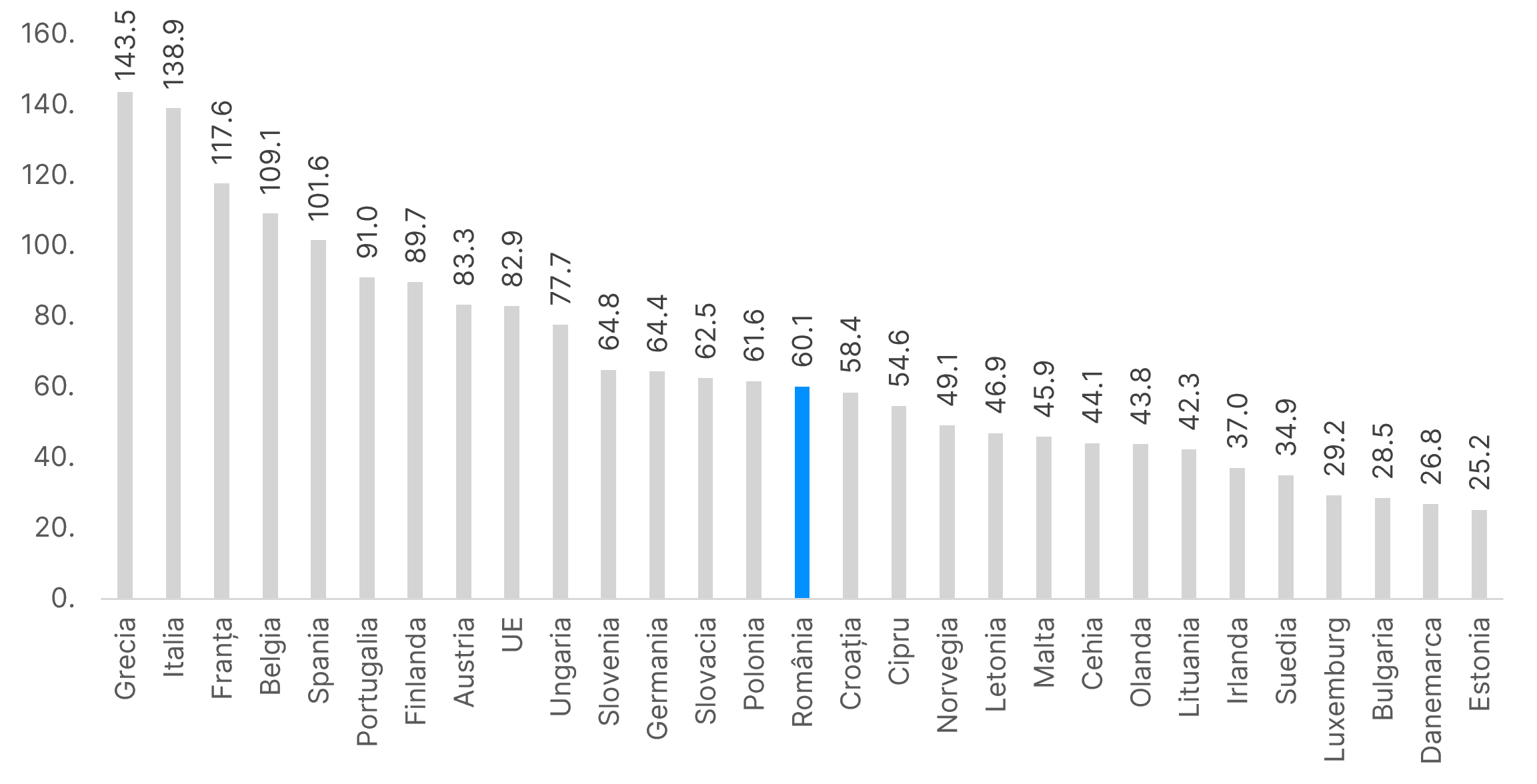
- At the end of the first quarter of 2026, the gross government debt of the EU reached 15.705 billion euro, that is 82.9% of GDP.
- The evolution of public debt at the European Union level, expressed as a percentage of GDP, had the following structure:
- T1 2025: 14.827 billion euros (81.4% from GDP )
- T4 2025: 15.377 bln. euro (81,8% from GDP )
- T1 2026: 15.705 billion euros (82.9% from GDP )
We observe that, in a single quarter, the debt increases by 327 billion euros, while, in a year, it increases by 877 billion euros. Europe continues to borrow, and the debt grows as a nominal stock year by year. - European extremes:
- At the summit: Greece (143.5% from GDP ), Italy (138.9% from GDP ), France (117.6% from GDP )
Savings with debts accumulated over decades, some with decreasing trends (Greece: -9.4 pp compared to one year before), others increasing (France: +4 pp).
THE MODEL OF GREECE
Greece still has the highest level of public debt in the European Union, at 143.5% of GDP. In other words, the Greek state owes approximately one and a half times what the entire economy produces in a year.
However, it is very important to underline the direction. Greece has reduced its debt/GDP ratio by 2.6 percentage points compared to the previous quarter and by 9.4 percentage points compared to last year, one of the most consistent improvements in the EU.
This thing showă că economia crește suficient de repede și că finanțele publice sunt gestionate mai prudent decât în trecut. Practic, deși datoria este încă foarte mare, Grecia merge în direcția corectă.
- At the base: Estonia (25.2% from GDP ), Denmark (26.8% from GDP ), Bulgaria (28.5% from GDP )
Here we see models of fiscal discipline, which have succeeded in prudently managing their public finances.
WHERE IS ROMANIA LOCATED
In Romania, the gross government debt reached, at the end of the first quarter of 2026, approximately 1,169.9 billion lei, the equivalent of 60.1% of GDP. For the first time, the level exceeds the threshold of 60% of GDP, a threshold also used in the Maastricht criteria*, even if its exceeding does not mechanically generate sanctions, as the dynamics of the debt, the deficit, and the macroeconomic context are also analyzed.
The evolution of Romania's public debt over the course of a year:
- T1 2025: 998.2 billion lei (55.8% from GDP )
- T4 2025: 1,137.3 billion lei (59.3% from GDP )
- T1 2026: 1,169.9 billion lei (60.1% from GDP )
Compared to 2025, we observe an increase of +171.7 billion lei, more precisely +17.2% in 12 months. Or, in other words, over the past year, on average, Romania's public debt has increased by 14.3 billion lei / month.
This increase reflects three simultaneous needs: financing the current budget deficit, refinancing maturing debt, and accumulating liquidity reserves.
THE MAASTRICHT TREATY IN CONTEXT
The 60% threshold of GDP is of particular importance because it represents the reference value established by the Maastricht criteria for the gross public debt of the government administration. These criteria, initially created for the evaluation of states wishing to adopt the euro currency, also provide for maintaining the budget deficit below 3% of GDP.
Exceeding the threshold of 60% does not automatically mean, however, that a state violates European rules or immediately enters a sanctioning procedure. The criterion can also be considered met when the debt is greater than 60%, but is on a downward trajectory and is approaching the reference value at a satisfactory pace.
Within the current European fiscal framework, exceeding the threshold, however, triggers closer monitoring and the requirement of a credible trajectory for adjusting expenditures and gradually reducing debt. For Romania, surpassing the level of 60% of GDP is particularly important as a signal regarding the deterioration of fiscal space.
SPEED OF DETERIORATION
And if value nominal helps us get an idea, it is very important to evaluate the situation also from a percentage point of view. Well, if compared to other European countries that have long surpassed the 100% threshold we could think that Romania is doing well, it is very important to look at both speed as well as at direction in which our country takes it in relation to the other member states.
Annual increase of debt, as a percentage of GDP, in the period Q1 2025 – Q1 2026:
- Finland: +5.5 pp
- Bulgaria: +4.8 pp
- Poland: +4.5 pp
- Romania: +4.3 pp
Thus, we observe that we record the fourth largest creșhi annual from the EU to the debt/GDP ratio. Our real problem is not that we briefly exceeded the 60% threshold, but the risk that the debt will continue to grow without a sufficiently firm fiscal correction.
DEBT STRUCTURE
And since the time has come to look at datorie, first things first. From the perspective of financial instruments, the largest part of Romania's debt is represented by government securities. These amounted to the equivalent of 48.3% of GDP, while loans represented 10.7% of GDP. Compared to the total debt, government securities represent approximately 80.4%.
This structure shows us that the financing of the Romanian state largely depends on constant access to domestic and external bond markets. Such a structure allows for the diversification of maturities and investors, but exposes the budget to changes in yields, changes in sovereign risk perception, and, in the case of debt denominated in foreign currency, to currency risk.
INTERESTS, DEBTS AND EXPENSES
The cost of debt is visible in the dynamics of budgetary expenditures on interest. In the first five months of 2026, Romania paid approximately 26.8 billion lei, compared to 22.9 billion lei in the same period of 2025. The increase was almost 4 billion lei, respectively 17.3%.
Interest expenses represented 1.3% of GDP, compared to 1.2% of GDP in the similar period of the previous year, and approximately 8.5% of total budgetary expenditures, compared to 7.1% in the first five months of 2025.
ALLOCATION OF EXPENSES
Almost one leu out of every 12 lei spent by the state in the first five months of the year was directed towards paying interest.
At the same time, interest costs have absorbed almost 9.6% of budget revenues total collected in the same period (279.5 billion lei). The current pace shows that the annual value of interest will remain very high and will limit the available space for investments, education, health, or measures to support the economy.
The cost of financing is influenced by still high domestic interest rates, inflation, risk premiums, and the size of the annual financing requirement. Maintaining the monetary policy rate at a high level (6.50%) and the significant yields demanded for local currency government securities contribute to a high cost of borrowing and refinanced debt.
WHAT'S NEXT?
The main risk for Romania is not only the level of debt, which still remains below the EU average (60.1% compared to 82.9%), but the speed at which it is growing. A persistently high budget deficit forces the state to continuously borrow both to cover current expenses and investments, as well as to refinance maturing debt. Moreover, modest economic growth reduces the favorable effect of GDP growth on the debt/GDP ratio, and high interest rates generate a self-reinforcing mechanism: more debt leads to higher interest expenses, which, in turn, increase the deficit and the borrowing requirement.
In case of a deterioration of investor confidence, Romania might be forced to offer even higher yields, which would increase the average cost of debt and shift an increasingly larger part of the budgetary burden to the following years.
According to our estimates, which can be consulted at BTResearch:
📈 Estimated public debt 2026: ~61.8% of GDP
📉 Estimated budget deficit 2026: ~6.0% of GDP
VERDICT
For Romania, exceeding the level of 60% of GDP, the annual increase of the debt by almost 172 billion lei and the increase in interest expenses on 26.8 billion lei in only five months represent important warning signals. Although the debt level remains below the European average, the dynamic is unfavorable, in an uncomfortable context: deficit raised, increasing interest rates and a modest economic growth that does not compensate for the accumulation of debt.
The stabilization of debt will depend on the authorities' ability to reduce the deficit without excessively affecting investments and economic growth, as well as on regaining investors' confidence through a predictable and credible fiscal strategy.