Pension fund administrators

As we saw last week, pension system is one of the most important economic and social mechanisms in Romania. How we prepare, in time, for the future, how contributions work and what the deal is with pension fund administrators are questions that appear more and more often in discussions about personal financial stability.
Therefore, it is time to answer them and how else but in the latest episode of The MacRO Zone.
FAST RECAP FOR OVERVIEW
- Pillar I – a must, the money from the contributions of employed persons (20.25% of the social security contributions) automatically goes to the state budget and is distributed according to current needs. The management of this pillar is carried out by the state through the National House of Public Pensions (CNPP).
- Second Pillar – mandatory. The money does not come, moreover, from the salary but is distributed automatically (4.75% of the social security contribution), and the accumulated funds are invested by private administrators under the supervision of the Financial Supervisory Authority (ASF). Upon retirement, the accumulated sum (contributions + returns) is returned to the participant in the form of a lump sum and/or installment payments (annuities).
🔎 How do you know if you have Pillar II?
If you started working after 2008 and were under 35 years old, congratulations you automatically received an account in Pillar II 🎉.
To find out exactly where your money goes you enter on ASF website and from there you see exactly in which fund the money goes and what amounts have been accumulated so far.
- Pillar III – completely voluntary. You contribute only if you want to, with as much as you want (maximum 15% of the gross income), and you can benefit from tax advantages (deduction of up to 400 euros per year for your own contribution, plus a deduction of up to 400 euros per year for the employer's contribution for you). Like Pillar II, this pillar is also managed by private administrators under the supervision of ASF.
ABOUT FUND MANAGERS AND FUND UNITS
A pension fund administrator is the financial entity responsible for managing the contributions of participants to private pension funds, namely Pillar II and Pillar III.
The operating mechanism is quite simple. Fund managers operate exactly like an investment fund. What does that mean? When you contribute, your money turns into fund units.
Value certain fund units are updated daily according to how the fund's investments (stocks, government bonds, bonds, etc.) increase or decrease. Thus the amount accumulated in your account will actually be:
number of fund units x the value of a fund unit (as of the current date)
PENSION FUNDS IN ROMANIA
At the national level there is 7 companies which administer the pensions. All are carefully supervised by ASF.
- Active in administration (~ 10% of GDP)
- Pillar II: ~192.3 billion lei, +27% vs Dec. 2024
- Pillar III: ~7.05 billion lei, +27% vs Dec. 2024
- Participants in private pensions(~47% of Romania's population)
- Pillar II: ~8.34 million active participants
- Pillar III: ~ 0.968 million voluntary participants
Ranking of private pension funds, pillar III
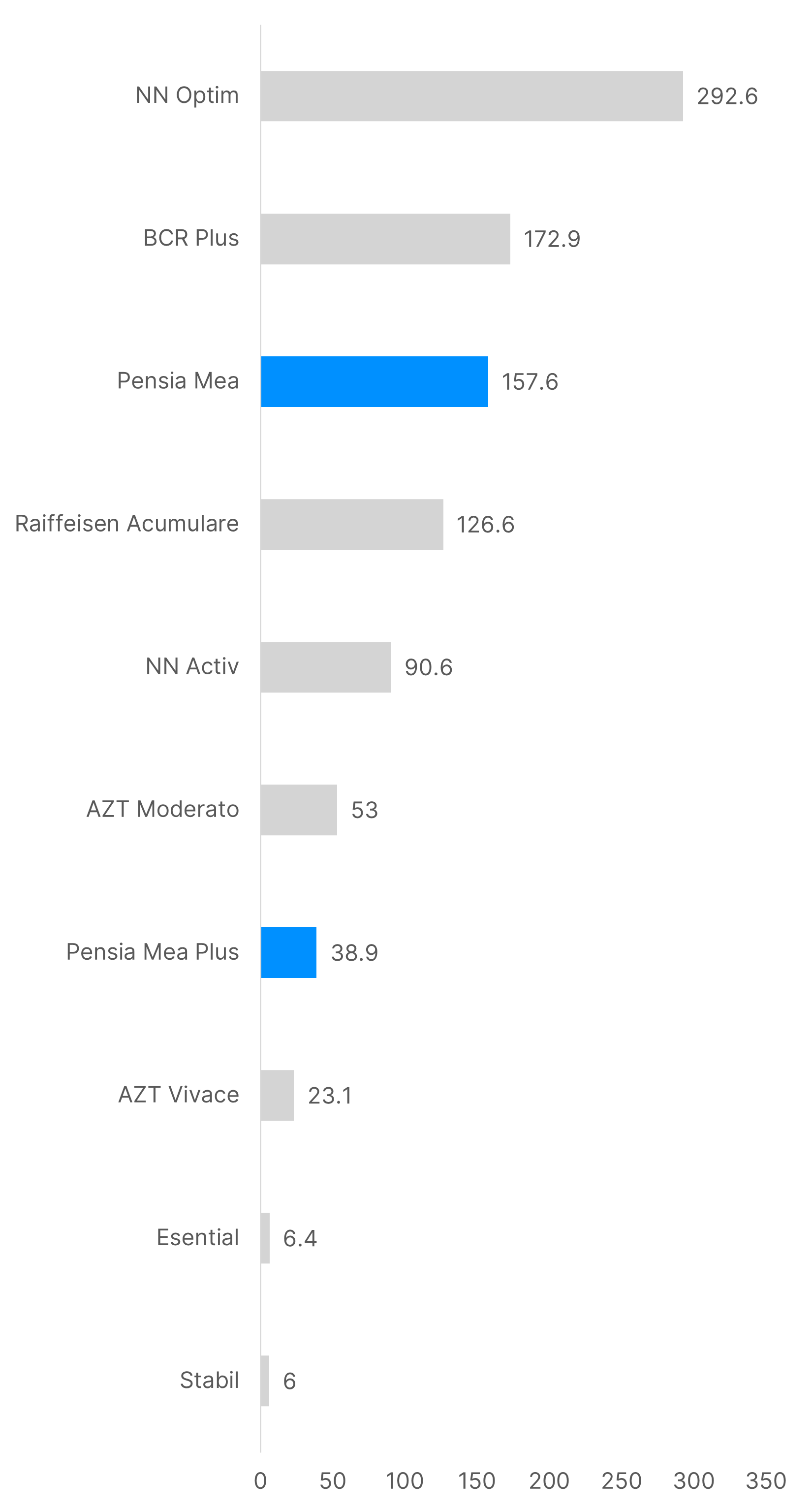
- NN Pensions
- One of the largest private pension fund managers in Romania, with a market share of 39.6% of the Pillar III participants (through NN Optim & NN Activ)
- NN Pensii investments are also included in Banca Transilvania, being a significant shareholder of the bank with a 9.4% share of TLV's shareholding.
- Private pensions @ BT
- BT Group has its own management company, BT Pensions, which manages two voluntary pension funds (Pillar III): My Pension and My Pension Plus
- With a +86% increase in the number of participants, by the end of 2024, and with a 65% increase in the number of participants in the first 10 months of 2025, My Pension is the pension fund with excellent dynamics.
- Since the beginning of the year, 47% of new contributors to Pillar III have chosen BT Pensii ☺. This places BT Pensii in 2nd place after NN in terms of number of participants, with a market share by number of participants of 20.3%.
- BCR, Raiffeisen & Allianz Țiriac
- Covers 40% of the market, forming a strong group with a stable customer base.
IMPACT IN ECONOMY
- Macroeconomic dimension: Total assets Pillar II + III have reached over 10% of Romania's GDP, an important psychological threshold that shows that the private pension sector has reached critical mass. Pension funds represent the largest accumulation of domestic capital outside the banking system.
- Constant funding flow for the budget deficit: Allows the state to borrow to a greater extent from internal sources, in the local currency, reducing dependence on external markets and high interest rates.
- Financial stability: Private pensions are an essential pillar of long-term financial stability in Romania. They reduce the vulnerability of the pension system to shocks demographic (because each participant has their own account, it does not depend only on the pension received from the state) and creates an internal pool of capital from which the economy can benefit.
IMPACT IN THE BUCHAREST STOCK EXCHANGE
- The pension funds are the largest institutional investor in Romania, bringing liquidity and stability to the stock market. For example, their presence as significant shareholders reduces excessive volatility, because they have a long-term horizon and buy regularly.
- Listings such as Digi, Sphera, MedLife, and culminating with Hidroelectrica, the largest listing (IPO) in BVB history, have been successful also because Pillar II funds participated massively as anchor investors.
- Pension funds have come to hold psignificant reports from many Romanian companies, through constant monthly purchases (contributions from beneficiaries come monthly and are invested).
LONG-TERM SAVING PUTS MONEY IN MOTION
In the end, one thing remains certain: the public pension (Pillar I) will be increasingly difficult to sustain due to demographic problems and budget deficits. Pillars II and III have long ceased to be luxury services, instead being a financial anchor for the future.
Modest contributions accumulated over the long term will generate a modest pension. Relevant contributions, made consistently, which benefit from professional management and sustainable returns can bring a consistent additional income at retirement age.