Evolution of public debt

What keeps you awake at night? It is one of the questions we keep trying to answer when it comes to business. But if we were to change the perspective and ask Romanian economists, then most likely the answer would be public debt.
And because this remains a hot topic on the agenda, we suggest taking a look at where we are and how we position ourselves in relation to other European countries. Welcome back to a new episode of The MacRO Zone 😊.
THE BASICS
Imagine that, at the end of each month, you find that you have spent more than you earned. You put the difference on the credit card. The next month, the same thing. And so on, for years in a row. At some point, the accumulated debt becomes so large that a good part of the salary goes only to interest.
Exactly this logic also applies to a state. Public debt is the total amount of money that the government has borrowed over time and has not yet repaid. It accumulates year after year, whenever the state spends more than it collects. The difference in a single year is called the budget deficit. The total accumulated deficits are a part of the debt.
In 2025, Romania closed the year with a deficit of -7.9% of GDP and a public debt of 59.3% of GDP.
PUBLIC DEBT: A HISTORIC RECORD
At the end of last year, the public debt reached 1,137.3 billion lei, a record level in Romania's history. The evolution throughout 2025 was continuously upward. If we started from a level of 54.8% of GDP (Q4’24), we rose steadily in the first three quarters 55.8% (Q1’25), 57.3% (Q2’25), 58.8% (Q3’25), making a final step up to 59.3% of GDP in the last quarter. A quarterly increase, with a slight deceleration towards the end of the year.
The red line in front is the one of 60% of GDP, the threshold established by the Maastricht Treaty. Beyond this percentage, the European mechanisms for fiscal surveillance are activated with greater attention. At 59.3%, Romania is less than one percentage point away.
EVOLUTION PUBLIC DEBT IN THE LAST DECADE
2015 – 2025 |%
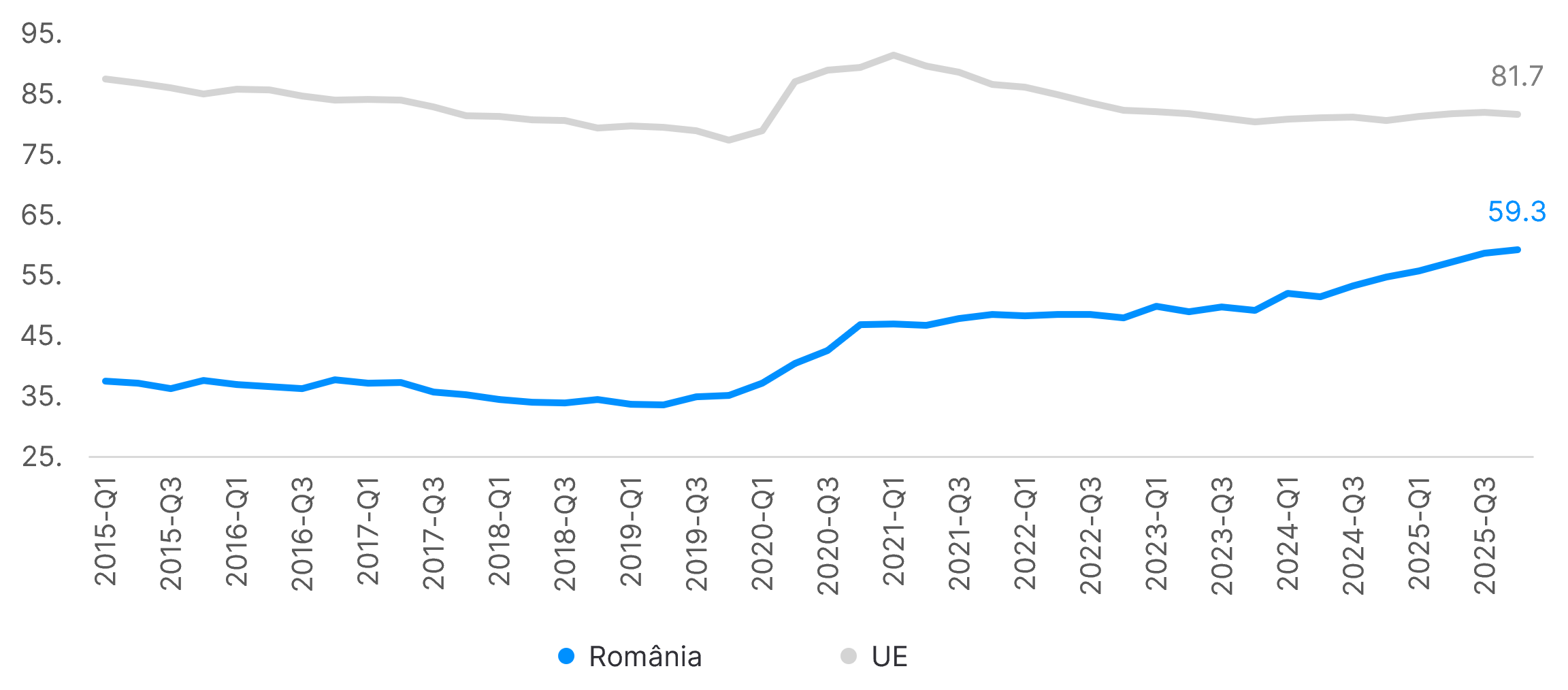
- Compared to the EU average of 81.7%, Romania seems comfortable. But the EU average includes Greece (146.1%), Italy (137.1%) and France (115.6%), economies with debts accumulated over decades.
- Compared to the region, we are, for the moment, in an intermediate and still manageable position, if we call upon budgetary discipline:
Poland: 59.7%
Hungary: 74.6%
Bulgaria: 29,9%
DEFICIT: IMPROVES, BUT REMAINS EXCEPTIONALLY HIGH
THE RELATIVELY GOOD NEWS: THE DEFICIT HAS DECREASED
From -9.3% of GDP in 2024 to -7.9% in 2025, a real improvement, mainly achieved through the packages of measures adopted by the government which led to an increase in budget revenues.
THE LESS GOOD NEWS: IT IS ONE OF THE LARGEST DEFICITS IN THE EU
EU average in 2025 was -3.1% of GDP, so Romania spends more unbalanced than the European average.
Indicator (standard ESA) | Romania 2024 | Romania 2025 | EU average 2025 |
Budget deficit | -9.3% GDP | -7.9% GDP | 3.1% GDP |
| Budgetary expenses | 43.3% GDP | 43.3% GDP | 49.5% GDP |
| Budget revenues | 34.0% GDP | 35.4% GDP | 46.4% GDP |
| Public debt | 54.8% GDP | 59.3% GDP | 81.7% GDP |
Looking at the table above, we notice that we have a paradox. Although Romania spends less than the EU average (43.3% VS 49.5%), it has a much larger deficit.
At a level located at 35.4% of GDP, Romania collects 11 percentage points less than the EU average (46.4% of GDP). The difference is huge and explains why we face such a large deficit, even if we do not spend excessively.
🔎 NOTE WELL
For a state to be able to function, it has a series of expenses, essential services that cannot be provided solely by the private sector. Think here of infrastructure, education, health, or safety, services that cannot be left exclusively to profit. Thus, expenses of the state, coherently administered, are actually an investment in the future: roads, networks, human capital.
The question that remains is how efficiently does the state manage these expenditures for o sustainable long-term development for the population of the country it governs.
DEBT STRUCTURE
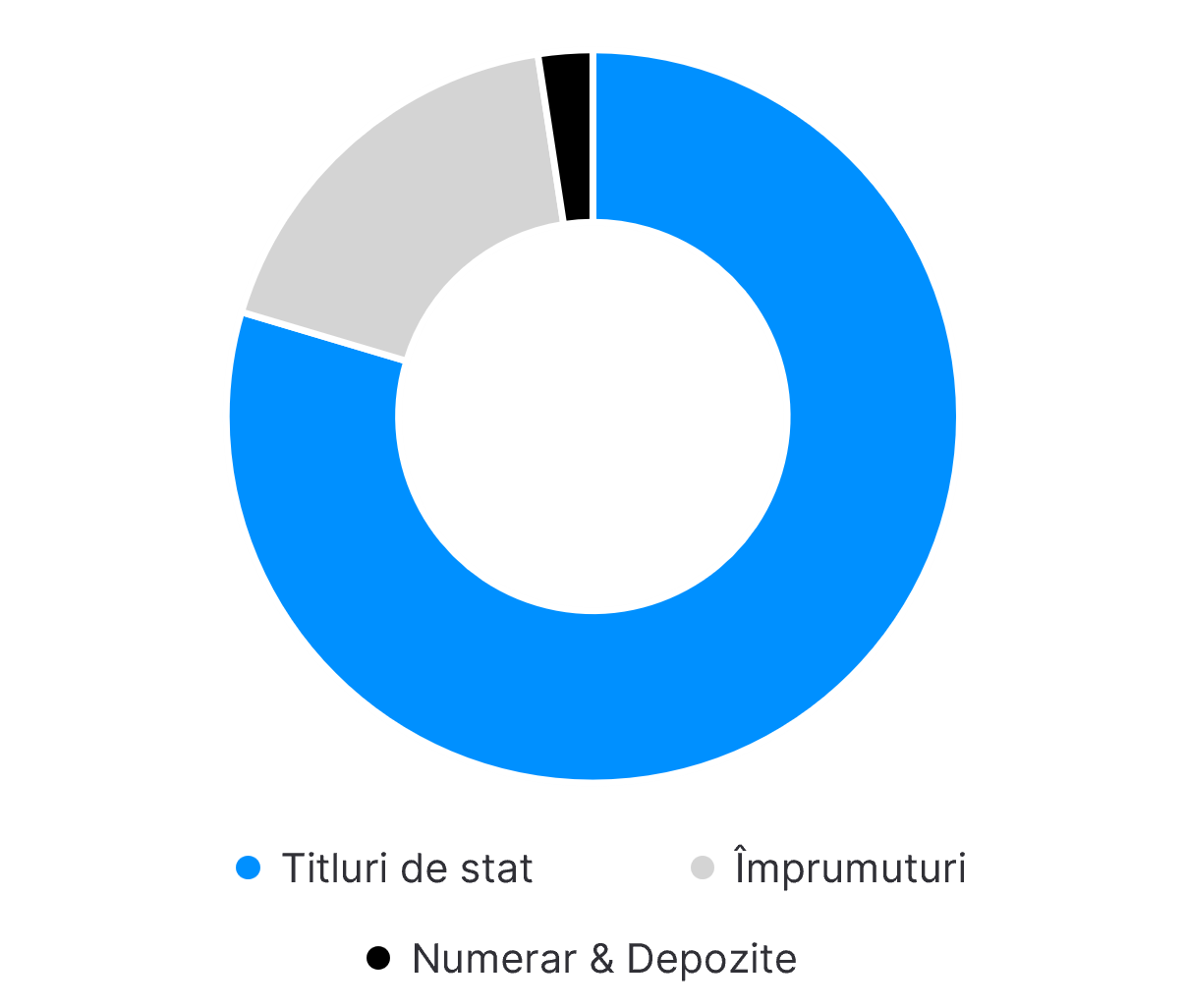
~80% (905-906 billion lei) of the debt is financed through government securities, concretely bonds issued on the capital markets. In this case, the Romanian state depends on investment appetite and interest rates to refinance its maturing debt.
Although it provides some flexibility, this instrument quickly turns into a direct cost: when interest rates rise, the cost of financing also increases.
~18% (204-205 billion lei) comes from loans from international financial institutions or other entities.
IMPACT
In 2025, Romania paid 14.2 billion lei more than in 2024, exclusively for interest on loans already contracted. Without any new service delivered to the citizens. Simply the cost of previously borrowed money.
| INDICATOR | 2024 | 2025 | Δ |
| Interest expenses | 36.3 BIL EUR | 50.5 BIL LC | +39.2% |
| % of GDP | 2,1% | 2,6% | +0.5PP |
| % of total expenses | 5,0% | 6,2% | +1,2PP |
THE SNOWBALL EFFECT
This is the logic of the snowball effect: debt increases not only from new deficits but also from the cost of old ones. A larger debt means higher interest rates , which means a bigger deficit, which means a bigger debt. The circle can only be broken by two things: fiscal consolidation or accelerated economic growth. Ideally, both simultaneously.
PNRR AND FOOTPRINT IN THE ECONOMY
European funds, especially through the PNRR, play an extremely important role in the dynamics of public debt. On the one hand, the grants (non-reimbursable) component contributes positively to financing investments without increasing the debt. On the other hand, the PNRR loans component directly adds to the debt stock.
In 2025, the impact of the RRP was visible: revenues from EU funds increased significantly, including those related to the RRP (22.9 billion lei, an increase of +171% vs 2024), iar cheltuielile pentru proiecte finanțate din granturi PNRR au ajuns la 28,7 miliarde lei (+168.9% vs 2024). In parallel, the loan component generated expenses of 13.7 billion lei, directly contributing to the increase of the debt.
Therefore, the PNRR has a mixed effect:
- reduce the pressure on the deficit through grants
- increases the debt through the loan component
In the medium term, however, if these funds are used efficiently and generate economic growth, they contribute to the improvement of the debt/GDP ratio by increasing the GDP. Thus, the final impact depends on the quality of the investments and the absorption capacity.
THE SCENARIO WE START FROM
A basic scenario for 2026 can be built starting from the assumption of a reduction of the budget deficit to 6.5% of GDP, according to fiscal policy objectives. In this context, even if the adjustment would be about 1.0–1.3 pp compared to 2025, the deficit level would remain sufficiently high to continue to generate debt growth.
Debt/GDP ratio could reach around 61.5–62 % of GDP in 2026, exceeding the Maastricht threshold of 60%. However, the growth rate would be lower than in 2024–2025, showing a relative stabilization. Thus, 2026 could mark the transition from a phase of accelerated debt growth to one of moderate but persistent growth.
And even if this scenario sounds ideal, considering the current context, we must take into account that it can become reality only under the conditions of a real fiscal consolidation, based on budgetary discipline, better tax collection, and investments that produce real growth.