Purchasing power

If you have traveled to Denmark or Luxembourg, you already know that a coffee, a dinner or a taxi ride can cost two or three times more than at home. And if you have friends settled in Germany or the Netherlands, you have probably heard from them that wages are higher, but so are rent, food, and utility bills.
That is precisely why comparing nominal incomes or expenses does not always tell the whole story, because at the end of the day, what matters is how much a person can buy with their money. And to measure this as fairly as possible, economists use a precise tool: the price level index.
Today, at The MacRO Зона, we propose to see where Romania ranks, category by category, and what this means for our daily life.
PURCHASING POWER
To calculate, in a real way, how much the population's income is worth, it is not enough to compare salaries, pensions, or GDP per capita in euros, because the same income can buy different amounts of goods and services in different countries . Therefore, indicators based on purchasing power parity and price level indices help in a better comparison between countries. Price Level Index shows how many units of the same currency are needed to buy the same volume of goods and services.
HOW DO WE MEASURE & INTERPRET?
This indicator is important because it shows us not only how "expensive" or "cheap" an economy is, but also how close it is to the price structure of the European market. It matters for the standard of living, for consumption decisions, for investments, for tourism, and for understanding economic convergence.
Thus, if the average of the European Union is set at 100, and a country has an index of 70, it means that goods and services cost, on average, 30% less than the EU average. If it has 140, it costs 40% more.
INVESTMENTS, PERCENT OF GDP
PRICE LEVEL INDEX FOR FINAL HOUSEHOLD CONSUMPTION
(EU=100) | 2025
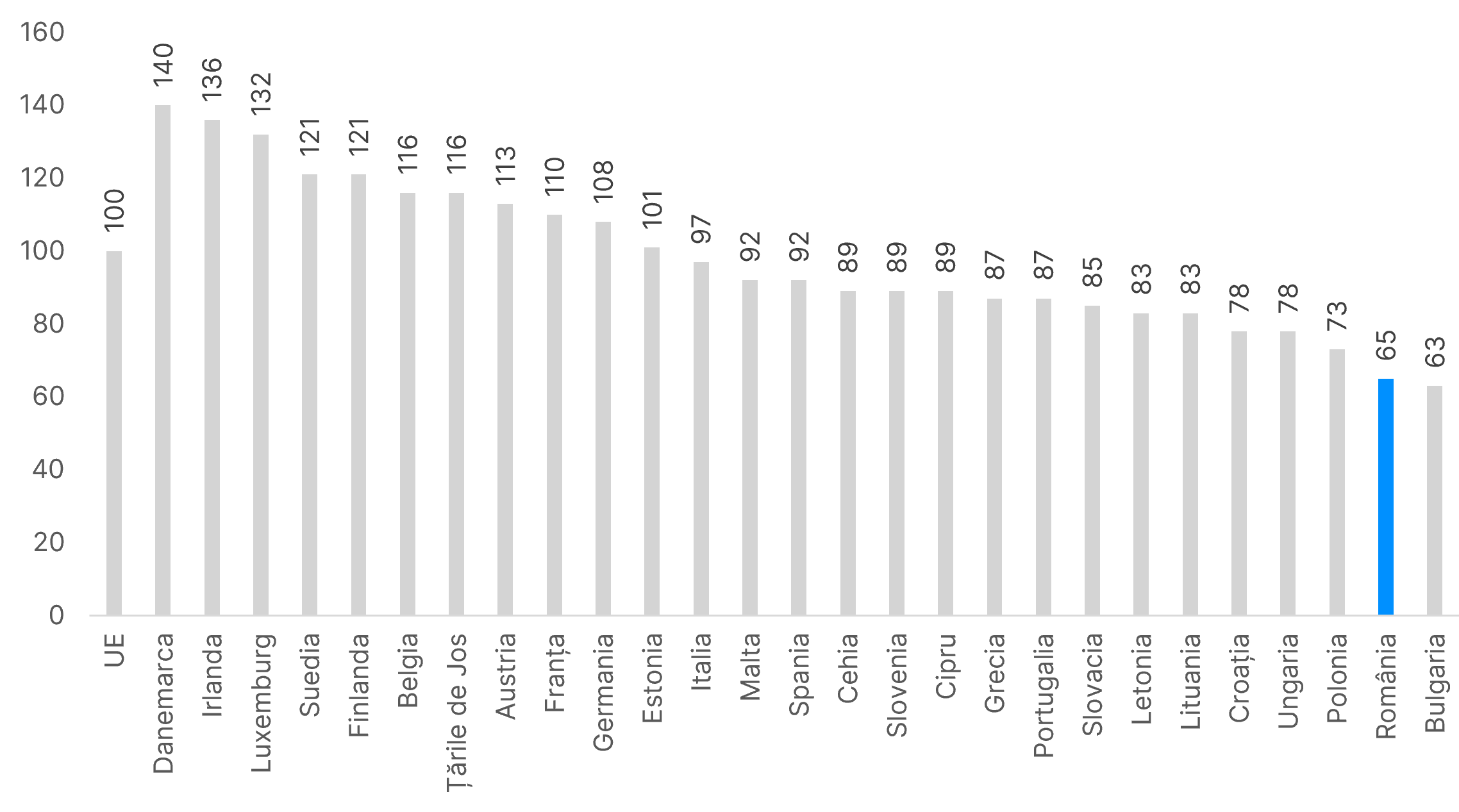
- In 2025, the price level index for the final consumption of households was 65 in Romania, compared to the EU average of 100. This means that, on average, goods and services consumed by households in Romania cost 35% less than the average of the European Union.
- From the perspective of the EU ranking, Romania is ranked 26th out of 27 member states if we arrange the countries from the most expensive to the cheapest. In other words, Romania is the second cheapest country in the EU for the final consumption of households, after Bulgaria.
- Top 3 most expensive states overall are:
- Denmark (140)
- Ireland (136)
- Luxembourg (132)
- This positioning confirms that Romania remains a economy with relatively low prices at the European level . However, this should not be automatically interpreted as a full advantage for the population: lower prices must be related to incomes, productivity, and the structure of consumption.
FOOD AND NON-ALCOHOLIC DRINKS: ROMANIA, THE CHEAPEST COUNTRY IN THE EU
For the group "food and non-alcoholic beverages", Romania has an index of 80, that is prices are 20% below the EU average. It is the lowest value in the EU, which places Romania in first place in the ranking of the cheapest countries, in this category.
THE MOST EXPENSIVE COUNTRIES | THE MOST CHEAP COUNTRIES |
| Luxembourg (122) | Romania (80) |
| Denmark (121) | Slovakia (83) |
| Ireland (116) | Czechia and Poland (90) |
This result is important because food has a high weight in household budgets, especially in lower-income countries. The fact that Romania has the lowest prices for food and non-alcoholic beverages alleviates the pressure on budgets, but does not eliminate the vulnerability of low-income households, for whom food continues to represent a large part of monthly expenses.
UTILITIES & HOUSING: 46% BELOW THE EU AVERAGE, BUT WITH POTENTIAL PRESSURES IN THE FUTURE
For "home administration, water, electricity, gas, and other fuels", Romania has an index of 54, that is prices are 46% below the EU average. Romania is ranked 24th out of 27 in the ranking from the most expensive to the cheapest countries.
THE MOST EXPENSIVE COUNTRIES | THE MOST CHEAP COUNTRIES |
| Ireland (190) | Bulgaria (41) |
| Luxembourg (182) | Croatia (48) |
| Denmark (167) | Poland (52) |
This category is essential for the standard of living, as it includes expenses that are difficult to postpone or reduce: housing, utilities, energy. The large difference between countries indicates that energy prices, market structures, public policies, and taxation strongly influence the costs borne by households.
CLOTHING: CLOSER TO THE EU AVERAGE
At the group "clothing and footwear", Romania has an index of 90, so prices are 10% below the EU average. In the ranking from the most expensive to the cheapest member states, Romania is in 24th place out of 27.
THE MOST EXPENSIVE COUNTRIES | THE MOST CHEAP COUNTRIES |
| Denmark (132) | Bulgaria (78) |
| Sweden (130) | Hungary (87) |
| Finland (122) | Spain (89) |
Therefore, Romania has lower prices than the EU average, but it is not in the group of the cheapest countries. This shows that, for clothing and footwear, the market is more integrated in Europe, and price differences are less extreme than in the case of services or housing-related costs.
FURNITURE & HOME APPLIANCES: ROMANIA IN THE TOP
For "furniture items, household equipment and current maintenance of the home", Romania has an index of 83, which means a price level 17% below the EU average. Romania ranks 26th out of 27 member states.
THE MOST EXPENSIVE COUNTRIES | THE MOST CHEAP COUNTRIES |
| Denmark (127) | Bulgaria (78) |
| Luxembourg (124) | Romania (83) |
| Sweden (114) | Cyprus (87) |
Romania's position shows that goods for home furnishing remain relatively affordable in the European comparison. However, the differences are smaller than for services, as many products are marketed internationally and have common supply chains.
TRANSPORT: THE SECOND CHEAPEST IN THE EU
In the "transport" group, Romania has an index of 80, with 20% below the EU average. In the ranking from the most expensive to the cheapest countries, Romania is in 26th place out of 27.
THE MOST EXPENSIVE COUNTRIES | THE MOST CHEAP COUNTRIES |
| Denmark (127) | Bulgaria (70) |
| Sweden (115) | Romania (80) |
| Finland, Ireland & The Netherlands (112) | Poland (81) |
Transport is a mixed category, which includes both goods and services. Price differences reflect taxes, wage costs, infrastructure, energy prices, and public policies. Romania remains significantly below the EU average, but not as low as Bulgaria.
LEISURE, SPORTS, CULTURE: AGAIN, FIRST PLACE IN THE RANKINGS
For "recreation, sports and culture," Romania has an index of 63, adică prețurile sunt cu 37% sub media UE. Este cel mai redus nivel din Uniunea Europeană, ceea ce plasează România pe locul 27 din 27 în clasamentul de la cele mai scumpe la cele mai ieftine state.
THE MOST EXPENSIVE COUNTRIES | THE MOST CHEAP COUNTRIES |
| Denmark (141) | Romania (63) |
| Sweden & Finland (127) | Bulgaria (66) |
| Austria (121) | Hungary & Poland (73) |
This category has a particularity: it includes both services and goods. The price of a cinema ticket, a gym membership, or a concert directly reflects the local wage costs. The fact that Romania is the cheapest shows that the sector has low internal costs, which means an advantage for consumers today, but with the perspective that prices will increase along with wages.
RESTAURANTS AND ACCOMMODATION: THE SECOND CHEAPEST IN THE EU
For "restaurants and accommodation services", Romania has an index of 59, with 41% below the EU average. Romania ranks 26th out of 27 in the ranking.
THE MOST EXPENSIVE COUNTRIES | THE MOST CHEAP COUNTRIES |
| Denmark (142) | Bulgaria (56) |
| Sweden (123) | Romania (59) |
| Finland (122) | Czechia (70) |
Relatively low prices can support Romania's competitiveness as a tourist destination, especially for tourists from countries with higher price levels. At the same time, they also reflect the lower wage costs in the hospitality sector.
COMMUNICATIONS: ROMANIA, THE CHEAPEST COUNTRY IN THE EU
For the "communications" group, which includes postal services, equipment, and telephony services, Romania has an index of 56,1. It is the lowest level in the European Union. Romania is in 27th place out of 27.
THE MOST EXPENSIVE COUNTRIES | THE MOST CHEAP COUNTRIES |
| Belgium (146.3) | Romania (56.1) |
| Sweden (137.5) | Poland (67.6) |
| Luxembourg (136.4) | Italy (89.4) |
This is one of the strongest contrasts in the data. Romania is well below the EU average in communications, and the difference compared to the most expensive countries is very large. For consumers, this means relatively low costs for connectivity and telecommunications services. For the economy, it can be a competitive advantage, especially in a context where digitization and online services are becoming increasingly important.
FUN FACT
One euro spent on communications "buys" much more in Romania than in Belgium. Compared to the price level index, communications are over two and a half times more expensive in Belgium than in Romania. It is one of the clearest differences and explains why Romania is often perceived as having telecommunications services that are very competitive in price.
ROMANIA, CLOSER TO THE EU
The data show that Romania is one of the cheapest countries in the European Union for household consumption. In the overall indicator, we are the second cheapest country after Bulgaria. For several categories, our country is actually the cheapest country in the EU.
This positioning has two interpretations:
- Lower prices support the purchasing power of incomes expressed in lei and can make certain goods and services more accessible than they would appear in a nominal European comparison.
- The low level of prices also reflects differences in incomes, productivity, labor costs, and economic structure. A cheaper country is not automatically a country with a higher standard of living; the ratio between incomes and prices matters.
In the medium term, it is likely that Romania's overall indicator will continue to gradually approach the EU average, but not uniformly across all categories. Income convergence, rising labor costs, investments, market integration, and changes in taxes or tariffs may push some prices upward.
Services, in particular, tend to become more expensive as wages increase, because they depend more on the local workforce.
Goods international marketed can remain closer to European levels, with smaller differences between countries.
For Romania, the challenge is not to remain "cheap" at any cost, but to transform economic convergence into a real increase in the standard of living. Ideally, incomes should approach the EU average faster than prices. If this happens, the purchasing power of the population increases. If prices rise faster than incomes, Romania's current advantage as a low-price economy may erode.
In essence, from the data we see a significantly cheaper Romania than the European average for now, but one that is in a process of convergence. The general indicator must be monitored in the following years not only as a measure of prices, but as a signal of how the Romanian economy is approaching the structure, costs, and consumption standards of the European Union.