Investments, engine of economic growth

There are two ways to grow an economy. One is like a celebration that lasts as long as the money in your pocket: you consume, you enjoy, and the next day you are left with the bill, sounds familiar? The other is like an investment in your own yard, you plant a tree that, although it does not bear fruit immediately, over time, it will give you shade and fruit for years.
Romania has grown for a long time on the first model: increasingly higher wages, higher consumption, continuously expanding domestic demand. It worked in the short term, and now we are all worried about how we will pay the bill, because an economy that grows mainly through consumption risks accumulating imbalances: inflation, increasingly large imports, external deficit, and, of course, interest rates.
The good news is that, lately, we see that Romania has begun to rebalance and to lean slightly on the second model: investments. Today, at The MacRO Зона , we propose to analyze this change and understand why an economic model shift matters so much, and where Romania stands in Europe.
TRANSITION TO A NEW ECONOMIC MODEL
Over time, I have emphasized this idea again: Romania will base its growth in the coming years more on investments and less on consumption. It is a healthier model for the economy because investments create productive assets, not just immediate demand.
- The capital of the economy is growing . A factory with new equipment, a newly-built road or a company with efficient software can produce more and more efficiently in the coming years.
- Technology enters the economy through investments, not through consumption, because when you buy modern equipment, you also buy the know-how behind it.
- Productivity work increases. The same employee produces more with better infrastructure and equipment.
Investments have multiplying effect, because a construction site generates demand for materials, transportation, design, financing and specialized labor, all simultaneously. At the same time, well-calibrated investments can contribute to reduction of regional disparities, на attraction of foreign direct investments and at strengthening of the export base.
INVESTMENTS, PERCENT OF GDP
Consumption can rapidly accelerate GDP, but, in an economy with limited domestic supply, it easily turns into inflation and higher imports. Investments, on the other hand, increase domestic supply and reduce exactly these structural constraints.
In a comparative European analysis, gross fixed capital formation as a percentage of GDP shows that a portion of the economy's resources is directed towards capital accumulation. A higher level indicates an economy in a phase of modernization, expansion of productive capacity, or catching up with gaps. However, the indicator must be interpreted with care: a high percentage does not automatically guarantee efficiency. The quality of investments, sectoral allocation, degree of absorption of European funds, administrative capacity, and economic return of projects matter.
GROSS FIXED CAPITAL FORMATION – INVESTMENTS
% OF GDP | 2025
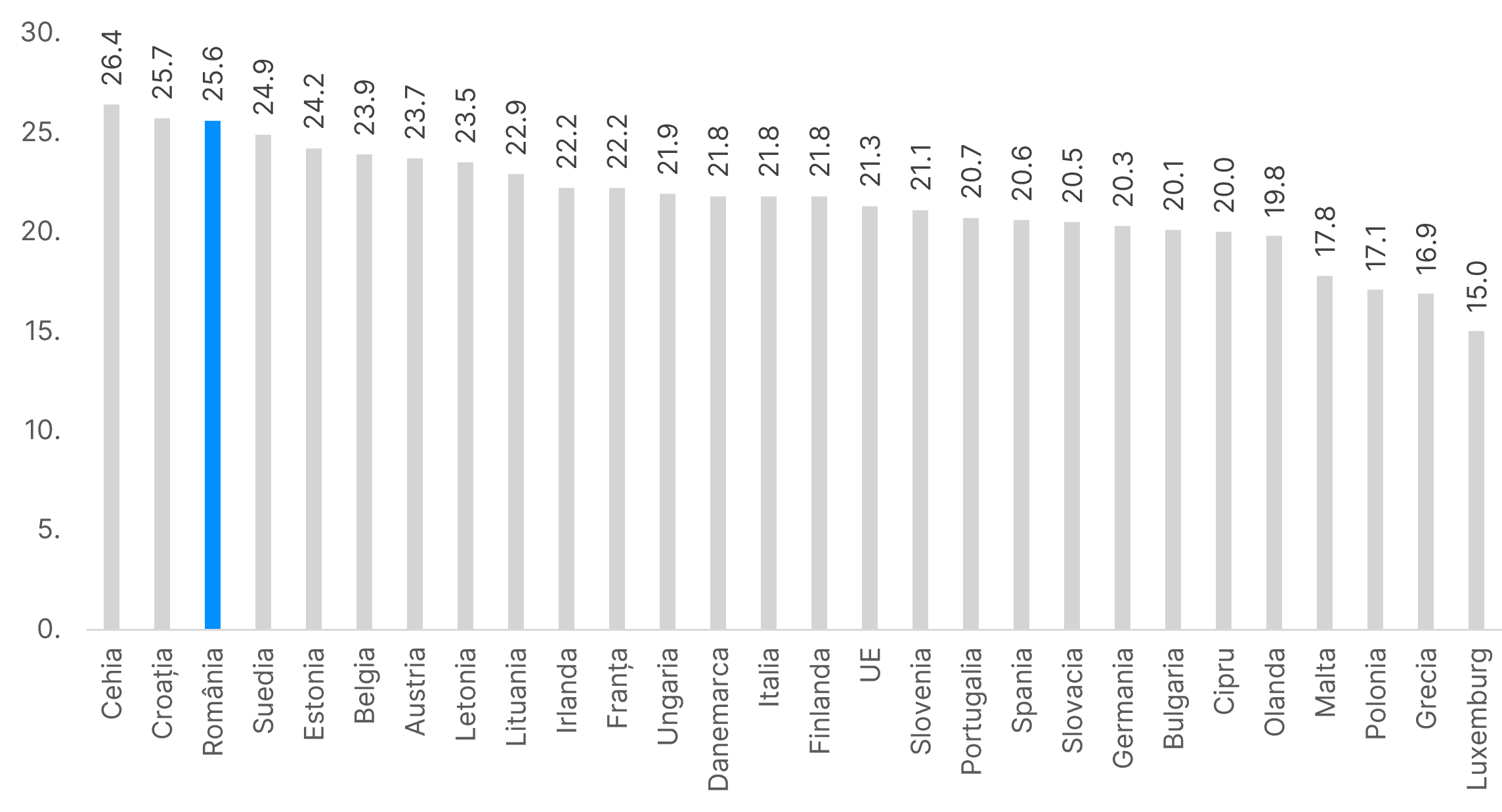
- In 2025, gross fixed capital formation as a percentage of GDP was as follows:
- Czech Republic – 26.4% of GDP
- Romania – 25.6% of GDP
- Sweden – 24.9% of GDP
- EU average: 21.3%
- The good news is that Romania is in upper part the European ranking of investments as a percentage of GDP, placing us comfortably above the EU average (21.3%).
- Romania invests more, as a percentage of the economy, than most member states, including the large economies of Western Europe. For a country with still large infrastructure gaps compared to the European average (roads, hospitals, schools, energy networks), this high level of investment is a necessity and at the same time a confirmation of the direction.
ROMANIA, THREE STAGES IN 10 YEARS
The evolution of Romanian investments between 2015 and 2025 tells a story in three acts.
- 2015–2018: Consumption, versus investments. Romania started from 24–25% of GDP in 2015, but the share gradually decreased to a minimum of 21,2% in 2018. This was the period of major salary increases and tax cuts. We saw economic growth artificially fueled by consumption, not by capital.
- 2019–2021: Investments, as a stabilizer. The indicator rose again over 23%. Even in the midst of the pandemic, investments remained relatively resilient, public projects and European funds continued to support capital formation, exactly when consumption was in free fall.
- 2022–2025: Romania has returned to almost 25% of GDP, reaching 25,6% in 2025. In the same period, consumption was restrained by inflation, high interest rates, and fiscal adjustments, and investments took over as the main driver of growth.
COMPARATIVE PRICE LEVELS FOR INVESTMENTS
In the macroeconomic analysis of investments, it is important to also look at the price dimension. That is, two countries can invest the same percentage of GDP, but the real volume of assetsobtained differ if prices differ.
This indicator expresses the price level for investments compared to the average of the European Union, and the interpretation will be as follows:
- >100 – Investments are relatively more expensive than the EU average
- 100 – EU average
- <100 – Investments are relatively cheaper than the EU average
The indicator does not measure the quality of investments and should not be interpreted as a ranking of competitiveness. It is extremely useful because it shows how much "investment volume" an economy can obtain for the same nominal amount.
INDEXES OF PRICE LEVELS FOR INVESTMENTS
2025
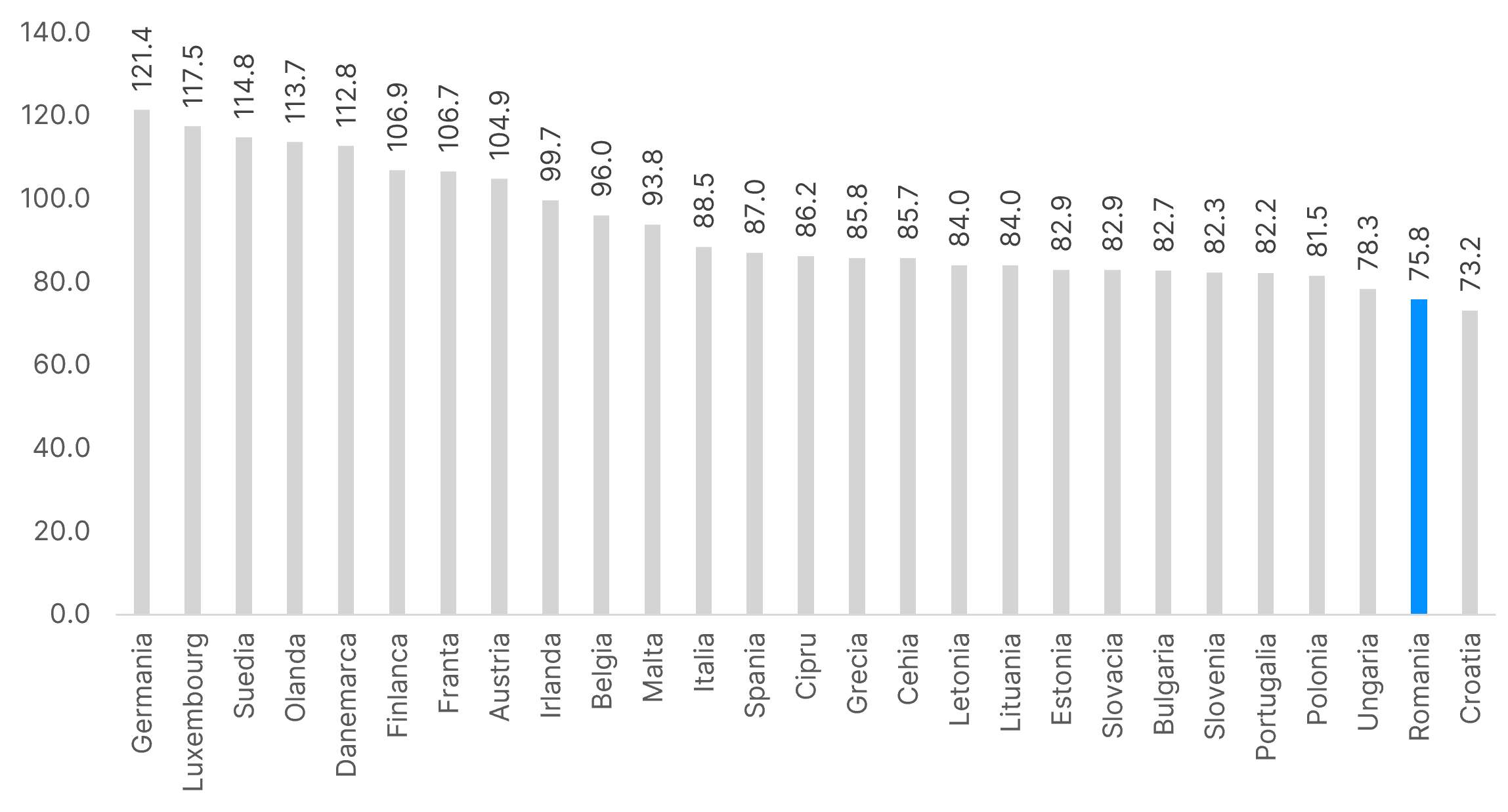
- For total investments (as an index), the highest price levels in the EU in 2025 were in:
- Germany – 121.4
- Luxembourg – 117.5
- Sweden – 114.8
These values indicate investments more expensive than the EU average, reflecting high costs of labor, land, services, materials, and project implementation.
- The lowest price levels in the EU were in:
- Croatia – 73.2
- Romania – 75.8
- Hungary – 78.3
ROMANIA, AMONG THE CHEAPEST MARKETS IN THE EU
We observe that Romania is thus in 26th place out of 27 in the EU, that is, the second cheapest country in the Union for total investments (as an index), after Croatia. Practically, the price level for investments in Romania is approximately 24% below the EU average.
This position has two major implications.
- For investors, Romania offers a relatively low cost of capital formation.
- A low level of prices still shows differences in economic maturity compared to Western economies.
Thus, with about 24% below the European average, with the same amount of money, an investor gets significantly more "volume" in Romania than in Germany or Luxembourg.
SOFTWARE: ROMANIA, THE CHEAPEST MARKET IN THE EU
Taking the analysis further and looking at the components that accelerate the growth process based on productivity, innovation, and competitiveness, it is worth highlighting separately the software part. Here, Romania (94.2) has the lowest price index in the entire European Union, ranking 27th out of 27. At the opposite pole, Czech Republic has 107.0.
This result is important for companies: the relatively lower cost of software can support digitization, automation, and investments in information systems. For an economy that needs to increase productivity, this is a relevant competitive advantage.
CONSTRUCTIONS: ROMANIA'S MAIN COMPETITIVE ADVANTAGE
If for total investments Romania is the second cheapest market in the EU, for constructions the advantage is even more pronounced.
The most expensive markets for construction (2025):
- Germany – 143.2
- Luxembourg – 130.6
- Sweden – 128.3
The cheapest:
- Croatia – 60.8
- Romania – 62.1
- Hungary – 65.7
The price level for construction in Romania is almost 38% below the EU average. For an economy that directs a large part of investments towards infrastructure, residential buildings, and engineering works, this means one concrete thing: for the same amount of money, Romania can build more than a country from Western Europe.
This cost advantage has already translated into concrete results. In 2025, the construction sector accounted for approximately 8.6% of Romania's GDP formation and contributed positively, in a year when the overall economy advanced modestly.
It is a remarkable performance in a difficult context: still high inflation, high interest rates, fiscal adjustment, political uncertainty, and weak external demand. While other sectors faced headwinds, construction has demonstrated that Romania can turn the cost advantage into a real contribution to GDP.
PERFECT EXECUTION
Romania has made a structural change worth noting: from growth based on consumption (vulnerable to inflation and external imbalances) to growth based on investment (slower, less spectacular, but much more sustainable in the long term).
With 25.6% of GDP gross fixed capital formation in 2025, we are in the European top 3. With investment prices 24% below the EU average, we have a cost advantage that few European economies still have. The real challenge from now on is not to invest more, but to invest better: in projects with real returns, with efficient absorption of European funds, and with a horizon that goes beyond a single electoral cycle. The price advantage gives us a rare chance. The quality of execution will decide if we use it.