Airfare

Have you ever wondered what happens with plane ticket prices? We are sure that, at some point, you booked a flight months in advance and found a ticket at a reasonable price, only to later find out that a friend paid half by booking a week before. Or maybe the opposite, you waited for an offerlast minutethat you knew a tip, and then ended up paying three times as much as the ticket would have cost in January.
Well, we asked ourselves too, and today, at The MacEN Area, we provide the answers to understand the logic behind pricing.
SETTING THE GROUND
Airfares are among the most volatile components of the consumer price index. Unlike other services, plane ticket rates arechange frequentlydepending on the season, the aircraft's occupancy rate, the time of booking, the number of operators on a route, and fuel costs.
MAIN INDICATOR
Dataanalyzed are expressed as the annual rateHICP (Harmonized Index of Consumer Prices). A value of 10% in a given month indicates that, on average, air transport services were 10% more expensive than in the same month of the previous year. The indicator does not reflect the price of a specific ticket or the change compared to the previous month, but compare the current price level compared to that of a year ago.
For analysis, we divided passenger air transport into three components: total air transport, domestic air transport, and international air transport. Total transport is influenced by the share of the two categories.
EVOLUTION THE PRICEAIR TRANSPORT
2023 - 2026 | % p.a. | Romania
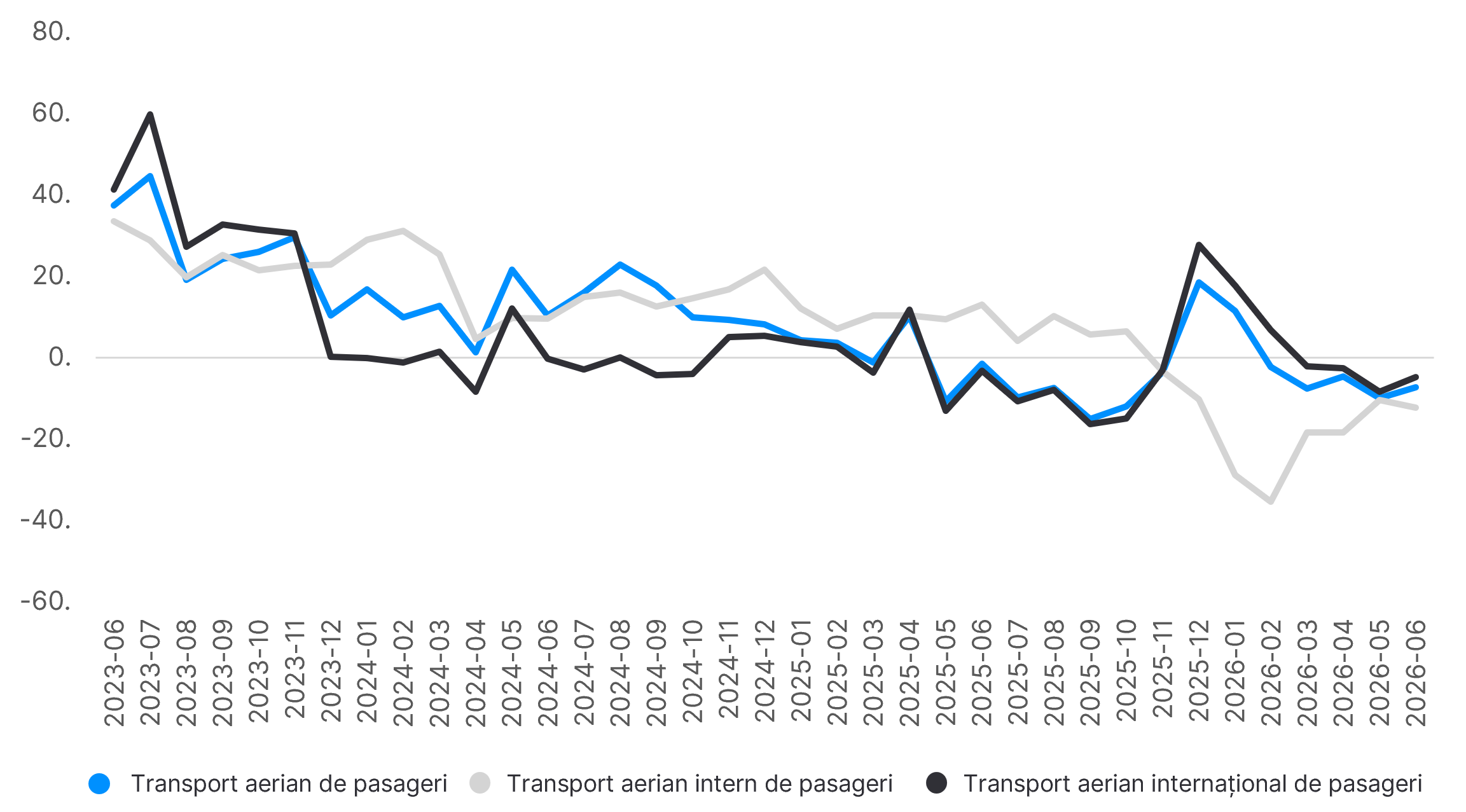
- Tickets market Air travel from Romania has shifted from exceptional price increases to significant reductions. After annual rises reaching up to 44.6% in 2023, the market entered a downward trend in 2025, and in the first half of 2026, total air transport prices were, on average, 3.4% below the previous year's level.
- International flightshave determined most of the fluctuations. In the summer of 2023, fares for international flights increased by up to nearly 60% compared to the previous year, but in 2025 declines prevailed, reaching -16.4% in certain months. Since the majority of Romania's air traffic is international, this component decisively influenced the overall index evolution.
- Domestic travelhad the most spectacular change. After increases of over 30% in some months of 2024, domestic flights registered an average decrease of approximately 21% in the first half of 2026, including a record drop of 35.4% in February 2026, the largest price reduction among all the analyzed segments.
This dynamic shows that air transport prices in Romania are very sensitive to changes in flight availability, low-cost carriers' pricing policies, as well as to the base effects caused by the very high fares of previous years.
ALTITUDE DIFFERENCE: DOMESTIC VS INTERNATIONAL FLIGHTS
Air transport has two very distinct aspects, which are worth understanding in detail.
INTERNATIONAL FLIGHTS
In 2023, Romania recorded a surge in international rates: +41.2% in June and nearly +60% in July, compared to around +1% on average at the European level. Thisshowthat the Romanian market has been much more sensitive to the imbalances between supply and demand. After the pandemic, demand for international flights increased sharply, driven by tourism, workforce mobility, and diaspora travel. At the same time, supply did not increase fast enough, and companies were able to pass this pressure on through prices.
From 2025 onwards, however, the relationship with Europe reversed. While in the EU prices for international flights have remained almost stagnant or increased slightly, in Romania decreases have predominated. The main explanation is the base effect: after the exceptional price hikes in 2023, comparison with those very high levels subsequently generated negative rates. Added to this was strong competition among low-cost operators and capacity expansion on certain routes. The consequence is that Romania has shifted from a trend significantly more expensive than the European average to a period of noticeable price reductions for passengers.
DOMESTIC FLIGHTSE
If we look at domestic flights, they have become more expensive in Europe, but in a relatively orderly and predictable way. Prices have increased by an average of 15.5% in the second half of 2023, by 10.6% (2024), by 4.4% (2025), and by another 2.2% (2026). Thatshowis a mature market, where the supply is relatively limited, fixed costs are high, and companies have managed to pass some of the costs onto passengers.
Romania experienced a much more extreme evolution. After two years of very sharp price increases, with significant annual growth, the market suddenly reversed direction. In the first half of 2026, domestic flight prices were on average 20.7% lower than a year earlier, while in Europe there was an increase of 2.2%. This difference shows that the domestic market in Romania is much more volatile, being affected by capacity changes, operators' commercial strategies, and baseline effects generated by previous price increases.
The main cause is the small size of the domestic market. Romania has few routes and few operators compared to major European markets. When an operator adds or removes capacity, when flight frequencies change, or when aggressive marketing campaigns appear, the effect on the average price is much stronger than in a large and diversified market.
For consumers, this can be an advantage in the short term, as periods of higher competition and supply generate significant price reductions. At the same time, however, the high volatility suggests a less mature market that is more dependent on the decisions of a few operators and a few key routes.
WHAT COSTS ARE BEHIND AN AIRLINE TICKET?
So far, we have noticed many factors that cause prices to soar, but now it’s time to analyze them one by one:
FUEL
- Fuel is one of thehigher expenses of an airline company. Its share in the industry's operating costs is 25.4% in 2025. This shows us that when the price of jet fuel rises, the cost of operating each flight increases. However, ticket prices do not automatically go up week to week because many companies have long-term contracts or hedge part of their consumption through financial instruments.
- If high prices persist for several weeks, companies can no longer absorb the cost indefinitely. At that point, part of the fuel price increase starts to be reflected in ticket prices, especially on long routes where fuel consumption is much higher.
- Behind these fluctuations lies a market much more complex than it appears at first glance. The price of jet fuel depends not only on oil but also on refinery capacity, imports, global demand, and even geopolitical tensions. For this reason, we will explore all these factors in more detail in a future episode.
SEASONALITY
- Airline algorithms know that everyone wants to fly in August. The same happens in December, during the Easter holidays, or when long weekends are approaching. Thus, during high-demand periods, the systems ofrevenue managementadjust prices in real time, based on how many seats are still available on the plane and how close the flight date is. As the plane fills up, the cheap fare classes disappear and only the expensive ones remain.
- This mechanism explains why fares can increase even when fuel prices fall. Costs influence the minimum level at which a company can operate profitably, but demand largely determines the actual price paid by the passenger.
BASE EFFECT
- HICP Ratesanalyzed are calculated against the same month of the previous year. If prices were unusually high in a given month, the rate in the following year may become negative even if current rates are still relatively high.
- That is, if in July 2023 a ticket that usually cost 100 euros rose to 160 euros (a 60% increase), then July 2023 becomes a very high reference point. When you compare July 2024 or July 2025 with that exceptional level, it’s much easier to see a negative value, even though the tickets are not necessarily cheap in absolute terms.
- This effect is very noticeable in the case of Romania. The 30–60% price increases in 2023 have created a high base for subsequent comparisons. The price reductions in 2025 and 2026 should therefore be seen as a normalization after an exceptional period, not just as an absolute decrease in travel costs.
- On routes operated by multiple companies, fares tend to be more competitive. When an operator introduces a new route or increases flight frequency, the seat availability rises, and other operators may respond with discounts.
- We in Romania see this phenomenon in real time because this dynamic is critical: on popular international routes (Bucharest-London, Cluj-Milan, etc.), competition is intense and protects the passenger, while on certain domestic routes or secondary destinations, the operator's bargaining power is stronger, and cost pressures are transferred more easily and quickly into the fare.
EXCHANGE RATE
- A significant part of an airline's costs (fuel, aircraft leasing, or maintenance) are expressed in US dollars. Revenues, however, may be in lei or euros. When the dollar appreciates against the leu, costs increase automatically even if the international fuel price has not changed.
VOLATILITY ON BOARD
So I saw that the price of an airline ticket results from complex factors, with the fuel price being one component that influences this mix but not the main driver. Like any other industry, ticket prices equally reflect the balance between supply and demand, the airline’s business strategy, and how much time remains until the departure date.
Being a sector with high volatility, price dynamics change constantly, but still, it is important to understand the mechanisms that form the price, as this can provide a certain agility in the purchasing process.