Crop coverage rate

If in the last episode of this series we aimed to scrutinize professional lifetime duration In Romania, today we invite you to be more bohemian and to explore a niche that brings us a little inspiration.
When we saycreative economy, many of us think of art, museums, and cultural activities, aspects linked to the world of beauty but apparently without a direct connection to GDP. Yet, in the European Union, almost 9 million people bringcontribcontribution to this economy by generating added value, intellectual property, and highly skilled jobs.
We invite you to a new episode ofThe MacEN Area, let’s look at the numberseasel and analyze this still exotic branch for Romania.
CREATIVE ECONOMY
Also known as orange economy, the creative economyIt is a concept based on the contribution and potential of creative assets that support economic growth and development. According to the latest report byUnited Nations, the creative economy represents 3.1% of GDP and 6.2% of jobs worldwide.
By analyzing the size of the figures, we can quite easily see that, when it comes tocultural participation rate, we no longer only refer tothe usual suspects represented by actors and painters, but we are referring to a much broader category. Thus, we encounter three situations:
- Cultural occupation + cultural sector -> an actor employed in a theater or a journalist working for a newspaper
- Cultural occupation + other sector -> a designer employed in the automotive industry or a photographer at a marketing company
- Non-cultural occupation + cultural sector -> an accountant employed by a publishing house or an economist working at a museum.
Combining the two criteria: the economic sector in which a person works and the occupation they practice, we observe the outline of the spherecultural activitieswhere, among others, editing and printing, film, video, and music production, television and radio broadcasting, advertising, design, photography, translation and interpreting, performing arts, libraries, archives, museums, and cultural heritage are included.
Whilecultural occupations including architects and designers, librarians, archivists and curators, authors, journalists, linguists, fine artists, musicians, actors, dancers, directors, photographers, and various workers in the field of artistic crafts.
EUROPEAN UNION, INCREASING LEVEL OF CULTURAL ENGAGEMENT
In 2025, approximately 8.9 million peopleworked in the cultural sector in the European Union, representing 4.3% of all employed persons.
Cultural employment has overall experienced upward growth in the last decade. The number of people working in this field in the EU increased from approximately 7.6 million (2015) to nearly 8.9 million (2025), representing a rise of about 1.3 million people, or roughly 17%.
TRENDS
The increase was not linear, however.
- The cultural sector was severely affected by the 2020 pandemic, especially through the closure of theatres, cinemas, concert halls and other cultural venues. The number of employed persons fell from approximately 8.18 million in 2019 to 7.98 million in 2020.
- Subsequently, the recovery was rapid: cultural attendance surpassed the pre-pandemic level in 2021 and continued to rise to a period high in 2025.
Inside the sector, developments have been varied.
- Artistic creation activities and performances saw a sharp decline during the pandemic, but then rebounded strongly, reaching 1.1 million people in 2025, the highest level since 2014.
- Employment increased in design, photography, and audiovisual production.
- Traditional editing has continued to lose jobs amid digitalization and changes in media consumption patterns.
OCCUPANCY RATE IN THE CULTURAL SECTOR
2025 | % of the total employed persons
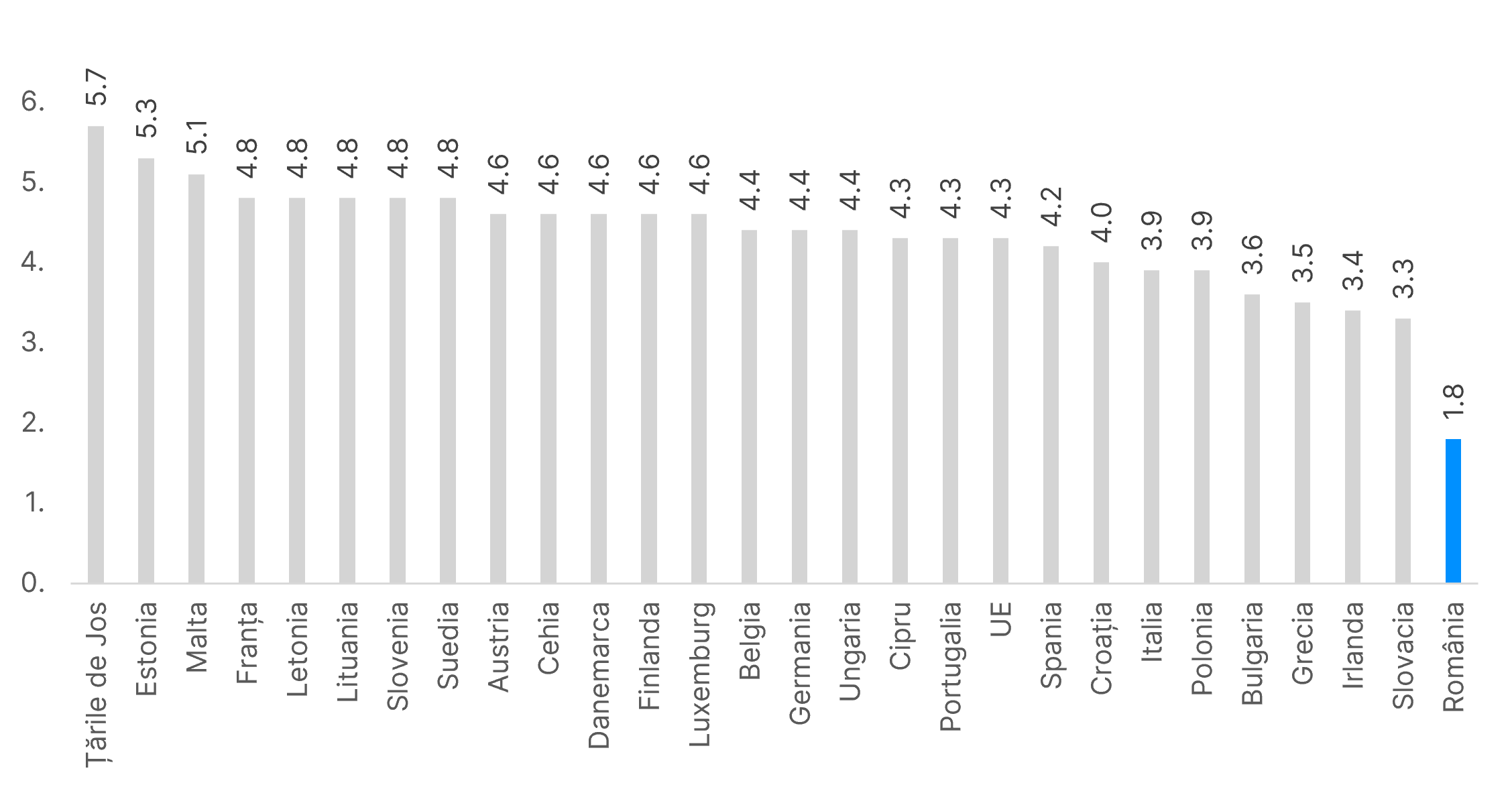
- Analyzing the employment rate in the cultural sector among member states, we observe considerable differences, ranging from the Netherlands (5.7%) to Romania (1.8%).
- In general, Western and Northern European countries have a higher proportion of cultural jobs than those in the East and South of the continent.
- Countries with the highest employment rate:The Netherlands (5.7%)– approximately 563,000 people
The position reflects the development of the creative industries, design, architecture, advertising, and the audiovisual sector, as well as the spread of freelancing and project-based work.
Estonia (5.3%) – approximately 37,000 peopleThe country benefits from a digitized economy, where content creation and creative services are better integrated with technology.
Malta (5.1%)– nearly 17,000 peopleRelative to the size of its economy, Malta has a fairly significant audiovisual and film production sector
- Countries with the lowest employment rate:Romania (1.8%)Slovakia (3.3%)Ireland (3.4%)
The difference between Romania and the next country in the ranking is very large: the cultural employment rate in Slovakia was 1.5 percentage points higher, and the EU average was 2.5 percentage points above Romania's.
CULTURE, REDUCED FOOTPRINT ON THE ROMANIAN ECONOMY
With 136,900 peopleworking in the cultural field, representing an employment rate of only1,8% compared to the 4.3% EU average, Romania ranks last among the member states.
If our country had the same rate of cultural employment as the European Union average, the sector would employ over 320,000 people. The gap compared to the current situation is therefore approximately 190,000 jobs. In other words, the Romanian economy is "losing" the potential of nearly 190,000 jobs in cultural and creative industries.
Although there have been year-to-year fluctuations, the progress in recent years is modest. The share of cultural employment increased from 1.6% (2018) to only 1.8% (2025), insufficient to reduce the gap compared to the rest of Europe.
Romania faces not only a limited number of jobs in traditional cultural institutions but also limited development of commercial creative industries: audiovisual production, design, creative advertising, digital publishing, games and multimedia content, translation, photography, or heritage-related services.
SECTOR RIGIDITY LIMITS OPPORTUNITIES
Looking at the statistics, in Romanialocurile existing in culture are very stable:
- 98.3% of employees work full-time
- 99.5% of employees have permanent contracts
- 99.3% of people declared only one job
These figures appear positive at first glance, due to the stability this sector offers employees, but at the same time showa relatively rigid sector as well, concentrated in public institutions and established organizations, with a lower presence of independent projects, of activities of freelanceor small creative boutiques.
In Romania, only 15.8% of cultural workers are self-employed, compared to nearly 31.6% in the EU. This indicates an underdeveloped creative entrepreneurial ecosystem. While a low rate of self-employment is not necessarily negative, especially when stable contracts are also reflected in social protection, combining this with the very low share of cultural employment, however, shows a weakly developed creative ecosystem, with few opportunities for independent artists, producers, translators, authors or designers to turn their creations into a sustainable economic activity.
MORE CULTURE, MORE JOBS, INNOVATION AND COMPETITIVENESS
The low cultural occupancy rate indicates that Romania underuses an important part of thehuman capitaland creative. The cultural sector should not be seen exclusively as a beneficiary of public subsidies but as a component of the knowledge-based economy, which, through processing, generates tangible added value:
- Design increases product competitiveness
- advertising supports sales
- architecture contributes to urban development
- film, video games and digital content can generate exports
- cultural heritage boosts tourism and local investments
A underdeveloped cultural sector means fewer jobs for graduates in the field, but also a potentially reduced innovationfor other industries, but also vice versa. When the local market offers many opportunities, creators, designers, authors, media specialists or cultural producers no longer look abroad for professional development and choose to stay to participate in the restoration and growth of cultural heritage.
More opportunities also mean reducing hidden economic costs such as the loss of creative talent, which can translate into producing original content, refining national identity, and participating in international cultural and economic exchanges.
WHERE DO WE START CREATING?
Culture contributes to collective identity, social cohesion, education, and well-being, but it also has a direct economic role. As we have seen so far, the cultural and creative sectors can generate jobs, investment, international trade, and intellectual property, and they can support urban regeneration and regional development.
And since there is no single solution to such a complex challenge, we can define several directions:
- More predictable public financing: a cultural sector cannot be planned on 12-month terms, with an uncertain budget from year to year, but needs a clear and coherent strategy.
- Support for independent artists and start-upcreative topics:support for independent producers and designersfreelance, small publishers, game studios, aprivate galleries, and here we can each contribute by purchasing tickets (REACTOR).
- Integration with tourism, technology and education: culture must not remain a warehouseseparately. Every well-organized festival translates into tourism (UNTOLD), every film awarded at Cannes goes around the world (Fjord), each history lesson screening turns into education (Spruce Forest.
- Access to European funds: Romania has access to European programs for the cultural and creative sectors (Creative Europe, ERDF), but the absorption capacity remains low.
- Financing and scaling:This summer, for the first time on the local capital market, it was launched for trading on the market AeROthe first communication agency (GRF), which shows us that creative businesses can also scale and accelerate.
- Cultural consumption growth: supply cannot develop without demand. An informed public, cultural education, and access to culture outside major cities are just as important as funding.
ROMANIA DOESN'T LACK CREATIVES, BUT THE INFRASTRUCTURE TO MEET THEIR NEEDS
Over the past decade, cultural employment in the EU has grown noticeably, surpassing the pandemic's effects and reaching nearly 9 million people by 2025. The expansion of audiovisual production, design, digital services, and the return of artistic activities have offset the decline of some traditional sectors, such as publishing and print media.
However, Romania has not followed the same path due to the sector’s small size and limited access to opportunities. Developing the cultural sector must be approached both as a social and identity objective and as an economic policy. A stronger cultural sector could generate highly skilled jobs, exports, innovation, tourism and local regeneration, while also helping retain talent and enhancing our country’s attractiveness and competitiveness.