Digital Subscription Economy
Today,Let's start with a memory exercise and challenge you to remember the last time you bought a printed newspaper. But a movie onDVD? If you find it hard to remember, means that you are also part of subscription economy.
Therefore, whether you pay a subscription toDuolingo, you have a Netflix account and a YouTube account, your way of consuming has a different dimension.
УThe MacEN Area, let's talk about the phenomenon ofdisruptionwhich has changed the way we relate to information, namely taking a look at the shift from ownership to access based on a subscription.
START
The relationship between consumer and product was, until recently, based on ownership. People bought a disc, a newspaper, a DVD movie, or a game and kept that product. However, digitalization has fundamentally changed this model. Instead of owning a limited collection, consumers increasingly pay for temporary access to an almost unlimited library of movies, music, press, or games.
It is the transition from buyer to subscriber, anticipated from the very beginning of the digital economy and later explained through various concepts such assubscription economyабо automatic customer. For companies, the one-off transaction is replaced by a recurring revenue stream, while for consumers, ownership is replaced by access, convenience, and continuous service updates.
FOREVER TRANSACTION
Robbie Kellman Baxter, author of the bookThe Membership Economy,introduce the term offorevertransaction explaining how a company can build a subscription offer valuable enough tothe client stops constantly looking for alternatives and grants the company the trust to continuously meet a specific need.
This model has already become an important part of consumption. However, its development is uneven across Europe: Northern and Western Europe are at an advanced stage of the subscription economy, while Central and Eastern European countries, including Romania, still have a significant gap.
DIGITAL SUBSCRIPTIONS GAIN GROUND IN EUROPE
In 2025, 1/3
European internet users paid for video streaming and approximately1/4for music. Press and gaming remain far behind but with steady growth.
As a consumption model, movies, TV series, and music are increasingly accessed through digital libraries available for a recurring fee, while for news and gaming, multiple consumption alternatives still coexist.
Добре знати:The percentages for the four categories should not be added together, as the same person may use and pay for multiple services.
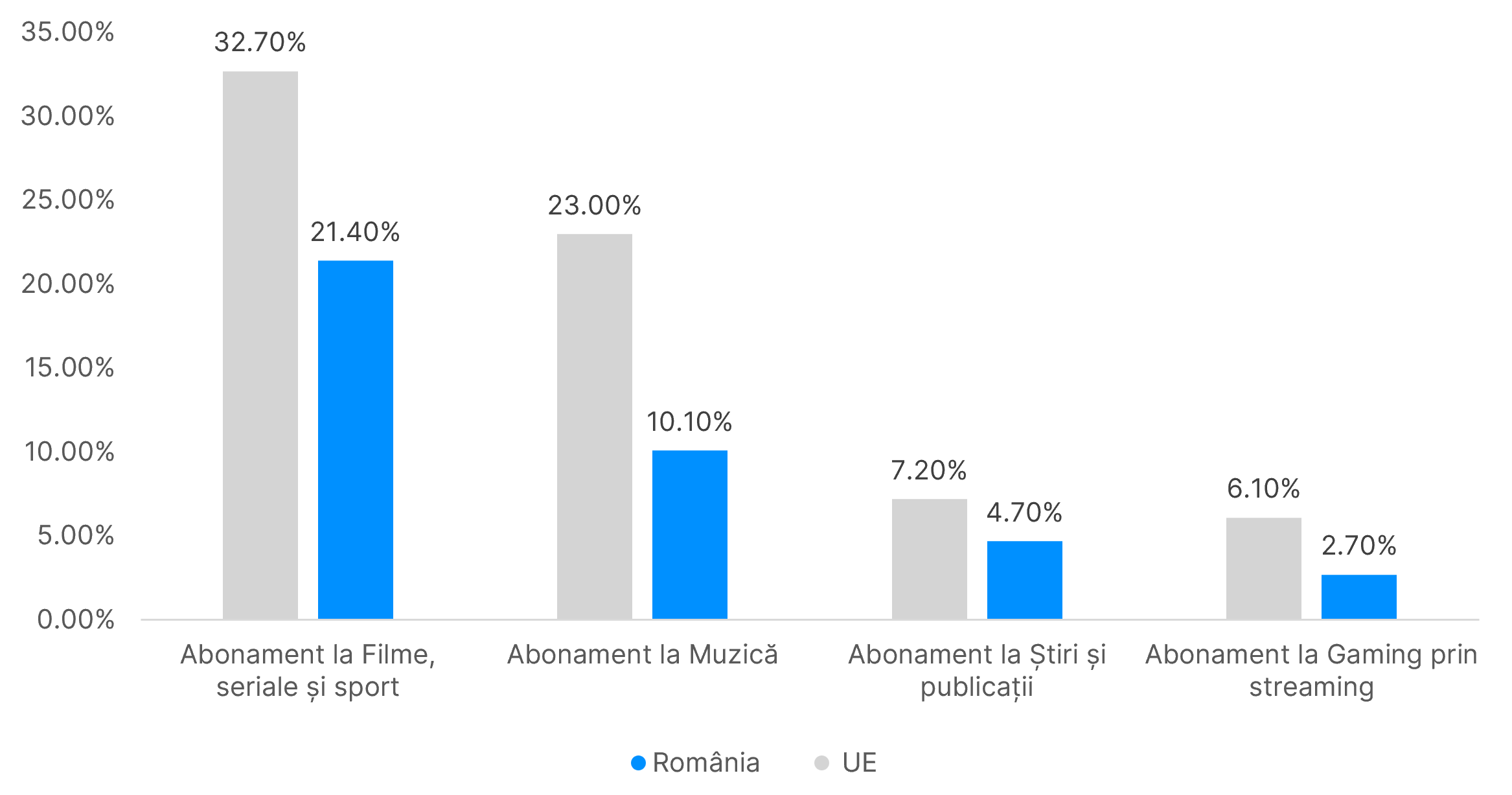
INTERNET USERS WITH A MEDIA SUBSCRIPTION IN ROMANIA AND THE EU
2025 | %
Thus,we see that,In one part of Europe, video subscriptions have become almost a mass-market service, comparable to telephony or internet, while in other countries they remain a product used by a minority. The differences reflect both disposable income and the level of digitalization, consumption habits, availability of local content, as well as the practice of sharing accounts within the family.
In the Nordic countries, about half of internet users pay for music, showing that streaming has largely replaced traditional purchasing. In Southern and Eastern Europe, free access, supported by advertising, likely remains much more significant.
The performance of the Nordic countries reflects not only purchasing power but also the tradition of subscription-based press, relatively high trust in established publications, and the early development of digital payment systems.
−The lowest weights were recorded in: Slovenia (1.93%), Bulgaria (2.16%), and Romania (2.65%)
ROMANIA RECOVERS QUICKLY, BUT STILL HAS A GAP
Romania is below the European Union average in all four subscription categories analyzed. The largest gap is recorded in music, while the smallest, in absolute terms, is in online press.
Type subscription | Romania 2025 | EU 2025 | Gap | Romania's Position in the EU | |
Movies, Series and Sports | 21,4% | 32,7% | -11.3 pp | 21 of 27 | |
| Music | 10,1% | 23,0% | −12.9 pp | 25 of 27 | |
News and Publications | 4,7% | 7,2% | -2.5 pp | 18 of 27 | |
Gaming via streaming | 2,7% | 6,1% | −3.5 pp | 25 of 27 |
A SUBSCRIPTION FOR UP TO 100 CHANNELS... OR NOT YET?
Like in Europe, video subscriptions are also the most developed category in Romania, with approximately 21.4% of internet users paying for a subscription. The increase compared to 2024 was 3.2 percentage points.
Although we still remain 11.3 points below the EU average, the long-term trend shows the gradual expansion of the market. The gap reflects not only Romanians' willingness to pay but also the overall consumption of video content via the internet. Traditional television, cable packages with multiple channels, and the common family use of streaming subscriptions explain part of the difference.
TELL ME (ON) WHAT YOU LISTEN TO AND I WILL TELL YOU WHO YOU ARE
In 2025, 10.1% of Romanian internet users paid for a music streaming service, compared to 23% in the EU. Romania ranked 25th, ahead of Croatia and Bulgaria.
However, music had the strongest annual growth among the four categories: from 6.1% in 2024 to 10.1% in 2025. The 4 percentage point increase was nearly double that recorded at the EU level.
IN THE MOUTH OF THE ONLINE PRESS
Romania is closest to the EU average for news and digital publication subscriptions: 4.7%, compared to 7.2%. The development in 2025 is remarkable: the share increased by 2.9 percentage points (1.8% in 2024). The explanation is a combination of factors, not a single structural change:
#1The effect of a very low starting base
The increase seems huge especially because the initial level was very low. A rise from 1.8% to 4.7% represents a relative advance of 160%.
#2Political Context and Exceptional Information Request
The 2024–2025 period was unusually politically intense:
• local and European Parliament elections
• parliamentary elections
• the presidential elections and the cancellation of the 2024 poll
• the resumption of the 2025 presidential elections
• political instability and debates on disinformation
• increased interest in investigations, explanations, and credible sources
In a highly crowded and polarized information environment, a larger portion of the public has been willing to pay for media perceived as more credible, specialized, or independent.
#3Expanding subscription and membership offers
The Romanian market has started to offer more ways to directly support the press:
• digital subscriptions
• premium content
• recurring contributions
• membership
• paid newsletters
• access to specialized publications
THE GAMING MARKET IN ROMANIA, SIDE LEVEL
QUEST
Subscriptions for game streaming services are used by only 2.7% of internet users, compared to 6.1% in the EU. We also record the lowest level for purchasing games via download in 2025 (4% of users), alongside Bulgaria and Italy (5%).
PRESS VS GAMING
Digital press(4.7%) exceeded services of gamingby streaming (2.7%) with 2 percentage points in 2025. Considering that Romania is a market where press content has long been perceived as freely available, the trend shows us that the Romanian audience is beginning to distinguish between simple access to information and access to relevant, credible, and specialized content from reliable sources.EXTRA PRESSURE ON SERVICES
In the last decade, the digitalization of cultural consumption has advanced significantly, especially in video and music. The next stage is no longer just attracting online users but retaining them in the long term. The competition shifts from selling the product to the quality of the ongoing relationship with the subscriber.
Still, each subscription quickly becomes a new line in the family budget, in a mediumeconomic inwhose monthly budgets are already under pressure from inflation, utilities as well asa
others
expenses. This is a lesson about consumer behavior in times of uncertainty: people pay for what they perceive as valuable and trustworthy.