Do you invest? Here’s what you need to know about taxes

Taxes shouldn’t be a cause for stress. And yet, for many of us, that’s exactly what they are.
“If I sell the shares, what tax do I pay?”, “Do I still need to file the Single Declaration?”, “What tax benefit does Pillar III have?” are questions that arise exactly when we need to make a decision.
The problem is that the answers often come in tax jargon, not in the language we think about our finances in.
This is where the BT Pulse series starts, created together with The Tax Institute, where we simply explain which taxes apply, who pays them, and what you need to know, without complicated terms and without "tax jargon".
Let's start with investments. Because, from 2026, the rules for taxing gains have changed.
The first investment almost always comes with the same question:Now what fees do I have to pay?Good news: the answer is simpler than it seems, and in many cases you don’t even have to calculate the tax yourself. And from 2026, the rules have changed, so it’s worth knowing the new ones.
Basic rule: the gain is taxed, not the investment
You don’t pay tax when you buy an investment or when its value increases. The tax liability usually arises only when you sell and make a profit.
Example:you invested 10,000 lei in an instrument and, after two years, you sell it for 12,500 lei. The tax applies only to the 2,500 lei gain, not the entire amount received.
The principle is the same for stocks, ETFs, or fund units; fiscally, it matters less which instrument you chose and more who you bought it through.
Does it matter who you invest through? Yes, it is the most important aspect
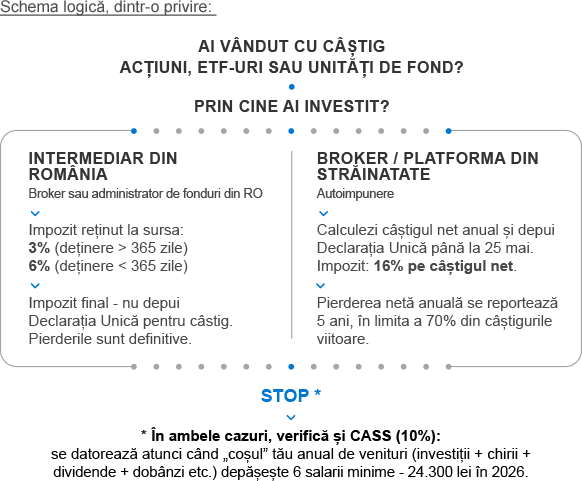
If you invest through an authorized intermediary in Romania, a broker or a fund manager, they calculate, withhold, and pay the tax for you:
- 3% of the gain if you held the securities for over one year
- 6% if you held them for less than a year
The tax is final: you have nothing more to declare for it
If you invest through a foreign broker or platform, the responsibility lies with you: you calculate the annual net gain, file the Single Declaration by May 25 of the following year, and pay 16% tax.
Income from abroad may also be taxed in the country of origin, in which case the double taxation avoidance agreement applies, potentially allowing you to offset the tax paid there.
What happens if you sell at a loss?
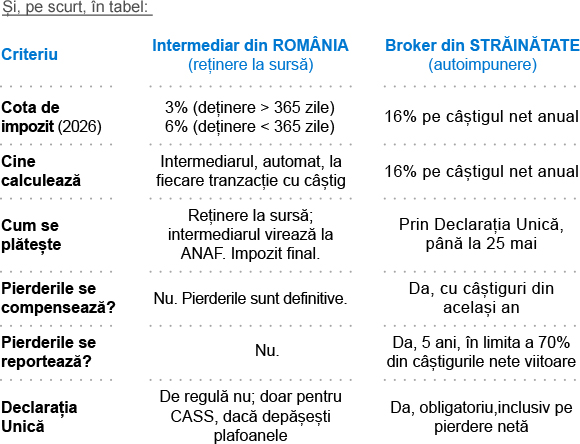
If you have no gain, you owe no tax on that transaction. What you can do with the loss, however, depends on the regime:
- through intermediaries in Romania (withholding tax), losses are final, not offset and not carried forward
- for foreign brokers (self-assessment), gains and losses from the same year are combined, and a net annual loss declared in the Single Declaration can be recovered from gains in the following 5 fiscal years, up to 70% of those gains
But CASS? The story of the "income basket"
Regardless of income tax, you may owe the health contribution (CASS, 10%).
Investment earnings are grouped into an annual "basket" along with income from rents, dividends, interest, and other non-salary earnings.
- If this basket remains below 6 minimum wages per year (24,300 lei in 2026), you do not owe CASS
- If it is exceeded, CASS is calculated on a fixed base of 6, 12, or 24 minimum wages, depending on whether the basket exceeds the threshold of 6, 12, or 24 wages respectively
To determine the CASS, you must submit the Single Declaration, even if the tax on your earnings has already been withheld at source.
Did you know...? What is NOT taxed
- portfolio value growth, as long as you don’t sell, there is no taxable income
- titles received through inheritance or donation
- transfers within partition (judicial or voluntary) or upon exiting joint ownership
- transfers of securities between spouses
What you should remember
- Tax is applied to the profit made on the sale, not the investment or the increase in value
- Through an intermediary in Romania, the tax (3%/6%) is withheld at source and is final; through a foreign broker, you declare and pay it yourself (16%)
- Losses are never taxed, but only in self-assessment can they reduce future tax (5 years, 70% cap)
- CASS is a separate obligation, on the total "basket" of income, check it even if the tax was withheld at source
Tax regime applicable as of the publication date (2026)
- Intermediated income from Romania (shares, ETFs, fund units): 3% (holding > 365 days) / 6% (holding < 365 days), withheld at source, increased rates from 1%/3%, starting January 1, 2026
- Income from foreign brokers: 16% on the annual net gain (previously 10%), via the Single Declaration
- Dividends: 16% (previously 10%), usually withheld at source
- Annual net loss (self-assessment): recoverable over the next 5 fiscal years, up to 70% of the annual net profits
- CASS: 10%, based on 6 / 12 / 24 minimum salaries, if the income "basket" exceeds the thresholds (6 salaries = 24,300 lei in 2026)
This material is for informational and educational purposes only. It
- does not constitute tax, legal, financial, or investment advice and cannot replace a professional analysis of each individual’s specific situation
- does not constitute an investment recommendation, investment research, an offer or an invitation to buy, sell or hold any financial instrument or to adopt any investment strategy, within the meaning of the applicable financial instruments market legislation
- do not take into account the investment objectives, financial situation or individual needs of any reader
Numerical examples are illustrative and simplified; the financial instruments mentioned are strictly for example purposes, and their mention does not constitute a purchase recommendation. The information reflects the legislation in force at the date of publication of each episode; tax legislation changes frequently, and its application depends on the circumstances of each individual case. Although the authors make every effort to ensure the accuracy of the information at the time of publication, Tax Institute and Banca Transilvania do not guarantee that it remains valid thereafter and do not assume responsibility for decisions made solely based on these materials.
Before making decisions with fiscal or financial impact, consult a certified tax advisor and, if applicable, a certified investment advisor. Investment decisions involve risks, including the risk of losing the invested amounts.