Economic relations Romania - Austria

After I analyzed, in October 2025, economic relations between Romania and Hungary, we turn our attention to Austria. The context of the analysis is given by two events taking place in January 2026, in Vienna. The first is organized by the Transilvania Bank Group and the Embassy of Romania in Austria, Connecting Growth – Investing in Romania. The second one, The Central & Eastern European Forum - Where CEE Markets Thrive, is a Financial Times event, during which BT organizes and supports the panel Focus Romania.
AUSTRIA, THE SECOND LARGEST INVESTOR IN ROMANIA
Austria is a strategic economic partner for Romania. Austrian investments are mainly concentrated in energy, the banking sector, industry, infrastructure and services, areas that directly influence the competitiveness of the Romanian economy. Austria is the second largest foreign investor as the final investor in Romania, after Germany.
Cooperation between Romania and Austria is based on economic interdependence, constant trade exchanges, a dynamic entrepreneurial environment, amplified by the common membership to the European Union and the Schengen Area. This favorable context stimulates regional cooperation and strengthens strategic partnerships, transforming the Romanian-Austrian relationship into a pillar of European integration.
Also, the two countries are connected through the large Romanian community in Austria, which contributes significantly to the Austrian economy and society.
BILATERAL TRADE
In the last ten years, Romania has had a negative trade balance with Austria, importing on average 1.4 billion euros more per year than it exported.
The year 2023 marked a record level of bilateral trade (6.3 billion euros), which was based on a combination of factors, including the strong recovery after the COVID-19 pandemic and solid economic growth in both countries.
Symmetry of trade exchanges: the most exported product categories by Romania to Austria in the last ten years, according to INS data, have been:
- Cars, devices and electrical equipment (0.6 billion euros in 2024; 32% of total exports)
- Means and materials of transport (0.3 billion euros in 2024)
- Common metals and articles thereof (0.2 billion euros in 2024)
Of the three categories, means and transport materials have had a steady upward trend in recent years, increasing by 4.2% in 2024 compared to the previous year. Thus, Romanian brands such as Dacia (Renault Group - automobiles) and Softronic (locomotives) report an increase in presence on the Austrian market. Dacia reached a 4.2% market share in Austria, with its sales increasing by 13.2% in 2024 compared to 2023. Thus, Austria is the fifth EU country by Dacia market share in the passenger car market, after Portugal, Italy, Belgium, and Luxembourg.
The same 3 categories of goods are also the most imported by Romania from Austria, which highlights the close connection between the two economies. On one hand, this aspect is explained by the fact that both countries have a strong presence in these fields. On the other hand, the strong presence of Austrian investors in Romania causes part of the Romanian exports to be produced by subsidiaries of Austrian firms in Romania, creating a circular trade flow.
BILATERAL TRADE EVOLUTION ROMANIA - AUSTRIA
2015 - 2024 | MLD EUR
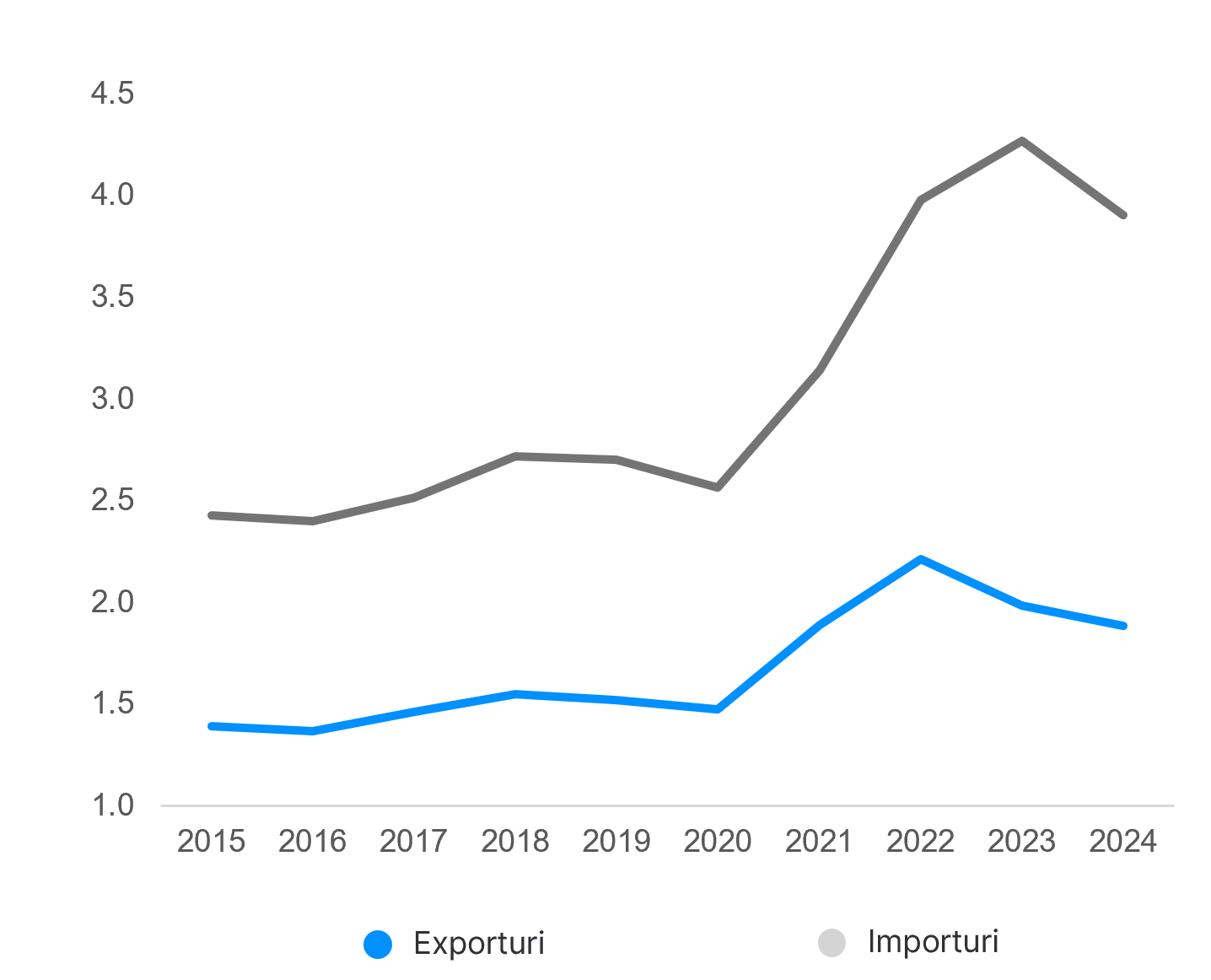
- Symmetry of trade exchanges also highlights the existence of integrated supply chains and cross-border specialization beyond the subsidiaries of firms from one country in the other country, so that for the same product components are manufactured in one country, assembled in another, and then shipped back as finished or semi-finished products.
- In the upcoming period, an increase in trade exchanges between the two countries is expected as a result of Romania's accession to the Schengen area, which facilitates cross-border exchanges of goods by reducing transport time and implicitly lowering costs.
FROM THE ALMOST 13,000 AUSTRIAN COMPANIES WITH SUBSIDIARIES IN THE EU, OVER 10% ARE IN ROMANIA
In 2024, Austrian companies held investments of 14 billion euros directly or through their subsidiaries and branches in intermediary countries, which represents 11.3% of the total balance of foreign direct investments in our country. Of the nearly 13,000 Austrian companies with subsidiaries in the European Union countries, over 10% are located in Romania.
Among the most well-known companies with Austrian capital in our country are: OMV Petrom, BCR Erste Group, Raiffeisen Bank, Vienna Insurance Group, Porsche Romania, Julius Meinl, Pfanner, Swarovski and Hervis Sports. A strong presence in the Romanian market is also noted in the construction sectors (Strabag, Porr), real estate (Immofinanz) or wood processing and furniture items (Egger, Kronospan, XXXLutz).
In addition to the goods and services brought by these companies to the Romanian market, the subsidiaries of Austrian firms contribute to the welfare of Romania through the local workforce. Austrian firms have almost 100,000 employees in our country and pay approximately 1.9 billion euros annually for salaries, taxes, and related benefits.
The Austrian market is also becoming attractive for a number of Romanian companies, especially for the IT sector. For example, the company Teraplast acquired the Austrian company Wolfgang Freiler in 2024.
INTERREGIONAL PROJECTS SUPPORTED BY EUROPEAN FUNDS
Romania and Austria are part of a series of projects co-financed by interregional development funds. These projects have a wide range of activities, such as: technological innovation, sustainable development, modernization of transport systems, improvement of institutional capacity, and increase of interregional collaboration.
For example, Danube Transnational Programme it was a partnership between 9 EU countries, carried out during the period 2014-2020. One of its four priorities was the creation of new inland waterways or the improvement of existing ones, ports and multimodal connections, in order to support sustainable local and regional mobility, modal integration and intelligent transport.
In the funding period 2021-2027, Romania and Austria are partners in a series of interregional projects, such as Urbact IV, focused on increasing the interest given to small and medium-sized cities as well as encouraging the dual transition (green and digital) to support competitiveness and sustainability.
ROMANIAN DIASPORA IN AUSTRIA
- Romanians are the second largest category of EU immigrants in Austria after the Germans, consisting of almost 150,000 Romanians.
- Annually, approximately 22,000 Romanians emigrate to Austria.
Economic relations between Romania and Austria are shaping up as a solid strategic partnership, built on substantial investments, dynamic trade exchanges, and an interdependence between the two economies. Although the trade balance remains negative for Romania, the upward evolution of sectors such as transportation means and IT shows the potential for balancing and diversifying bilateral flows.
Austria strengthens its position as a major investor in Romania, contributing not only to the development of infrastructure and industry, but also to job creation and the integration of the Romanian economy into European production chains. At the same time, Romanian firms are starting to make their presence increasingly felt on the Austrian market. Romania's inclusion in the Schengen Area will amplify these ties, reducing logistical barriers and trade costs and opening up new opportunities for regional cooperation.