Inflation: The factor influencing the evolution of prices
After the evolution of recent years, inflation is tempered, remaining in line with Romania's economic development. But because trends can fluctuate, turning into increases or decreases depending on the comparison period, today we take a look at generalized inflation from 1993 until the end of 2024.
WHAT IS INFLATION?
Inflation is the increase generalized and sustained increase in the prices of goods and services in an economy over a certain period of time.
Inflation reduces the purchasing power of money, which means that the same amount of money can buy fewer goods and services over time.
Inflation in Romania
Evolution 1995 - 2025 % | Year/Year
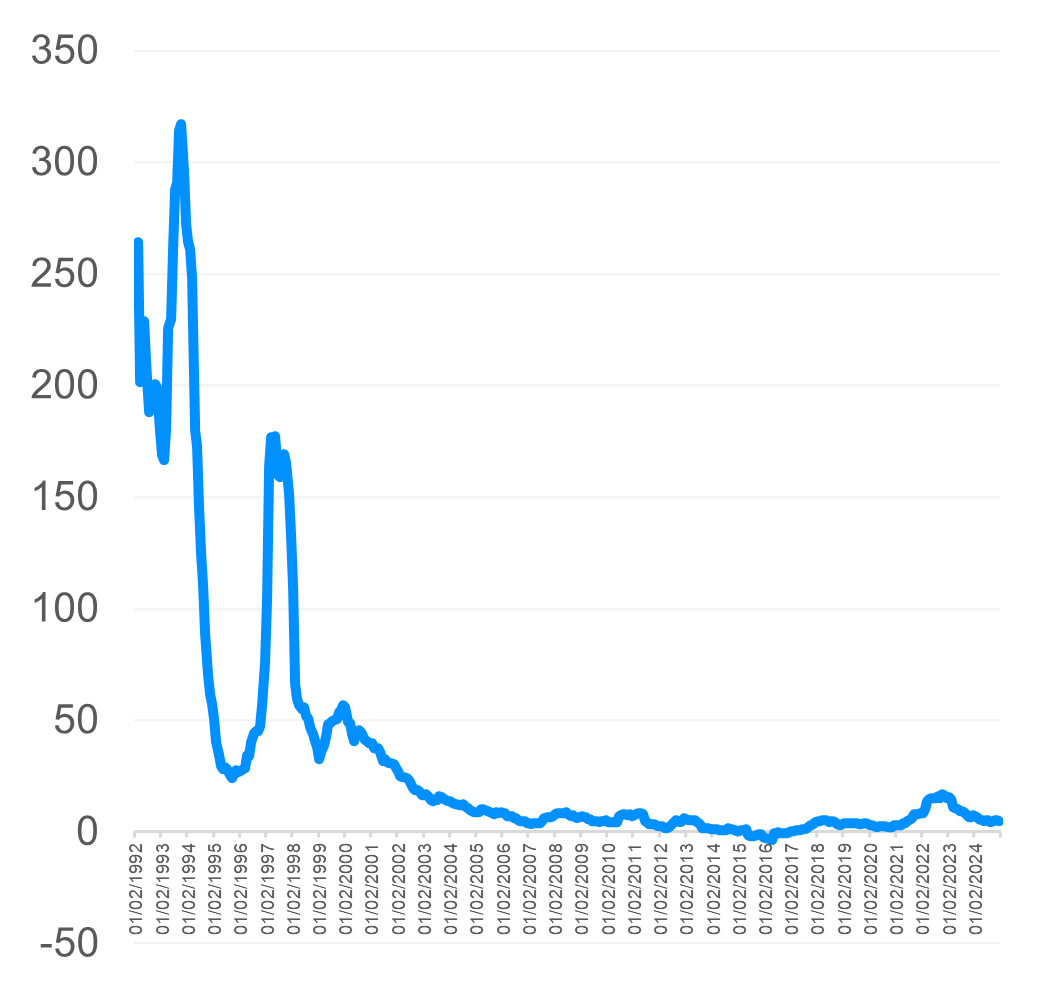
- We see a strong decrease in inflation in the last 30 years. After the historic peaks in the '90s, Romania managed to stabilize inflation, which however returned against the background of the geopolitical context of the year 2022.
- Currently, inflation is at a downward trend, which reflects both the NBR measures and a tempering of external pressures on prices.
- The NBR target of 2.5% is likely to be reached in 2026-2027 if no external shocks occur.
CAUSES OF INFLATION
Inflation through request (”demand-pull”)
- Appears when the demand exceeds the supply of goods and services.
- Ex: The increase in salaries leads to an increase in consumption → companies cannot produce enough → prices rise.
Inflation through costs ("cost-push")
- Appears when production costs rise (e.g.: more expensive raw materials, higher wages).
- Ex: The increase in the price of oil causes the rise in transportation and other products.
INTERPRETATION OF INFLATION
Inflation must be interpreted according to the economic context, thus we have:
- 2-2.5% per year – Inflation slow, considered favorable for economic growth.
- 3-10% per year – Inflation moderate, begins to affect the economy quite strongly.
- >10% per year – Inflation excessive, indicates economic instability.
- 50% per month – Hyperinflation, can strongly affect an economy.
THE BROTHERS OF INFLATION
Deflation
- It implies a decrease in prices. Although it may sound like a dream, it can be dangerous.
- In Japan, in the period 1990-2010, prices were falling, and people avoided spending, which led to economic stagnation.
Hyperinflation
- It implies a strong increase in prices.
- After the fall of communism, Romania went through economic transition. In 1993, inflation reached a record of 317% per year – prices doubled in just a few months.
STICKY INFLATION
Or persistent inflation refers to an inflation rate that remains high for a long period, even after the factors that initially caused it disappear.
In case the term seems familiar to you, you are right 😊. The best example took place in the period 2022 – 2023 in the Euro Area, after the energy crisis caused by the war in Ukraine. Energy and food prices increased sharply. Even after energy prices started to fall, inflation remained high.
As we have seen over a broader time perspective, in Romania, inflation fluctuates but does not disappear from the everyday landscape. The adaptation of economic policies and the market response will determine the future pace.