Central Bank and Reference Interest Rate

Welcome to a new episode of The MacRO Zone. Today we focus our attention on one of the most important actors in the economy: the Central Bank and implicitly about its most relevant instrument, the reference interest rate.
How money is managed in the economy, what happens with interest rates and how financial stability is maintained, we find out more details today.
CENTRAL BANK
The Central Bank is the institution responsible for implementing the monetary policy of a state or a monetary union. It regulates the money supply, sets interest rates, supervises the banking system, and ensures financial stability.
CENTRAL BANK RESPONSIBILITIES
- Monetary Policy – Controls inflation and price stability by adjusting the interest rate
- Financial System Stability – Supervises commercial banks to prevent systemic risks
- Management of International Reserves – Administers currency reserves and gold for currency stabilization
- Credit Policy – Controls credit flows to influence economic growth
- The National Coin Emission - Have the monopoly of issuing banknotes and coins
NATIONAL BANK OF ROMANIA
National Bank of Romania (BNR) was founded on April 17, 1880, being the 16th central bank in the world. Its fundamental objective is insurance and maintenance price stability.
THE MAIN ATTRIBUTES OF BNR
- Elaboration and application of monetary policy and exchange rate policy
- Authorization, regulation and supervision of credit institutions
- Issuance of banknotes and coins as legal means of payment
- Establishing the currency regime and supervising its compliance
- Administration of Romania's international reserves (currencies plus gold), which in February 2025 amounted to 71.76 billion euros
MONETARY POLICY RATE
Monetary Policy Rate, or popularly known as the reference interest rate is an essential instrument used by the NBR to control inflation and influence economic growth.
REFERENCE INTEREST RATE
2006 – 2025 | %
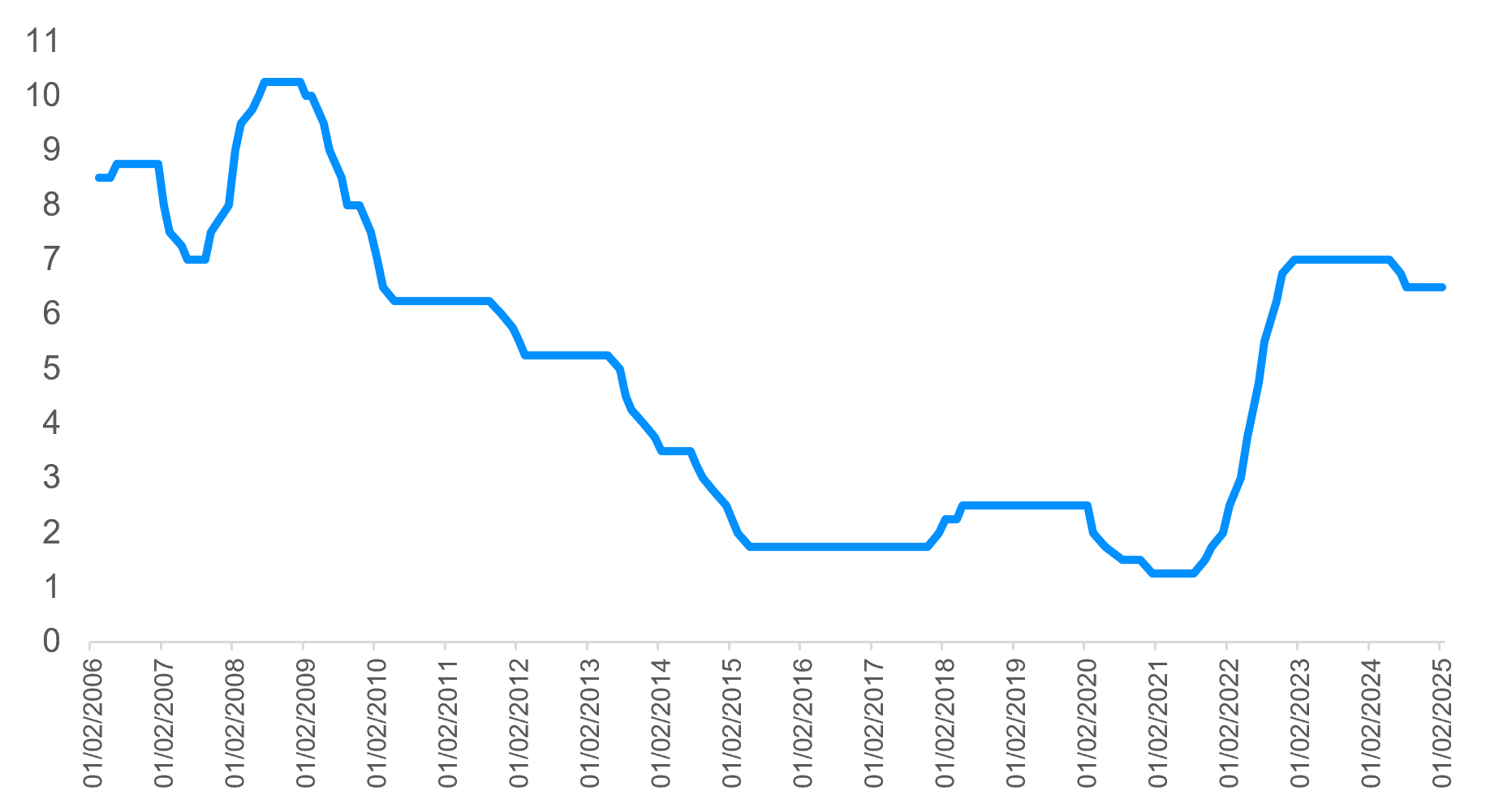
- The 2000s – High rates for combating inflation (over 10%).
- Post financial crisis of 2008 – Gradual reduction of the rate for stimulate the economy.
- Years 2015 – 2019 – Stabilization around the value of 1.75% - 2.50%.
- 2022 – 2023 – Rate increases for combating inflation determined by the energy and geopolitical crisis (up to 7%).
- 2025 – The reference interest rate is 6.50%, above the inflation rate (5.02%), which shows that BNR is trying to temper inflation on medium and long term.
WHAT INFLUENCES THE REFERENCE INTEREST RATE?
- Cost of lending – A higher rate increases the cost of loans for individuals and companies.
- Inflation – Higher rates reduce consumption and, implicitly, inflationary pressures. A higher rate increases the cost of loans for the population and companies.
- Exchange rate – Higher rates attract foreign investments, which can appreciate the national currency. (Smaller depreciation on higher interest rates).
Thus, we can observe that through monetary policy, central banks guide economies towards stability and sustainable growth.
Precisely for this reason, the National Bank of Romania plays an essential role in maintaining the economic balance. Its decisions can stimulate economic growth or slow down inflation, depending on the context, and in a period with many challenges, a stable central bank is the key to a predictable and healthy economy.