Accessibility beyond limits
Accessibility is no longer a nice to have anymore, she has turned into a must-have. Precisely for this reason, at the most recent edition DEI Cluj Talk Series, powered by Banca Transilvania, we put accessibility at the center of the conversation.
Inclusive Design
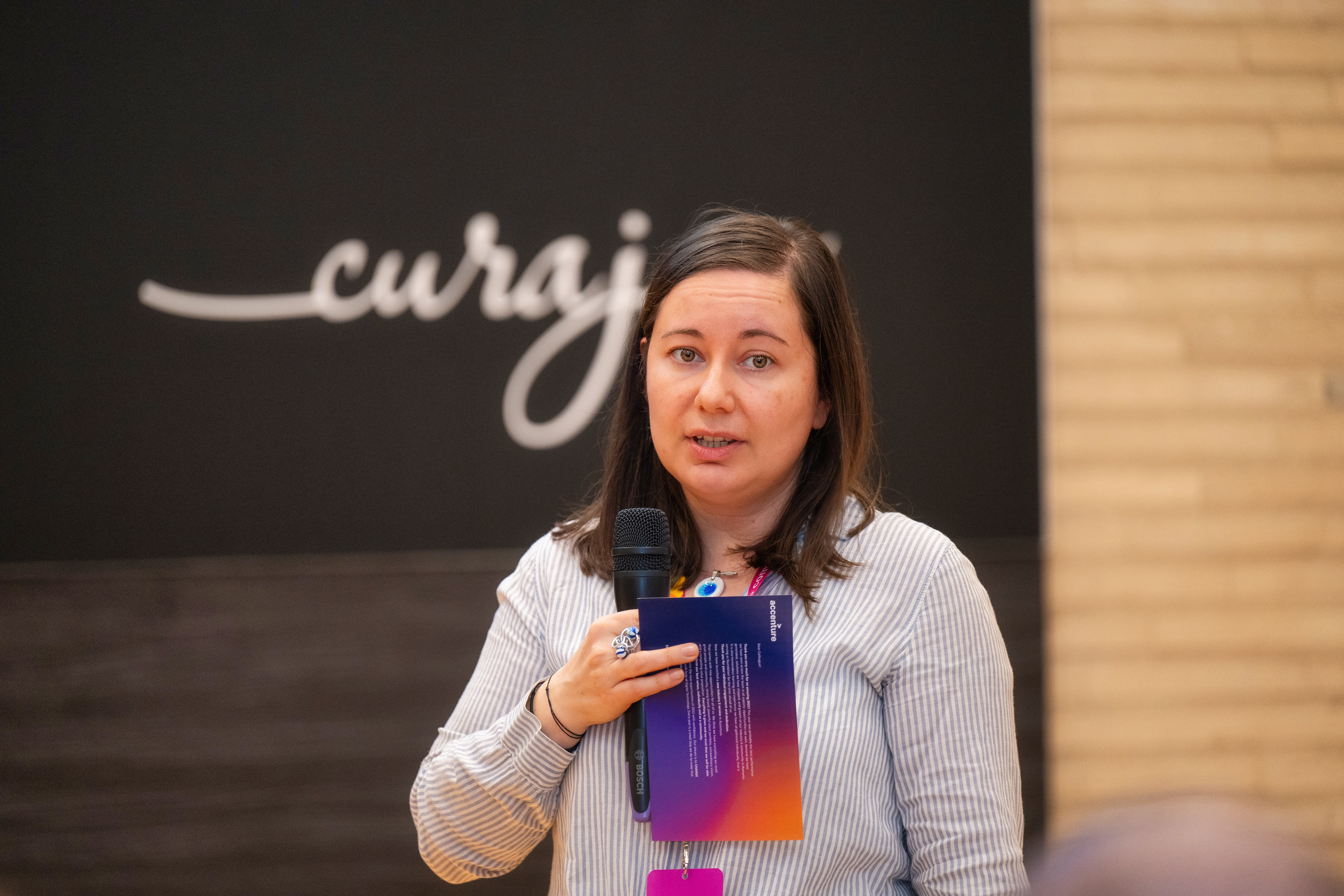
Our first speaker was Emese Markovics, UX UI Design Associate Manager @Accenture, and she opened our horizons about how accessibility very quickly transformed from a cost into a sustainable investment. Here’s why 😊.
- Accessible design is essential for approximately 15% of the population, provides additional support for another 40%, but brings real benefits and comfort to 100% of users.
- Inclusive design means taking into account the entire human experience and giving up the idea of an "ideal user." Thus, when creating a digital product, it is necessary to consider disabilities (motor, visual, auditory, cognitive), neurodivergence (ADHD, dyslexia, autism), or temporary conditions (injury, recovery), as well as the context in which people find themselves, such as bright light, noise, or fatigue. By integrating these perspectives into design, it ends up addressing a broader spectrum of needs. For example, a button large enough for someone with arthritis will be easier to use also for someone who has a child in arms.
- Inclusive journeys increase conversion, as an accessible path for the user translates into clarity, safety, and control.
Why does this matter?- When users do not know where they are in a process, conversion decreases.
- When I don't understand what follows, abandonment increases.
- When they are not sure what happens after a click, trust disappears.
- An accessible product is the result of 3 fundamental principles that can bring a real change in perspective for the user
- Clarity and structure – One goal per screen, a clear visual hierarchy, logically grouped information. When things are easy to understand, they are easy to use.
- Predictability and prioritization – Logical order, visible focus, coherent flow. Users must always know what comes next and where they are.
- Readable content – Simple language, consistent patterns, no surprises. No one is willing to make unnecessary cognitive effort.
- A truly inclusive product has accessibility built into design, through interfaces easy to perceive and use, in product management, through clear and assumed priorities and through engineering, tested and compliant solutions.
Customer Experience
Then I listened to Dr. Mihai Tomescu, Phd. Inclusive Business Strategist and person with visual disabilities, who explained to us that accessibility is actually a common language that helps us build better experiences for everyone.
Accessibility= A language that we all know, an old language. But that we forget from time to time. We speak it every time we choose clarity over complication, empathy over assumptions, and people over rigid processes.
And in our learning process, we received a set of rules through which we too can speak accessibility so that we make life a little better, including for those around us:
- Patterns & Biases
We think in patterns and often use internalized biases to save cognitive effort. Thus, we make decisions on autopilot, based on assumptions and old patterns. Accessibility begins when we ask the right questions and rely on evidence, not prejudices.- A simple example: A client who makes a mistake on a form is not necessarily careless, they may be neurodivergent or simply overwhelmed by complexity. Accessibility begins when we choose to understand before judging.
- A simple example: A client who makes a mistake on a form is not necessarily careless, they may be neurodivergent or simply overwhelmed by complexity. Accessibility begins when we choose to understand before judging.
- Simplicity = Clarity
People act more easily when things are clear: they know how long it takes, how much it costs, and if they understand the next steps. Simple design reduces friction and increases trust. - Diversity's strength – Can be your superpower
Diversity is an accelerator of innovation. Inclusive communities are more open to new ideas and create better solutions for everyone, tolerance and innovation feed each other. - Do not turn your head
To successfully communicate intelligently with your interlocutor, you first need to know and understand him. For this exact reason, the best plan is a strategy that focuses on the person. - Digital empathy
Validation and normalization are the key elements that make a product empathetic, and an empathetic product triggers positive emotions and healthy habits, building a unique experience for the customer. - Innovation game
Innovation is not measured by the number of features, but by how open the company culture is to innovation. Obviously, companies that become early adopters become leaders and attract the market after them. - Childhood stories
As in Harap-Alb, people with different abilities succeed together. Neurodiversity is a competitive advantage, not a burden. - The Power of the Horses from Letea
A product does not have to do everything, but it must be accessible to everyone. Real value lies in freedom of access, not in excessive functionality. - The 3 A's of successful products
Accessibility alone is not enough. The success of a digital product depends on three fundamental pillars that must coexist.- Affordability – a reasonable cost for users
- Availability – the product must include a large availability, regardless of device, platform, or connection)
- Accessibility – Inclusive design, integration with assistive technologies
- Fail Safe
Accessibility is not checked off, it is cultivated. It is built incrementally, through testing, feedback, and continuous adjustments.
Applicable legal framework
In the end, Argentina Rafail, Counsel Co-Head of Employment @Dentons, explained to us what the transition looks like from being "in compliance" to how we actually apply Law 232.
- Law 232 marks an important step in the maturation of digital accessibility. We no longer talk just about meeting technical requirements, but about a real change in perspective: for whom we build digital products and how easily they can be used in real life.
The legal framework puts under the microscope two essential categories
- Hardware and terminals – ATMs, electronic devices;
- Digital infrastructure – e-commerce platforms, internet banking and mobile applications.
Conformity versus Reality
- The law sets clear criteria, but complying with the legal minimum is only the starting point, not the final objective. A product can be "compliant on paper," but difficult to use in practice.
- For example, an application may check the accessibility standards, but if the text does not scale correctly or the interface is not designed for real scenarios, the user may encounter blocks at critical steps, such as completing a payment.
- With the implementation of the new legislative framework, it is no longer enough to say that a product is accessible, you must be able to demonstrate this through testing, documentation, and real user experience.
- The real stake is overcoming the logic of minimal compliance and moving towards inclusive design, which works for all end consumers, regardless of abilities, context, or temporary limitations. For organizations, this means a transition:
- from “sufficient” solutions to truly usable solutions
- from legal requirements to responsibility towards people
Accessibility thus becomes not only an obligation but also an essential criterion of quality and trust in today's digital products, transforming products into coherent and equitable digital experiences.
We are glad that we managed to host this event, alongside Chamber of Commerce for Diversity, and so to take one more step in our journey of developing accessibility solutions dedicate to BT clients.
The event on March 16, held at the BT headquarters, brought together HR leaders, UX/UI specialists, as well as colleagues from the legal and compliance area from the Cluj business environment and from the university area, along with people with disabilities, whose direct experience brought the most valuable perspective 💜.