Inflation now, a surge
We speak and hear more and more often about inflation. Or about the price of products. Or about the minimum consumption basket. What is the connection between them and what does it mean for us? Let's start from the beginning: the price of products and services can change at any time because that is how it is in a market economy. When the increase is generalized, we talk about inflation.
The evolution of consumer prices is a benchmark in the economy because it is related to the well-being of the population. Having the same incomes, the higher the prices, the less you can buy. For example, if the inflation rate is 7%, then the shopping basket is just as much smaller than the previous year. Inflation also causes companies to pay increased attention to managing production, operational, and financing costs.
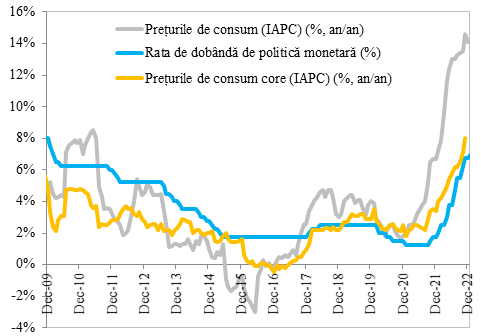
For balanced economic growth, generating development, price stability represents a fundamental ingredient. In November 2022, in Romania prices increased by almost 17%, the highest level since 2003. The minimum was in May 2016, when we had a decrease of 3.46%.
Price stability = growth at annual rates of about 2%
Price stability means an increase in consumer prices at annual rates of approximately 2%, the inflation target level of central banks in the United States of America and the Eurozone. Thus, in periods of slow growth in consumer prices, companies allocate resources more efficiently, and the population can make better-informed consumption decisions. In this context, we witness an increase in productivity in the economy, with a positive impact on the well-being of the population.
What generates inflation?
A series of factors from the sphere of demand and supply in the economy:
- acceleration of the demand for goods and services;
- intensification of production costs;
- excess supply of money in the economy;
- inflation spiral – wages;
- intensification of expectations regarding the medium-term consumer price dynamics.
An increase in consumer prices at high rates for a longer period induces costs in the economy, including:
- distortions in companies' investment decisions – when inflation persists at a high level companies cannot concretely identify the demand dynamics in their activity segment;
- decrease in the purchasing power of the population, with an impact on productivity in the labor market;
- menu costs (determined by price updates);
- redistribution of income, from creditors to debtors.
How is inflation calculated
Inflation is calculated based on the weighting of price developments for goods and services, according to the annual structure of household expenses – the average consumption habits.
For example, in Romania in the year 2022 the structure of the consumption basket was as follows:
- food products – 33.02%;
- non-food goods – 49.38%;
- services – 17.60%.
From the European perspective, it is very important to monitor inflation using the harmonized index of consumer prices – calculated based on a unique methodology for all EU countries.
During the last quarters, we have witnessed a widespread increase in consumer prices with accelerating rates (towards the highest in recent decades), globally, at the European level, and domestically. This intensification of inflationary pressures was caused by a series of factors from the supply side (the overlapping shocks, including the energy market shock), demand side (post-pandemic economic recovery), and geopolitical side (events in Ukraine and their consequences).
For example, according to International Monetary Fund (IMF) data, international energy prices increased at an average annual rate of 99.6% in 2021 and at an average annual rate of 70.4% in the period January – November 2022. The evolution was not determined by a significant increase in energy demand, but by the consequences of the pandemic – the transition to a new economic model, based predominantly on energy consumption from renewable sources. In this context, governments have implemented measures to counteract developments in the energy market, including domestically, these having been recently extended until the spring of 2025.
At the same time, international crude oil prices increased at average annual rates of approximately 70% in 2021, and 40% in 2022.
Also, international food prices increased by 26.1% year-on-year on average in 2021 and by 15.2% year-on-year on average in the period January – November 2022.
At the level of the real economy, we have witnessed the continuation of the post-pandemic recovery in recent quarters, a development influenced by a series of factors, including the low level of real financing costs (nominal interest rates adjusted for inflation), but also the excess savings accumulated in the quarters during which health restrictions were in place.
Consumer prices increased with accelerating annual averages in 2022
In this context, consumer prices increased with accelerating average annual rates in 2022, towards the highest levels in recent decades:
• United States (the world's largest economy, with a nominal GDP of over 25.7 trillion dollars in the third quarter of 2022): consumer prices rose at an average annual rate of 8% in 2022, accelerating from 4.7% in 2021.
• Eurozone: consumer prices increased in 2022 by 8.4% year/year on average, accelerating from 2.6% year/year on average in 2021.
• Romania: consumer prices (on the EU harmonized index) increased by 12% year/year on average in 2022, accelerating from 4.1% year/year in 2021.
By Romanian standards, consumer prices rose by 13.8% year on year on average in 2022: prices for food goods, non-food goods, and service tariffs increased by 15.69%, 14.74%, and 7.75%, respectively.
If we exclude the dynamics of volatile components (whose evolution is influenced by factors unrelated to supply/demand mechanisms) consumer prices increased in 2022 at much slower rates: 6.2% in the USA, 3.9% in the Eurozone, and 5.7% in Romania (data for the period January – November).
In the context of increasing inflationary pressures, central banks have reacted by aggressively raising monetary policy interest rates in the period January – December 2022: from (0% -0.25%) to (4.25% - 4.5%) in the USA, from 0% to 2.5% in the Eurozone, and from 1.75% to 6.75% in Romania.
Towards the end of last year, we witnessed adjustments in international commodity quotations and the accumulation of signals of deterioration in the economic activity sphere, globally, in the European area, and nationally. Therefore, the annual dynamics of consumer prices changed trend from the end of last year, from acceleration to deceleration, an evolution also influenced by the impact of monetary policy decisions in recent quarters.
Tempering estimates
Intensification of inflationary pressures in recent months cannot have a persistent nature because we have not witnessed a strong increase in the velocity of money circulation. It was rather an inflationary surge, determined by the confluence of factors from the supply sphere, demand, and of a geo-political nature.
Macroeconomic forecasts indicate pronounced moderation prospects for the annual dynamics of consumer prices in 2023 and 2024, amid the dissipation of the impact of supply-side shocks, economic adjustments, and monetary policy decisions in recent quarters.
Bloomberg indicates for the USA the slowdown of the annual dynamics of consumer prices from 8% in 2022 to 4% in 2023 and 2.5% in 2024.
In the Euro Area consumer prices could rise at average annual rates slowing from 8.4% in 2022 to 6% in 2023, respectively 2.3% in 2024.
In the revised scenario for Romania's economy, consumer prices (on the EU harmonized index) could increase with moderate average annual rates from 12% in 2022, to 8.5% in 2023, and 4.3% in 2024. The year has good signs.
Inflation vs. monetary policy interest rate in Romania